Portal:Minerals

The Minerals Portal
In geology and mineralogy, a mineral or mineral species is, broadly speaking, a solid chemical compound with a fairly well-defined chemical composition and a specific crystal structure that occurs naturally in pure form.
The geological definition of mineral normally excludes compounds that occur only in living organisms. However, some minerals are often biogenic (such as calcite) or are organic compounds in the sense of chemistry (such as mellite). Moreover, living organisms often synthesize inorganic minerals (such as hydroxylapatite) that also occur in rocks.
The concept of mineral is distinct from rock, which is any bulk solid geologic material that is relatively homogeneous at a large enough scale. A rock may consist of one type of mineral, or may be an aggregate of two or more different types of minerals, spacially segregated into distinct phases.
Some natural solid substances without a definite crystalline structure, such as opal or obsidian, are more properly called mineraloids. If a chemical compound occurs naturally with different crystal structures, each structure is considered a different mineral species. Thus, for example, quartz and stishovite are two different minerals consisting of the same compound, silicon dioxide. (Full article...)
Mineralogy is a subject of geology specializing in the scientific study of the chemistry, crystal structure, and physical (including optical) properties of minerals and mineralized artifacts. Specific studies within mineralogy include the processes of mineral origin and formation, classification of minerals, their geographical distribution, as well as their utilization. (Full article...)
Selected articles


Corundum is a crystalline form of aluminium oxide (Al2O3) typically containing traces of iron, titanium, vanadium and chromium. It is a rock-forming mineral. It is a naturally transparent material, but can have different colors depending on the presence of transition metal impurities in its crystalline structure. Corundum has two primary gem varieties: ruby and sapphire. Rubies are red due to the presence of chromium, and sapphires exhibit a range of colors depending on what transition metal is present. A rare type of sapphire, padparadscha sapphire, is pink-orange.
The name "corundum" is derived from the Tamil-Dravidian word kurundam (ruby-sapphire) (appearing in Sanskrit as kuruvinda).
Because of corundum's hardness (pure corundum is defined to have 9.0 on the Mohs scale), it can scratch almost all other minerals. It is commonly used as an abrasive on sandpaper and on large tools used in machining metals, plastics, and wood. Emery, a variety of corundum with no value as a gemstone, is commonly used as an abrasive. It is a black granular form of corundum, in which the mineral is intimately mixed with magnetite, hematite, or hercynite.
In addition to its hardness, corundum has a density of 4.02 g/cm3 (251 lb/cu ft), which is unusually high for a transparent mineral composed of the low-atomic mass elements aluminium and oxygen. (Full article...)
Cinnabar (/ˈsɪnəˌbɑːr/; from Ancient Greek κιννάβαρι (kinnábari)), or cinnabarite (/ˌsɪnəˈbɑːraɪt/), is the bright scarlet to brick-red form of mercury(II) sulfide (HgS). It is the most common source ore for refining elemental mercury and is the historic source for the brilliant red or scarlet pigment termed vermilion and associated red mercury pigments.
Cinnabar generally occurs as a vein-filling mineral associated with recent volcanic activity and alkaline hot springs. The mineral resembles quartz in symmetry and in its exhibiting birefringence. Cinnabar has a mean refractive index near 3.2, a hardness between 2.0 and 2.5, and a specific gravity of approximately 8.1. The color and properties derive from a structure that is a hexagonal crystalline lattice belonging to the trigonal crystal system, crystals that sometimes exhibit twinning.
Cinnabar has been used for its color since antiquity in the Near East, including as a rouge-type cosmetic, in the New World since the Olmec culture, and in China since as early as the Yangshao culture, where it was used in coloring stoneware.
Associated modern precautions for use and handling of cinnabar arise from the toxicity of the mercury component, which was recognized as early as ancient Rome. (Full article...)
Borax (also referred to as sodium borate, tincal /ˈtɪŋkəl/ and tincar /ˈtɪŋkər/) is a salt (ionic compound), a hydrated or anhydrous borate of sodium, with the chemical formula Na2H20B4O17. It is a colorless crystalline solid, that dissolves in water to make a basic solution.
It is commonly available in powder or granular form and has many industrial and household uses, including as a pesticide, as a metal soldering flux, as a component of glass, enamel, and pottery glazes, for tanning of skins and hides, for artificial aging of wood, as a preservative against wood fungus, and as a pharmaceutic alkalizer. In chemical laboratories, it is used as a buffering agent.
The terms tincal tincar refer to native borax, historically mined from dry lake beds in various parts of Asia. (Full article...) Intergrowth of lustrous, cubic crystals of pyrite, with some surfaces showing characteristic striations, from Huanzala mine, Ancash, Peru. Specimen size: 7.0 × 5.0 × 2.5 cm
The mineral pyrite (/ˈpaɪraɪt/), or iron pyrite, also known as fool's gold, is an iron sulfide with the chemical formula FeS2 (iron (II) disulfide). Pyrite is the most abundant sulfide mineral.
Pyrite's metallic luster and pale brass-yellow hue give it a superficial resemblance to gold, hence the well-known nickname of fool's gold. The color has also led to the nicknames brass, brazzle, and Brazil, primarily used to refer to pyrite found in coal.
The name pyrite is derived from the Greek πυρίτης λίθος (pyritēs lithos), 'stone or mineral which strikes fire', in turn from πῦρ (pyr), 'fire'. In ancient Roman times, this name was applied to several types of stone that would create sparks when struck against steel; Pliny the Elder described one of them as being brassy, almost certainly a reference to what we now call pyrite.
By Georgius Agricola's time, c. 1550, the term had become a generic term for all of the sulfide minerals. (Full article...)_-_Kopalnia_soli_Wieliczka%252C_Polska.jpg.webp) Halite from the Wieliczka salt mine, Małopolskie, Poland
Halite from the Wieliczka salt mine, Małopolskie, Poland
Halite (/ˈhælaɪt, ˈheɪlaɪt/), commonly known as rock salt, is a type of salt, the mineral (natural) form of sodium chloride (NaCl). Halite forms isometric crystals. The mineral is typically colorless or white, but may also be light blue, dark blue, purple, pink, red, orange, yellow or gray depending on inclusion of other materials, impurities, and structural or isotopic abnormalities in the crystals. It commonly occurs with other evaporite deposit minerals such as several of the sulfates, halides, and borates. The name halite is derived from the Ancient Greek word for "salt", ἅλς (háls). (Full article...) Brazilian trigonal hematite crystal
Hematite (/ˈhiːməˌtaɪt, ˈhɛmə-/), also spelled as haematite, is a common iron oxide compound with the formula, Fe2O3 and is widely found in rocks and soils. Hematite crystals belong to the rhombohedral lattice system which is designated the alpha polymorph of Fe
2O
3. It has the same crystal structure as corundum (Al
2O
3) and ilmenite (FeTiO
3). With this it forms a complete solid solution at temperatures above 950 °C (1,740 °F).
Hematite naturally occurs in black to steel or silver-gray, brown to reddish-brown, or red colors. It is mined as an important ore mineral of iron. It is electrically conductive. Hematite varieties include kidney ore, martite (pseudomorphs after magnetite), iron rose and specularite (specular hematite). While these forms vary, they all have a rust-red streak. Hematite is not only harder than pure iron, but also much more brittle. Maghemite is a polymorph of hematite (γ-Fe
2O
3) with the same chemical formula, but with a spinel structure like magnetite.
Large deposits of hematite are found in banded iron formations. Gray hematite is typically found in places that have still, standing water or mineral hot springs, such as those in Yellowstone National Park in North America. The mineral can precipitate in the water and collect in layers at the bottom of the lake, spring, or other standing water. Hematite can also occur in the absence of water, usually as the result of volcanic activity.
Clay-sized hematite crystals can also occur as a secondary mineral formed by weathering processes in soil, and along with other iron oxides or oxyhydroxides such as goethite, which is responsible for the red color of many tropical, ancient, or otherwise highly weathered soils. (Full article...)
Chalcopyrite (/ˌkælkəˈpaɪˌraɪt, -koʊ-/ KAL-kə-PY-ryte, -koh-) is a copper iron sulfide mineral and the most abundant copper ore mineral. It has the chemical formula CuFeS2 and crystallizes in the tetragonal system. It has a brassy to golden yellow color and a hardness of 3.5 to 4 on the Mohs scale. Its streak is diagnostic as green-tinged black.
On exposure to air, chalcopyrite tarnishes to a variety of oxides, hydroxides, and sulfates. Associated copper minerals include the sulfides bornite (Cu5FeS4), chalcocite (Cu2S), covellite (CuS), digenite (Cu9S5); carbonates such as malachite and azurite, and rarely oxides such as cuprite (Cu2O). It is rarely found in association with native copper. Chalcopyrite is a conductor of electricity.
Copper can be extracted from chalcopyrite ore using various methods. The two predominant methods are pyrometallurgy and hydrometallurgy, the former being the most commercially viable. (Full article...) Dolomite (white) on talc
Dolomite (/ˈdɒl.əˌmaɪt, ˈdoʊ.lə-/) is an anhydrous carbonate mineral composed of calcium magnesium carbonate, ideally CaMg(CO3)2. The term is also used for a sedimentary carbonate rock composed mostly of the mineral dolomite. An alternative name sometimes used for the dolomitic rock type is dolostone. (Full article...)
Gypsum is a soft sulfate mineral composed of calcium sulfate dihydrate, with the chemical formula CaSO4·2H2O. It is widely mined and is used as a fertilizer and as the main constituent in many forms of plaster, blackboard or sidewalk chalk, and drywall. Alabaster, a fine-grained white or lightly tinted variety of gypsum, has been used for sculpture by many cultures including Ancient Egypt, Mesopotamia, Ancient Rome, the Byzantine Empire, and the Nottingham alabasters of Medieval England. Gypsum also crystallizes as translucent crystals of selenite. It forms as an evaporite mineral and as a hydration product of anhydrite.
The Mohs scale of mineral hardness defines gypsum as hardness value 2 based on scratch hardness comparison. (Full article...) A ruby crystal from Dodoma Region, Tanzania
A ruby is a pinkish red to blood-red colored gemstone, a variety of the mineral corundum (aluminium oxide). Ruby is one of the most popular traditional jewelry gems and is very durable. Other varieties of gem-quality corundum are called sapphires. Ruby is one of the traditional cardinal gems, alongside amethyst, sapphire, emerald, and diamond. The word ruby comes from ruber, Latin for red. The color of a ruby is due to the element chromium.
Some gemstones that are popularly or historically called rubies, such as the Black Prince's Ruby in the British Imperial State Crown, are actually spinels. These were once known as "Balas rubies".
The quality of a ruby is determined by its color, cut, and clarity, which, along with carat weight, affect its value. The brightest and most valuable shade of red, called blood-red or pigeon blood, commands a large premium over other rubies of similar quality. After color follows clarity: similar to diamonds, a clear stone will command a premium, but a ruby without any needle-like rutile inclusions may indicate that the stone has been treated. Ruby is the traditional birthstone for July and is usually pinker than garnet, although some rhodolite garnets have a similar pinkish hue to most rubies. The world's most valuable ruby to be sold at auction is the Sunrise Ruby. (Full article...) Beachy Head is a part of the extensive Southern England Chalk Formation.
Chalk is a soft, white, porous, sedimentary carbonate rock. It is a form of limestone composed of the mineral calcite and originally formed deep under the sea by the compression of microscopic plankton that had settled to the sea floor. Chalk is common throughout Western Europe, where deposits underlie parts of France, and steep cliffs are often seen where they meet the sea in places such as the Dover cliffs on the Kent coast of the English Channel.
Chalk is mined for use in industry, such as for quicklime, bricks and builder's putty, and in agriculture, for raising pH in soils with high acidity. It is also used for "blackboard chalk" for writing and drawing on various types of surfaces, although these can also be manufactured from other carbonate-based minerals, or gypsum. (Full article...) Crystal structure of table salt (sodium in purple, chlorine in green)
In crystallography, crystal structure is a description of the ordered arrangement of atoms, ions, or molecules in a crystalline material. Ordered structures occur from the intrinsic nature of the constituent particles to form symmetric patterns that repeat along the principal directions of three-dimensional space in matter.
The smallest group of particles in the material that constitutes this repeating pattern is the unit cell of the structure. The unit cell completely reflects the symmetry and structure of the entire crystal, which is built up by repetitive translation of the unit cell along its principal axes. The translation vectors define the nodes of the Bravais lattice.
The lengths of the principal axes, or edges, of the unit cell and the angles between them are the lattice constants, also called lattice parameters or cell parameters. The symmetry properties of the crystal are described by the concept of space groups. All possible symmetric arrangements of particles in three-dimensional space may be described by the 230 space groups.
The crystal structure and symmetry play a critical role in determining many physical properties, such as cleavage, electronic band structure, and optical transparency. (Full article...) Magnetite from Bolivia
Magnetite is a mineral and one of the main iron ores, with the chemical formula Fe2+Fe3+2O4. It is one of the oxides of iron, and is ferrimagnetic; it is attracted to a magnet and can be magnetized to become a permanent magnet itself. With the exception of extremely rare native iron deposits, it is the most magnetic of all the naturally occurring minerals on Earth. Naturally magnetized pieces of magnetite, called lodestone, will attract small pieces of iron, which is how ancient peoples first discovered the property of magnetism.
Magnetite is black or brownish-black with a metallic luster, has a Mohs hardness of 5–6 and leaves a black streak. Small grains of magnetite are very common in igneous and metamorphic rocks.
The chemical IUPAC name is iron(II,III) oxide and the common chemical name is ferrous-ferric oxide. (Full article...)- Zeolites are microporous, crystalline aluminosilicate materials commonly used as commercial adsorbents and catalysts. They mainly consist of silicon, aluminium, oxygen, and have the general formula Mn+
1/n(AlO
2)−
(SiO
2)
x・yH
2O where Mn+
1/n is either a metal ion or H+. These positive ions can be exchanged for others in a contacting electrolyte solution. H+
exchanged zeolites are particularly useful as solid acid catalysts.
The term zeolite was originally coined in 1756 by Swedish mineralogist Axel Fredrik Cronstedt, who observed that rapidly heating a material, believed to have been stilbite, produced large amounts of steam from water that had been adsorbed by the material. Based on this, he called the material zeolite, from the Greek ζέω (zéō), meaning "to boil" and λίθος (líthos), meaning "stone".
Zeolites occur naturally but are also produced industrially on a large scale. , 253 unique zeolite frameworks have been identified, and over 40 naturally occurring zeolite frameworks are known. Every new zeolite structure that is obtained is examined by the International Zeolite Association Structure Commission (IZA-SC) and receives a three letter designation. (Full article...) 
Amethyst is a violet variety of quartz. The name comes from the Koine Greek αμέθυστος amethystos from α- a-, "not" and μεθύσκω (Ancient Greek) methysko / μεθώ metho (Modern Greek), "intoxicate", a reference to the belief that the stone protected its owner from drunkenness. Ancient Greeks wore amethyst and carved drinking vessels from it in the belief that it would prevent intoxication.
Amethyst, a semiprecious stone, is often used in jewelry. (Full article...) The slightly misshapen octahedral shape of this rough diamond crystal in matrix is typical of the mineral. Its lustrous faces also indicate that this crystal is from a primary deposit.
Diamond is a solid form of the element carbon with its atoms arranged in a crystal structure called diamond cubic. Another solid form of carbon known as graphite is the chemically stable form of carbon at room temperature and pressure, but diamond is metastable and converts to it at a negligible rate under those conditions. Diamond has the highest hardness and thermal conductivity of any natural material, properties that are used in major industrial applications such as cutting and polishing tools. They are also the reason that diamond anvil cells can subject materials to pressures found deep in the Earth.
Because the arrangement of atoms in diamond is extremely rigid, few types of impurity can contaminate it (two exceptions are boron and nitrogen). Small numbers of defects or impurities (about one per million of lattice atoms) color diamond blue (boron), yellow (nitrogen), brown (defects), green (radiation exposure), purple, pink, orange, or red. Diamond also has a very high refractive index and a relatively high optical dispersion.
Most natural diamonds have ages between 1 billion and 3.5 billion years. Most were formed at depths between 150 and 250 kilometres (93 and 155 mi) in the Earth's mantle, although a few have come from as deep as 800 kilometres (500 mi). Under high pressure and temperature, carbon-containing fluids dissolved various minerals and replaced them with diamonds. Much more recently (hundreds to tens of million years ago), they were carried to the surface in volcanic eruptions and deposited in igneous rocks known as kimberlites and lamproites.
Synthetic diamonds can be grown from high-purity carbon under high pressures and temperatures or from hydrocarbon gases by chemical vapor deposition (CVD). Imitation diamonds can also be made out of materials such as cubic zirconia and silicon carbide. Natural, synthetic and imitation diamonds are most commonly distinguished using optical techniques or thermal conductivity measurements. (Full article...) Malachite from the Democratic Republic of the Congo
Malachite is a copper carbonate hydroxide mineral, with the formula Cu2CO3(OH)2. This opaque, green-banded mineral crystallizes in the monoclinic crystal system, and most often forms botryoidal, fibrous, or stalagmitic masses, in fractures and deep, underground spaces, where the water table and hydrothermal fluids provide the means for chemical precipitation. Individual crystals are rare, but occur as slender to acicular prisms. Pseudomorphs after more tabular or blocky azurite crystals also occur. (Full article...)
Apatite is a group of phosphate minerals, usually hydroxyapatite, fluorapatite and chlorapatite, with high concentrations of OH−, F− and Cl− ion, respectively, in the crystal. The formula of the admixture of the three most common endmembers is written as Ca10(PO4)6(OH,F,Cl)2, and the crystal unit cell formulae of the individual minerals are written as Ca10(PO4)6(OH)2, Ca10(PO4)6F2 and Ca10(PO4)6Cl2.
The mineral was named apatite by the German geologist Abraham Gottlob Werner in 1786, although the specific mineral he had described was reclassified as fluorapatite in 1860 by the German mineralogist Karl Friedrich August Rammelsberg. Apatite is often mistaken for other minerals. This tendency is reflected in the mineral's name, which is derived from the Greek word ἀπατάω (apatáō), which means to deceive. (Full article...)
Rutile is an oxide mineral composed of titanium dioxide (TiO2), the most common natural form of TiO2. Rarer polymorphs of TiO2 are known, including anatase, akaogiite, and brookite.
Rutile has one of the highest refractive indices at visible wavelengths of any known crystal and also exhibits a particularly large birefringence and high dispersion. Owing to these properties, it is useful for the manufacture of certain optical elements, especially polarization optics, for longer visible and infrared wavelengths up to about 4.5 micrometres. Natural rutile may contain up to 10% iron and significant amounts of niobium and tantalum.
Rutile derives its name from the Latin rutilus ('red'), in reference to the deep red color observed in some specimens when viewed by transmitted light. Rutile was first described in 1803 by Abraham Gottlob Werner using specimens obtained in Horcajuelo de la Sierra, Madrid (Spain), which is consequently the type locality. (Full article...) Galena with minor pyrite
Galena, also called lead glance, is the natural mineral form of lead(II) sulfide (PbS). It is the most important ore of lead and an important source of silver.
Galena is one of the most abundant and widely distributed sulfide minerals. It crystallizes in the cubic crystal system often showing octahedral forms. It is often associated with the minerals sphalerite, calcite and fluorite. (Full article...) Quartz crystal cluster from Tibet
Quartz is a hard, crystalline mineral composed of silica (silicon dioxide). The atoms are linked in a continuous framework of SiO4 silicon–oxygen tetrahedra, with each oxygen being shared between two tetrahedra, giving an overall chemical formula of SiO2. Quartz is the second most abundant mineral in Earth's continental crust, behind feldspar.
Quartz exists in two forms, the normal α-quartz and the high-temperature β-quartz, both of which are chiral. The transformation from α-quartz to β-quartz takes place abruptly at 573 °C (846 K; 1,063 °F). Since the transformation is accompanied by a significant change in volume, it can easily induce microfracturing of ceramics or rocks passing through this temperature threshold.
There are many different varieties of quartz, several of which are classified as gemstones. Since antiquity, varieties of quartz have been the most commonly used minerals in the making of jewelry and hardstone carvings, especially in Eurasia.
Quartz is the mineral defining the value of 7 on the Mohs scale of hardness, a qualitative scratch method for determining the hardness of a material to abrasion. (Full article...) The 423-carat (85 g) blue Logan Sapphire
Sapphire is a precious gemstone, a variety of the mineral corundum, consisting of aluminium oxide (α-Al2O3) with trace amounts of elements such as iron, titanium, chromium, vanadium, or magnesium. The name sapphire is derived via the Latin "sapphirus" from the Greek "sappheiros", which referred to lapis lazuli. It is typically blue, but natural "fancy" sapphires also occur in yellow, purple, orange, and green colors; "parti sapphires" show two or more colors. Red corundum stones also occur, but are called rubies rather than sapphires. Pink-colored corundum may be classified either as ruby or sapphire depending on locale. Commonly, natural sapphires are cut and polished into gemstones and worn in jewelry. They also may be created synthetically in laboratories for industrial or decorative purposes in large crystal boules. Because of the remarkable hardness of sapphires – 9 on the Mohs scale (the third hardest mineral, after diamond at 10 and moissanite at 9.5) – sapphires are also used in some non-ornamental applications, such as infrared optical components, high-durability windows, wristwatch crystals and movement bearings, and very thin electronic wafers, which are used as the insulating substrates of special-purpose solid-state electronics such as integrated circuits and GaN-based blue LEDs. Sapphire is the birthstone for September and the gem of the 45th anniversary. A sapphire jubilee occurs after 65 years. (Full article...)
Asbestos (/æsˈbɛstəs, æzˈ-, -tɒs/ ass-BEST-əs, az-, -oss) is a naturally occurring fibrous silicate mineral. There are six types, all of which are composed of long and thin fibrous crystals, each fibre being composed of many microscopic "fibrils" that can be released into the atmosphere by abrasion and other processes. Inhalation of asbestos fibres can lead to various dangerous lung conditions, including mesothelioma, asbestosis, and lung cancer. As a result of these health effects, asbestos is considered a serious health and safety hazard.
Archaeological studies have found evidence of asbestos being used as far back as the Stone Age to strengthen ceramic pots, but large-scale mining began at the end of the 19th century when manufacturers and builders began using asbestos for its desirable physical properties. Asbestos is an excellent thermal and electrical insulator, and is highly fire-resistant, so for much of the 20th century it was very commonly used across the world as a building material, until its adverse effects on human health were more widely acknowledged in the 1970s. Many modern buildings constructed before the 1980s are thought to contain asbestos.
The use of asbestos for construction and fireproofing has been made illegal in many countries. Despite this, at least 100,000 people are thought to die each year from diseases related to asbestos exposure. In part, this is because many older buildings still contain asbestos; in addition, the consequences of exposure can take decades to arise. The most common diseases associated with chronic asbestos exposure are asbestosis (scarring of the lungs due to asbestos inhalation) and mesothelioma (a type of cancer).
Many developing countries still support the use of asbestos as a building material, and mining of asbestos is ongoing, with the top producer, Russia, having an estimated production of 790,000 tonnes in 2020. (Full article...)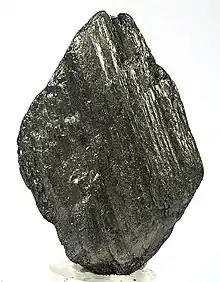 Graphite specimen
Graphite (/ˈɡræfaɪt/) is a crystalline form of the element carbon. It consists of stacked layers of graphene. Graphite occurs naturally and is the most stable form of carbon under standard conditions. Synthetic and natural graphite are consumed on large scale (300 kton/year, in 1989) for uses in pencils, lubricants, and electrodes. Under high pressures and temperatures it converts to diamond. It is a good (but not excellent) conductor of both heat and electricity. (Full article...)
Talc, or talcum, is a clay mineral, composed of hydrated magnesium silicate with the chemical formula Mg3Si4O10(OH)2. Talc in powdered form, often combined with corn starch, is used as baby powder. This mineral is used as a thickening agent and lubricant. It is an ingredient in ceramics, paints, and roofing material. It is a main ingredient in many cosmetics. It occurs as foliated to fibrous masses, and in an exceptionally rare crystal form. It has a perfect basal cleavage and an uneven flat fracture, and it is foliated with a two-dimensional platy form.
The Mohs scale of mineral hardness, based on scratch hardness comparison, defines value 1 as the hardness of talc, the softest mineral. When scraped on a streak plate, talc produces a white streak; though this indicator is of little importance, because most silicate minerals produce a white streak. Talc is translucent to opaque, with colors ranging from whitish grey to green with a vitreous and pearly luster. Talc is not soluble in water, and is slightly soluble in dilute mineral acids.
Soapstone is a metamorphic rock composed predominantly of talc. (Full article...)
Selected mineralogist
 Portrait of Marshall McDonald
Marshall McDonald (October 18, 1835 – September 1, 1895) was an American engineer, geologist, mineralogist, pisciculturist, and fisheries scientist. McDonald served as the commissioner of the United States Commission of Fish and Fisheries from 1888 until his death in 1895. He is best known for his inventions of a number of fish hatching apparatuses and a fish ladder that enabled salmon and other migrating fish species to ascend the rapids of watercourses resulting in an increased spawning ground. McDonald's administration of the U.S. Commission of Fish and Fisheries was notably free of scandal and furthered the "protection and culture" of fish species throughout the United States.
Born in 1835 in Romney, Virginia (present-day West Virginia), McDonald was the son of Angus William McDonald, a military officer and lawyer, and his wife, Leacy Anne Naylor. From 1854 to 1855, McDonald studied natural history under Spencer Fullerton Baird at the Smithsonian Institution in Washington, D.C. He then attended the University of Virginia and Virginia Military Institute, from which he graduated in 1860. McDonald served as an assistant professor of chemistry at the institute under Stonewall Jackson and continued to teach intermittently throughout the American Civil War. (Full article...)- Ferruccio Zambonini (17 December 1880 – 12 January 1932) was an Italian mineralogist and geologist. Most of his time he worked on the geology and mineralogy of Mount Vesuvius. (Full article...)
 N. Nordenskiöld (Photo publ., 1870)
Nils Gustaf Nordenskiöld (October 12, 1792 – February 2, 1866) was a Finnish mineralogist and traveller. He was the father of mineralogist and polar explorer Adolf Erik Nordenskiöld. (Full article...) Georg August Goldfuss; by Adolf Hohneck (1841)
Georg August Goldfuss (Goldfuß, 18 April 1782 – 2 October 1848) was a German palaeontologist, zoologist and botanist.
Goldfuss was born at Thurnau near Bayreuth. He was educated at Erlangen, where he graduated PhD in 1804 and became professor of zoology in 1818. He was subsequently appointed professor of zoology and mineralogy at the University of Bonn. Aided by Count Georg zu Münster, he issued the important Petrefacta Germaniae (1826–44), a work which was intended to illustrate the invertebrate fossils of Germany, but it was left incomplete after the sponges, corals, crinoids, echinoderms and part of the mollusca had been figured. A collection of Goldfuss' botanical specimens are housed at Bonn University. (Full article...)- Stuart Olof Agrell (5 March 1913 – 29 January 1996) was an optical mineralogist and a pioneer in applications of the electron microprobe to petrology. His involvement as a principal investigator in the analysis of moon rocks collected in the Apollo program brought him to the attention of the British media and public. (Full article...)
- Luca Bindi (born 1971) is an Italian geologist. He holds the Chair of Mineralogy and Crystallography and is the Head of the Department of Earth Sciences of the University of Florence. He is also a research associate at the Istituto di Geoscienze e Georisorse of the National Research Council (Italy) (CNR). He has received national and international scientific awards that include the President of the Republic Prize 2015 in the category of Physical, Mathematical and Natural Sciences. Since 2019 is a Member of the National Academy of Lincei.
He is the Italian scientist who has contributed to the description of the highest number of new minerals and is among the top ten researchers in the world for the number of new mineralogical species described. In his career he has described about 2% of the 6,000 minerals known in nature. Most of the new materials were discovered in the precious patrimony of the collections of the Museum System of the Florentine University, with its approximately fifty thousand specimens. The researcher is entitled to a further record: among the 130 minerals he described there are 15 extraterrestrials (almost 3% of the 500 discovered), identified in meteorite fragments. (Full article...)  Solvay Conference on Physics in Brussels 1951. Left to right, sitting: Crussaro, N.P. Allen, Cauchois, Borelius, Bragg, Moller, Sietz, Hollomon, Frank; middle row: Rathenau,(nl) Koster, Rudberg,(sv), Flamache, Goche, Groven, Orowan, Burgers, Shockley, Guinier, C.S. Smith, Dehlinger, Laval, Henriot; top row: Gaspart, Lomer, Cottrell, Homes, Curien
Hubert Curien (30 October 1924 – 6 February 2005) was a French physicist and a key figure in European science politics, as the President of CERN Council (1994–1996), the first chairman of the European Space Agency (ESA) (1981–1984), and second President of the Academia Europæa and a President of Fondation de France. (Full article...)- Gottlob Eduard Linck (20 February 1858, Ötisheim – 22 December 1947, Jena) was a German mineralogist.
From 1879, he studied at the polytechnic college in Stuttgart, followed by classes at the Universities of Strasbourg and Tübingen. In 1888 he was habilitated for mineralogy and petrography at Strasbourg, where in 1894, he became an associate professor. Later the same year, he was named professor of mineralogy and geology at the University of Jena, a position he maintained until his retirement in 1930. On five occasions, he served as university rector at Jena. (Full article...) 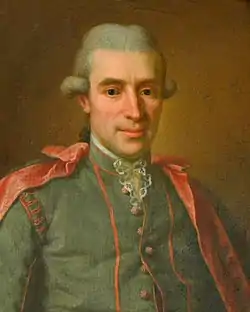 Portrait by Ulrika Pasch
Torbern Olaf (Olof) Bergman (KVO) (20 March 1735 – 8 July 1784) was a Swedish chemist and mineralogist noted for his 1775 Dissertation on Elective Attractions, containing the largest chemical affinity tables ever published. Bergman was the first chemist to use the A, B, C, etc., system of notation for chemical species. (Full article...)_(cropped).jpg.webp) Gustav von Leonhard
Gustav von Leonhard
Gustav von Leonhard (12 November 1816 in Munich – 27 December 1878 in Heidelberg) was a German mineralogist and geologist. He was the son of mineralogist Karl Cäsar von Leonhard.
He studied mineralogy and related sciences at the University of Heidelberg, receiving his doctorate in 1840. He continued his education in Berlin, and in 1841 obtained his habilitation at Heidelberg. In 1853 he became an associate professor of mineralogy at the University of Heidelberg. (Full article...)- Alexander Sadebeck (26 June 1843 in Breslau – 9 December 1879 in Hamburg) was a German geologist and mineralogist. He was a brother of botanist Richard Sadebeck (1839–1905).
He studied mineralogy and geology at the University of Berlin as a pupil of Gustav Rose. In 1865 he received his doctorate with a dissertation on Upper Jurassic formations in Pomerania. In 1872 he was appointed professor of mineralogy and geology at the University of Kiel. (Full article...) 
Frederick Augustus Ludwig Karl Wilhelm Genth (May 17, 1820 – February 2, 1893) was a German-American chemist, specializing in analytical chemistry and mineralogy. (Full article...).jpg.webp) Norman Levi Bowen
Norman Levi Bowen
Norman Levi Bowen FRS (June 21, 1887 – September 11, 1956) was a Canadian geologist. Bowen "revolutionized experimental petrology and our understanding of mineral crystallization". Beginning geology students are familiar with Bowen's reaction series depicting how different minerals crystallize under varying pressures and temperatures." (Full article...) William Niven, mineralogist, circa 1895
William Niven (2 October 1850 – 2 June 1937) was a mineralogist and archeologist noted for his discovery of the minerals yttrialite, thorogummite, aguilarite and nivenite (named after him), as well as a set of controversial tablets. Originally from Scotland, Niven came to the United States in 1879, where he became heavily involved in mineralogy and mining. (Full article...)
Ignacy Domeyko or Domejko, pseudonym: Żegota (Spanish: Ignacio Domeyko, Spanish pronunciation: [iɣˈnasjo ðoˈmejko]; 31 July 1802 – 23 January 1889) was a Polish geologist, mineralogist, educator, and founder of the University of Santiago, in Chile. Domeyko spent most of his life, and died, in his adopted country, Chile.
After a youth passed in partitioned Poland, Domeyko participated in the Polish–Russian War 1830–31. Upon Russian victory, he was exiled, spending part of his life in France (where he had gone with a fellow Philomath, Polish poet Adam Mickiewicz) before eventually settling in Chile, whose citizen he became. (Full article...) Georgius Agricola (fictive 1927 portrait)
Georgius Agricola (/əˈɡrɪkələ/; born Georg Bauer; 24 March 1494 – 21 November 1555) was a German Humanist scholar, mineralogist and metallurgist. Born in the small town of Glauchau, in the Electorate of Saxony of the Holy Roman Empire, he was broadly educated, but took a particular interest in the mining and refining of metals. For his groundbreaking work De Natura Fossilium published in 1546, he is generally referred to as the Father of Mineralogy.
He is well known for his pioneering work De re metallica libri XII, that was published in 1556, one year after his death. This 12-volume work is a comprehensive and systematic study, classification and methodical guide on all available factual and practical aspects, that are of concern for mining, the mining sciences and metallurgy, investigated and researched in its natural environment by means of direct observation. Unrivalled in its complexity and accuracy, it served as the standard reference work for two centuries. Agricola stated in the preface, that he will exclude all those things which I have not myself seen, or have not read or heard of.[...].That which I have neither seen, nor carefully considered after reading or hearing of, I have not written about. (Full article...)
Rodney Charles Ewing (born September 20, 1946) is an American mineralogist and materials scientist whose research is focused on the properties of nuclear materials.
He is the Frank Stanton Professor in Nuclear Security at the Center for International Security and Cooperation, a Senior Fellow of the Freeman Spogli Institute for International Studies, a Senior Fellow of the Precourt Institute for Energy, an Affiliate of the Stanford Woods Institute for the Environment, and a Professor in the School of Earth, Energy and Environmental Sciences at Stanford University. (Full article...)
Gaius Plinius Secundus (AD 23/24 – AD 79), called Pliny the Elder (/ˈplɪni/), was a Roman author, naturalist, natural philosopher, and naval and army commander of the early Roman Empire, and a friend of the emperor Vespasian. He wrote the encyclopedic Naturalis Historia (Natural History), which became an editorial model for encyclopedias. He spent most of his spare time studying, writing, and investigating natural and geographic phenomena in the field.
His nephew, Pliny the Younger, wrote of him in a letter to the historian Tacitus: (Full article...)
George Gibbs (January 7, 1776 – August 6, 1833) was an American mineralogist and mineral collector. The mineral gibbsite is named after him. (Full article...) Ernst Erhard Schmid
Ernst Erhard Friedrich Wilhelm Schmid (22 May 1815 in Hildburghausen – 16 February 1885 in Jena) was a German paleontologist. He was the son of law professor Karl Ernst Schmid (1774–1852).
He studied natural sciences at the universities of Jena and Vienna, receiving his doctorate in 1839. In 1843 he became an associate professor at Jena, where with Matthias Jakob Schleiden, he founded a physiological institute. At the institute he dealt with subjects that included mineralogy, geology, chemistry and physics. In 1856 he was appointed a professor of natural sciences at the University of Jena. (Full article...)- Friedrich Klockmann (12 April 1858, Schwerin – 17 November 1937, Aachen) was a German geologist and mineralogist.
He studied geology and mineralogy at the Bergakademie in Clausthal and at the University of Rostock, receiving his doctorate in 1881. Following graduation he worked for the Prussian Geological Survey, based in Berlin. From 1887 he taught classes in mineralogy and geology at the academy in Clausthal, and in 1892 attained the title of professor. From 1899 he worked as a professor at the technical university in Aachen, where in 1917/18 he served as academic rector. (Full article...) - Fritz Henning Emil Paul Berndt Laves (27 February 1906 – 12 August 1978) was a German crystallographer who served as the president of the German Mineralogical Society from 1956 to 1958. He is the namesake of Laves phases and the Laves tilings; the Laves graph, a highly-symmetrical three-dimensional crystal structure that he studied, was named after him by H. S. M. Coxeter. (Full article...)
 Daubenton in 1791
Louis Jean-Marie Daubenton (29 May 1716 – 1 January 1800) was a French naturalist and contributor to the Encyclopédie ou Dictionnaire raisonné des sciences, des arts et des métiers. (Full article...).jpg.webp) Paul Heinrich von Groth (1910); photograph by Theodor Hilsdorf
Paul Heinrich von Groth (1910); photograph by Theodor Hilsdorf
Paul Heinrich Ritter von Groth (23 June 1843 – 2 December 1927) was a German mineralogist. His most important contribution to science was his systematic classification of minerals based on their chemical compositions and crystal structures. (Full article...)- Julian Royce Goldsmith (1918–1999) was a mineralogist and geochemist at the University of Chicago (Moore, 1971). Goldsmith, along with colleague Fritz Laves, first defined the crystallographic polymorphism of alkali feldspar (Newton, 1989). Goldsmith also experimented on the temperature dependence of the solid solution between calcite and dolomite (Newton, 1989). Goldsmith’s research also led him to experiment with the determination of the stability of intermediate structural states of albite (Newton, 1989). For his outstanding contributions to the study of mineralogy and geochemistry, Goldsmith was awarded the prestigious Roebling Medal by the Mineralogical Society of America in 1988 (Newton, 1989). The mineral julgoldite was named for him. (Full article...)
Related portals
Get involved
For editor resources and to collaborate with other editors on improving Wikipedia's Minerals-related articles, see WikiProject Rocks and minerals.
General images

 Black andradite, an end-member of the orthosilicate garnet group. (from Mineral)
 Perfect basal cleavage as seen in biotite (black), and good cleavage seen in the matrix (pink orthoclase). (from Mineral)
 Native gold. Rare specimen of stout crystals growing off of a central stalk, size 3.7 x 1.1 x 0.4 cm, from Venezuela. (from Mineral)
 Schist is a metamorphic rock characterized by an abundance of platy minerals. In this example, the rock has prominent sillimanite porphyroblasts as large as 3 cm (1.2 in). (from Mineral)
 Pink cubic halite (NaCl; halide class) crystals on a nahcolite matrix (NaHCO3; a carbonate, and mineral form of sodium bicarbonate, used as baking soda). (from Mineral)
 Red cinnabar (HgS), a mercury ore, on dolomite. (from Mineral)
 Pyrite (from Lustre (mineralogy))
 Mohs hardness kit, containing one specimen of each mineral on the ten-point hardness scale (from Mohs scale)
 When minerals react, the products will sometimes assume the shape of the reagent; the product mineral is termed a pseudomorph of (or after) the reagent. Illustrated here is a pseudomorph of kaolinite after orthoclase. Here, the pseudomorph preserved the Carlsbad twinning common in orthoclase. (from Mineral)
- Diamond is the hardest natural material, and has a Mohs hardness of 10. (from Mineral)
 Epidote often has a distinctive pistachio-green colour. (from Mineral)
 Muscovite, a mineral species in the mica group, within the phyllosilicate subclass (from Mineral)
 Hübnerite, the manganese-rich end-member of the wolframite series, with minor quartz in the background (from Mineral)
 An example of elbaite, a species of tourmaline, with distinctive colour banding. (from Mineral)
 Gypsum desert rose (from Mineral)


 Sphalerite crystal partially encased in calcite from the Devonian Milwaukee Formation of Wisconsin (from Mineral)
Did you know ...?

- ... that when first noted, arsenoclasite appeared very similar to sarkinite (pictured), but with one perfect cleavage?
- ... that caryopilite was named for the Greek words for walnut and felt?
- ... that the mineral bobfergusonite has been found only in Canada and Argentina?
- ... that while the mineral magnesiopascoite was discovered in Utah, the two cotype specimens are in a museum in California?
Subcategories

- Select [►] to view subcategories
Topics
| Overview | | |
|---|---|---|
| Common minerals | ||
Gemmological classifications by E. Ya. Kievlenko (1980), updated | |||||||||
| Jewelry stones |
| ||||||||
| Jewelry-Industrial stones |
| ||||||||
| Industrial stones |
| ||||||||

Associated Wikimedia
The following Wikimedia Foundation sister projects provide more on this subject:
-
 Commons
Free media repository -
 Wikibooks
Free textbooks and manuals -
 Wikidata
Free knowledge base -
 Wikinews
Free-content news -
 Wikiquote
Collection of quotations -
 Wikisource
Free-content library -
 Wikiversity
Free learning tools -
 Wiktionary
Dictionary and thesaurus
References
-
 List of all portalsList of all portals
 -
 The arts portal
 -
 Biography portal
 -
 Current events portal
 -
 Geography portal
 -
 History portal
 -
 Mathematics portal
 -
 Science portal
 -
 Society portal
 -
 Technology portal
 -
 Random portalRandom portal
 -
 WikiProject PortalsWikiProject Portals