Portal:German Empire

German Empire

.svg.png.webp)
The German Empire (German: Deutsches Kaiserreich, officially Deutsches Reich), was the German nation state that existed from the Unification of Germany in 1871 until the abdication of Kaiser Wilhelm II in 1918.
The German Empire consisted of 26 states, most of them ruled by noble families. They included four kingdoms, six grand duchies, five duchies (six before 1876), seven principalities, three free Hanseatic cities, and one imperial territory. Although Prussia was one of several kingdoms in the realm, it contained about two thirds of Germany's population and territory.
After 1850, the states of Germany had rapidly become industrialized, with particular strengths in coal, iron (and later steel), chemicals, and railways. In 1871, Germany had a population of 41 million people; by 1913, this had increased to 68 million. A heavily rural collection of states in 1815, the now united Germany became predominantly urban. During its 47 years of existence, the German Empire was an industrial, technological, and scientific giant, gaining more Nobel Prizes in science than any other country.
Selected article

The Algeciras Conference of 1906 took place in Algeciras, Spain, and lasted from 16 January to 7 April. The purpose of the conference was to find a solution to the First Moroccan Crisis of 1905 between France and the German Empire, which arose as Germany attempted to prevent France from establishing a protectorate over Morocco in what was known as the Tangier Crisis.
Britain and France's Entente Cordiale of 1904 had defined diplomatic cooperation between them and recognized British authority over Egypt and French control in Morocco (with some Spanish concessions). Germany saw this development putting an end to the rivalry between Britain and France, which would further isolate Germany in European affairs.
On 31 March 1905, Kaiser Wilhelm II of Germany visited Morocco's capital, Tangier, and delivered a sabre-rattling speech calling for an international conference to ensure Morocco's independence. German diplomats believed they could convince U.S. President Theodore Roosevelt to challenge French intervention in Morocco. Roosevelt — at that time mediating the Russo-Japanese War, and aware of the U.S. Senate's stance to avoid involvement in European affairs — was disinclined to become involved in the Moroccan crisis. However, with the situation in June 1905 worsening to the point of war between Germany and France (and possibly Britain), in July Roosevelt persuaded the French to attend a January peace conference in Algeciras.
Selected biography

Hermann Detzner (16 October 1882 – 1 December 1970) was an officer in the German colonial security force (Schutztruppe) in Kamerun (Cameroon) and German New Guinea, as well as a surveyor, an engineer, an adventurer, and a writer. In early 1914, the German government sent Detzner to explore and chart the interior of Kaiser-Wilhelmsland, the imperial protectorate on the island of New Guinea. When World War I broke out in Europe, he was well into the interior and without radio contact. He refused to surrender to Australian troops when they occupied German New Guinea, concealing himself in the jungle with a band of approximately 20 soldiers. For four years, Detzner and his troops provocatively marched through the bush, singing "Watch on the Rhine" and flying the German Imperial flag. He led at least one expedition from the Huon Peninsula to the north coast, and a second by a mountain route, to attempt an escape to the neutral Dutch colony to the west. He explored areas of the New Guinean interior formerly unseen by Europeans and surrendered in full dress uniform, flying the Imperial flag, to Australian forces in January 1919.
Selected images
 The Reichstag in the 1890s / early 1900s.
 The New Town Hall in Hanover was opened on July 20, 1913.
 Draftees of the German Army, 1898.
 Berlin, Unter den Linden, around 1900.
 Augustusplatz with Leipzig Opera House, around 1900
.jpg.webp) Die Proklamation des Deutschen Kaiserreiches by Anton von Werner (1877), depicting the proclamation of the foundation of the German Reich (18 January 1871, Palace of Versailles).
Die Proklamation des Deutschen Kaiserreiches by Anton von Werner (1877), depicting the proclamation of the foundation of the German Reich (18 January 1871, Palace of Versailles). The Stadtschloss with the National Memorial to emperor Wilhelm I, around 1900
.jpg.webp) A platoon of German Reservists in German New Guinea after the outbreak of war.
A platoon of German Reservists in German New Guinea after the outbreak of war..jpg.webp) Hamburg's central promenade Jungfernstieg on River Alster in 1900.
Hamburg's central promenade Jungfernstieg on River Alster in 1900. "Ankunft Seiner Majestät in Saarbrücken" ("His Majesty arriving at Saarbrücken") by Anton von Werner (1877)
Did you know?

- ...that the Reichstag building was constructed to house the Imperial Diet of the German Empire? It was opened in 1894 and housed the Diet until 1933, when it was severely damaged after it was set on fire.
- ...that the German term Sozialstaat has been used since 1870 to describe state support programs devised by German Sozialpolitiker ("social politicians") and implemented as part of Bismarck's conservative reforms?
Subcategories
Clicking the ► sign will expand or collapse the respective category.
Topics
States of the German Empire (1871–1918) | ||
|---|---|---|
| Kingdoms |
| -en.png.webp) |
| Grand Duchies | ||
| Duchies | ||
| Principalities | ||
| City-states | ||
| Imperial Territories | ||
| Other | ||
States of the German Empire
_Hamburg.svg.png.webp)



.svg.png.webp)


.svg.png.webp)
.svg.png.webp)

.svg.png.webp)


Kingdoms
Grand Duchies
- Grand Duchy of Baden
- Grand Duchy of Hesse
- Grand Duchy of Mecklenburg-Schwerin
- Grand Duchy of Saxe-Weimar-Eisenach
- Grand Duchy of Mecklenburg-Strelitz
- Grand Duchy of Oldenburg
Duchies
- Duchy of Brunswick
- Duchy of Saxe-Altenburg
- Duchy of Saxe-Meiningen
- Duchy of Saxe-Coburg and Gotha
- Duchy of Anhalt
- Duchy of Saxe-Lauenburg
Principalities
- Principality of Schwarzburg-Sondershausen
- Principality of Schwarzburg-Rudolstadt
- Principality of Waldeck-Pyrmont
- Principality of Reuss-Greiz
- Principality of Reuss-Gera
- Principality of Schaumburg-Lippe
- Principality of Lippe
Free and Hanseatic Cities
- Free and Hanseatic City of Lübeck
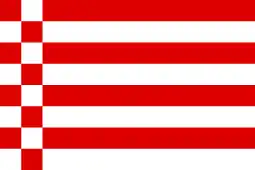
- Free and Hanseatic City of Bremen
- Free and Hanseatic City of Hamburg
Imperial Territories
Colonies of the German Empire
The German colonial empire (German: Deutsches Kolonialreich) constituted the overseas colonies, dependencies and territories of Imperial Germany. Short-lived attempts of colonization by individual German states had occurred in preceding centuries, but crucial colonial efforts only began in 1884 with the Scramble for Africa. Germany lost control when World War I began in 1914 and its colonies were seized by its enemies in the first weeks of the war. However some military units held out for a while longer: German South-West Africa surrendered in 1915, Kamerun in 1916 and German East Africa only in 1918 by end of the war. Germany's colonial empire was officially confiscated with the Treaty of Versailles after Germany's defeat in the war and the various units became League of Nations mandates under the supervision (but not ownership) of one of the victorious powers.
 |
 |
 |
 |
 |
 | |
| German New Guinea | German Samoa | German South-West Africa | Kamerun | Togoland | German East Africa |
Associated Wikimedia
The following Wikimedia Foundation sister projects provide more on this subject:
-
 Commons
Free media repository -
 Wikibooks
Free textbooks and manuals -
 Wikidata
Free knowledge base -
 Wikinews
Free-content news -
 Wikiquote
Collection of quotations -
 Wikisource
Free-content library -
 Wikiversity
Free learning tools -
 Wiktionary
Dictionary and thesaurus
-
 List of all portalsList of all portals
 -
 The arts portal
 -
 Biography portal
 -
 Current events portal
 -
 Geography portal
 -
 History portal
 -
 Mathematics portal
 -
 Science portal
 -
 Society portal
 -
 Technology portal
 -
 Random portalRandom portal
 -
 WikiProject PortalsWikiProject Portals