Portal:Fungi

The Fungi Portal
_01.jpg.webp)
A fungus is any member of a large group of eukaryotic organisms that includes microorganisms such as yeasts and molds, as well as the more familiar mushrooms. The Fungi are classified as a kingdom that is separate from plants and animals. The discipline of biology devoted to the study of fungi is known as mycology or fungal biology, which is historically regarded as a branch of botany, even though genetic studies have shown that fungi are more closely related to animals than to plants. Fungi reproduce via spores and grow as hyphae, mycelia, and futher specialized structures. Fungal spores are often produced on specialized structures or in fruiting bodies, such as the head of a mushroom. Abundant worldwide, most fungi are mostly invisible to the naked eye because of the small size of their structures, and their cryptic lifestyles in soil, on dead matter, and as symbionts of plants, animals, or other fungi. Fungi perform an essential role in the decomposition of organic matter and have fundamental roles in nutrient cycling and exchange. They have long been used as a direct source of food, such as mushrooms and truffles, as a leavening agent for bread, and in fermentation of various food products, such as wine, beer, and soy sauce.
Since the 1940s, fungi have been used for the production of antibiotics, and, more recently, various enzymes produced by fungi are used industrially and in detergents. Fungi are also used as biological agents to control weeds and pests. Many species produce bioactive compounds called mycotoxins, such as alkaloids and polyketides, that are toxic to animals including humans. The fruiting structures of a few species are consumed recreationally or in traditional ceremonies as a source of psychotropic compounds. Fungi can break down manufactured materials and buildings, and become significant pathogens of humans and other animals. Losses of crops due to fungal diseases or food spoilage can have a large impact on human food supplies and local economies. Despite their importance on human affairs, little is known of the true biodiversity of Kingdom Fungi, which has been estimated at around 1.5 million species, with about 5% of these having been formally classified.
| More about fungi... |
Selected article

The small, tough, fruit bodies are grayish-brown balls that are initially enclosed by a skin, or peridium, made up of four distinct layers of tissue. The outer tissue layer splits to form star-like rays and expose a circular spore case. Inside the spore case is the gleba—fertile spore-producing tissue that is white and firm when young, but becomes brown and powdery in age. The grayish-brown spore case is set on a short, slender stalk, and has a well-defined narrow pore at the top where mature spores may escape. Fully expanded, the fruit body reaches dimensions up to 2–3 cm (0.8–1.2 in) wide and up to about 3 cm (1.2 in) tall. The outer skin is purplish-brown, with four or five cream or yellowish-brown colored rays that have their tips stuck in the substrate. There is a flat mat of interwoven mycelia between ray tips. The spores are spherical, warty, and have a diameter of up to 6 µm. Geastrum quadrifidum is one of a number of earthstars whose rays arch downward as they mature, lifting the spore sac upward, high enough to catch air currents that disseminate the spores into new habitats. The species is easily confused with Geastrum fornicatum, a larger earthstar without a well-defined pore mouth.
Selected species

Things to do
If you want to help Wikipedia to improve its coverage of fungi, here are some things you can do...
- Assess some fungi articles.
- Join Wikipedia:WikiProject Fungi or ask on the talk page.
- Join the lichen task force.
- Review, improve, expand or clean some of the newly created fungi-related articles.
- Expand some high priority fungus stubs.
- Expand or sort other fungi-related stubs.
- Add images to articles in the list of unillustrated fungi articles, or add more articles to the list.
- Write fungi-related articles from scratch. For ideas of needed articles, see the redlinks on-
- Wikipedia:WikiProject Fungi/List of unwritten articles (high priority)
- Wikipedia:WikiProject Missing encyclopedic articles/Skysmith's list of missing articles/Biology/Fungi
- Members of Category:Lists of fungal species
- Review the fungi articles flagged as needing attention.
WikiProjects

WikiProjects related to fungi:
- WikiProject Science
- WikiProject Biology
- WikiProject Tree of Life
- WikiProject Fungi
- WikiProject Tree of Life
- WikiProject Biology
- WikiProject Medicine
- WikiProject Food
Selected picture

Did you know?
- ... that the bleeding tooth fungus secretes a red juice that contains an anticoagulant similar in biological activity to heparin?
- ... that the pinwheel Marasmius releases its spores in response to rain, rather than circadian rhythm like other mushrooms?
- ... that the royal fly agaric was the German Mycological Society's "Mushroom of the Year" in 2000?
- ... that the fungal genus Polytolypa is known from a single specimen found growing on dung of the North American porcupine?
- ... that only eastern Northern American strains of the bitter oyster, a widely distributed mushroom species, are bioluminescent?
General images -
 Roles of fungi in the marine carbon cycleRoles of fungi in the marine carbon cycle by processing phytoplankton-derived organic matter. Parasitic fungi, as well as saprotrophic fungi, directly assimilate phytoplankton organic carbon. By releasing zoospores, the fungi bridge the trophic linkage to zooplankton, known as the mycoloop. By modifying the particulate and dissolved organic carbon, they can affect bacteria and the microbial loop. These processes may modify marine snow chemical composition and the subsequent functioning of the biological carbon pump. (from Marine fungi)
 Fungi within Ascomycota form ascogonium and antheridium with trichogyne bridge (from Mating in fungi)
 Diagram of a mycoloop (fungus loop)Parasitic chytrids can transfer material from large inedible phytoplankton to zooplankton. Chytrids zoospores are excellent food for zooplankton in terms of size (2–5 μm in diameter), shape, nutritional quality (rich in polyunsaturated fatty acids and cholesterols). Large colonies of host phytoplankton may also be fragmented by chytrid infections and become edible to zooplankton. (from Marine fungi)
 Ganoderma lingzhi (from Mushroom)
 There are over 100 psychoactive mushroom species of genus Psilocybe native to regions all around the world. (from Mushroom)
 Tinea corporis (from Fungal infection)
 Phylogenetic and symbiogenetic tree of living organisms, showing a view of the origins of eukaryotes and prokaryotes (from Marine fungi)
 A mushroom (probably Russula brevipes) parasitized by Hypomyces lactifluorum resulting in a "lobster mushroom" (from Mushroom)
 Amanita muscaria, the most easily recognised "toadstool", is frequently depicted in fairy stories and on greeting cards. It is often associated with gnomes. (from Mushroom)
 Chytrid parasites of marine diatoms. (A) Chytrid sporangia on Pleurosigma sp. The white arrow indicates the operculate discharge pore. (B) Rhizoids (white arrow) extending into diatom host. (C) Chlorophyll aggregates localized to infection sites (white arrows). (D and E) Single hosts bearing multiple zoosporangia at different stages of development. The white arrow in panel E highlights branching rhizoids. (F) Endobiotic chytrid-like sporangia within diatom frustule. Bars = 10 μm. (from Marine fungi)
 Eumycetoma (from Fungal infection)
 Psilocybe zapotecorum, a hallucinogenic mushroom (from Mushroom)
 The photochemistry of vitamin D2 biosynthesis (from Medicinal fungi)
 Morphological diversity of fungi collected from a marine sponge species, Ircinia variabilis (from Marine fungi)
 Driftwood(from Marine fungi)
 Neurospora crassa life cycle. The haploid mycelium reproduces asexually by two processes: (1) simple proliferation of existing mycelium, and (2) formation of conidia (macro- and micro-) which can be dispersed and then germinate to produce new mycelium. In the sexual cycle, mating can only occur between individual strains of different mating type, A and a. Fertilization occurs by the passage of nuclei of conidia or mycelium of one mating type into the protoperithecia of the opposite mating type through the trichogyne. Fusion of the nuclei of opposite mating types occurs within the protoperithecium to form a zygote (2N) nucleus. (from Mating in fungi)
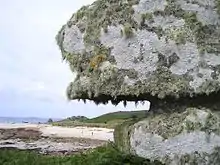 Lichen covered rocks(from Marine fungi)
 Pityriasis versicolor (from Fungal infection)
 Fungi within Zygomycota form progametangia with suspensors during mating (from Mating in fungi)
 Oral candidiasis (from Fungal infection)
![Image 23Pennate diatom from an Arctic meltpond, infected with two chytrid-like [zoo-]sporangium fungal pathogens (in false-colour red). Scale bar = 10 µm. (from Marine fungi)](../I/Pennate_diatom_infected_with_two_chytrid-like_fungal_pathogens.png.webp) Pennate diatom from an Arctic meltpond, infected with two chytrid-like [zoo-]sporangium fungal pathogens (in false-colour red). Scale bar = 10 µm. (from Marine fungi)
Pennate diatom from an Arctic meltpond, infected with two chytrid-like [zoo-]sporangium fungal pathogens (in false-colour red). Scale bar = 10 µm. (from Marine fungi) Culinary mushrooms are available in a wide diversity of shapes and colors at this market stand at the San Francisco Ferry Building. (from Mushroom)
 Mycoloop links between phytoplankton and zooplanktonChytrid‐mediated trophic links between phytoplankton and zooplankton (mycoloop). While small phytoplankton species can be grazed upon by zooplankton, large phytoplankton species constitute poorly edible or even inedible prey. Chytrid infections on large phytoplankton can induce changes in palatability, as a result of host aggregation (reduced edibility) or mechanistic fragmentation of cells or filaments (increased palatability). First, chytrid parasites extract and repack nutrients and energy from their hosts in form of readily edible zoospores. Second, infected and fragmented hosts including attached sporangia can also be ingested by grazers (i.e. concomitant predation). (from Marine fungi)
 Group photograph taken at a meeting of the British Mycological Society in 1913 (from Mycology)
 Salmon with fungal disease (from Marine fungi)
 Young Amanita phalloides "death cap" mushrooms, with a matchbox for size comparison (from Mushroom)
 Ling Zhi-8, an immunomodulatory protein isolated from Ganoderma lucidum (from Medicinal fungi)
.JPG.webp) The psychotropic mushroom Amanita muscaria, commonly known as "fly agaric" (from Mushroom)
The psychotropic mushroom Amanita muscaria, commonly known as "fly agaric" (from Mushroom) 40x brightfield microscopy of Pestalotia/Pestalotiopsis spores. Note the appendages. Some strains (Pestalotiopsis pauciseta) produce taxol. (from Medicinal fungi)
 Yellow flower pot mushrooms (Leucocoprinus birnbaumii) at various states of development (from Mushroom)
 Amanita jacksonii buttons emerging from their universal veils (from Mushroom)
 Maitake, a polypore mushroom (from Mushroom)
 Onychomycosis (from Fungal infection)
 The Agaricus bisporus, one of the most widely cultivated and popular mushrooms in the world (from Mushroom)
 Typical mating fusion of two compatible monokaryons in Basidiomycota (from Mating in fungi)
 Morphological characteristics of the caps of mushrooms (from Mushroom)
 A tinder fungus, Fomes fomentarius (from Mushroom)
Related portals
Topics
- Fungi: Bracket fungus, carnivorous fungus, coprophilous fungi, entomopathogenic fungus, evolution of fungi, lichen, mushroom, mycology (lichenology, mycotoxicology, paleomycology), mycorrhiza, pathogenic fungi, puffball, wood-decay fungus
- Fungal orders: Chytridiomycota, Blastocladiomycota, Neocallimastigomycota, Zygomycota, Glomeromycota. Dikarya: Ascomycota, Basidiomycota
- Fungi lists: Species: Agaricus species, Amanita species, Boletus species, Cortinarius species, Cyathus species, Hygrocybe species, Hygrophorus species, Inocybe species, Lactarius species, Mycosphaerella species, Panaeolus species, Psilocybe species, Russula species, Scleroderma species Other lists: Mycology journals, psilocybin mushrooms
- Uses: Edible mushroom, mushroom poisoning, psilocybin mushrooms, mushroom hunting, fungiculture, fermentation, baker's yeast, mycoremediation, lichenometry, mushroom dye



Categories

Wikimedia
Sources
-
 List of all portalsList of all portals
 -
 The arts portal
 -
 Biography portal
 -
 Current events portal
 -
 Geography portal
 -
 History portal
 -
 Mathematics portal
 -
 Science portal
 -
 Society portal
 -
 Technology portal
 -
 Random portalRandom portal
 -
 WikiProject PortalsWikiProject Portals