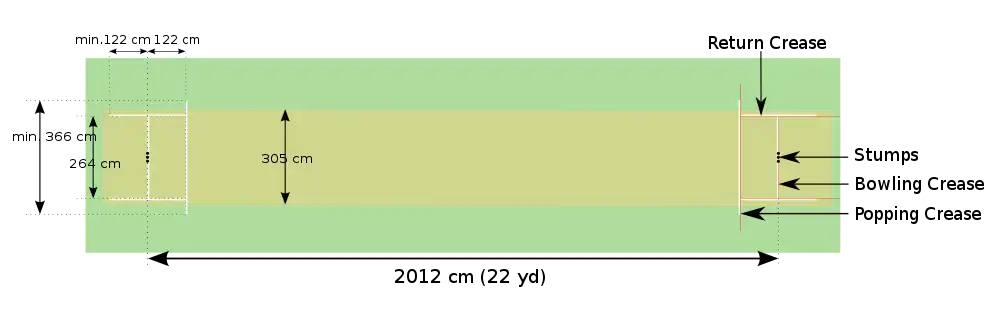
Cricket is a bat-and-ball game played between two teams of eleven players on a field at the centre of which is a 22-yard (20-metre) pitch with a wicket at each end, each comprising two bails balanced on three stumps. The batting side scores runs by striking the ballbowled at one of the wickets with the bat and then running between the wickets, while the bowling and fielding side tries to prevent this (by preventing the ball from leaving the field, and getting the ball to either wicket) and dismiss each batter (so they are "out"). Means of dismissal include being bowled, when the ball hits the stumps and dislodges the bails, and by the fielding side either catching the ball after it is hit by the bat, but before it hits the ground, or hitting a wicket with the ball before a batter can cross the crease in front of the wicket. When ten batters have been dismissed, the innings ends and the teams swap roles. The game is adjudicated by two umpires, aided by a third umpire and match referee in international matches. They communicate with two off-field scorers who record the match's statistical information.
Selected article
Kevin Peter PietersenMBE (born 27 June 1980) is a cricket commentator, conservationist, and former England international cricket player. He is a right-handed batsman and occasional off spinbowler who played in all three formats for England between 2005 and 2014, which included a brief tenure as captain. He won the Player of the Series award for his heroics in 2010 ICC World Twenty20 and for helping the England Cricket Team win their maiden ICC trophy.
Pietersen was born to an Afrikaner father and English mother in South Africa. He made his first-class debut for Natal in 1997 and moved to England in 2000, after voicing his displeasure at what he said was the racial quota system in South African cricket. Being of English ancestry, Pietersen was eligible for the England team so long as he first served a four-year qualifying period in English county cricket. He was called up by England almost immediately after he completed four years with Nottinghamshire. He made his international debut in the One Day International (ODI) match against Zimbabwe in 2004 and his Test match debut in the 2005 Ashes series against Australia. (Full article...)
Since Brabourne hosted its first international match in 1948, 35 Test centuries and 2 ODI centuries have been scored at the ground.
Brabourne Stadium is a cricket ground in Mumbai, India. It is the home of the Cricket Club of India and has played host to Ranji Trophy matches (including seventeen finals) and Indian Premier League matches, as well as being a Test, One Day International and Twenty20 International (T20) venue. It has a capacity of 20,000 spectators. The ground has hosted eighteen Test matches, the first in 1948 when India played the West Indies. It has also staged nine One Day International matches, the first of which was in 1989 when Australia lost to Pakistan by 66 runs. One T20 International has been played at the ground when India beat Australia by 7 wickets in 2007 (first T20 International to be played in India). Of the nine One Day Internationals played at the stadium, five matches (including the final) were staged during the ICC Champions Trophy in 2006.
The first Test century (100 or more runs in a single innings) scored at the ground was in 1948 by the West Indian Allan Rae in the first innings of the first Test match played at Brabourne Stadium. The first Indian to score a century at the Brabourne was Rusi Modi in the third innings of the same match. In total, 35 Test centuries have been scored at the ground in 18 Test matches. Virender Sehwag's 293, scored against Sri Lanka in 2009, is the highest Test innings achieved at the ground. The highest Test score by an overseas player is 194 by the West Indian Everton Weekes in 1948. Vijay Hazare has scored the most Test centuries at the ground with four. (Full article...)
Image 2
The Frank Worrell Trophy is awarded to the winner of the West Indies–Australia Test match series in cricket. The trophy is named after Frank Worrell who was the first black captain of the West Indies. It was first awarded at the end of the 1960–61 series in Australia, the first Test of which ended in a tie. The Australian Cricket Board of Control and Don Bradman commissioned former Test cricketer and professional jeweller Ernie McCormick to create a perpetual trophy following the tie. The trophy's design incorporated a ball used in the tied Test.
, Australia hold the trophy following their 2–0 series victory in the West Indies 2022–23 tour. Australia also lead in overall wins, winning 15 of the 25 series, while the West Indies have won 8, the remaining 2 ending in draws (with the trophy being retained by the incumbents). Brian Lara is the most successful batsman in the history of the trophy, scoring 2,815 runs for the West Indies in 56 innings at an average of 52.12. He also holds the record for the highest score (277) which he made in the third Test at the Sydney Cricket Ground during the 1992–93 series. West Indian fast bowler Courtney Walsh has taken the most wickets in the trophy, with 135 over 38 matches, at an average of 28.68, while Australia's Graham McKenzie has the best bowling figures of 8 wickets for 71 runs, achieved in the second Test of the 1968–69 series. Australian Mark Waugh has taken the most catches, with 45 in 28 matches, while West Indian Jeff Dujon is the most successful wicketkeeper, making 84 dismissals in 23 matches. (Full article...)
Image 3
Second women's Test match between Australia and England in Sydney in 1935; Myrtle Maclagan (not pictured) scored the first century in women's Test cricket during this match while Betty Snowball (wicketkeeper, third from left) scored a century two Tests later.
Test cricket is the longest version of the sport of cricket. Test matches are played between international teams of eleven players each over four innings; each team bats twice. In the women's variant, the game is scheduled to last four days of play. The Women's Cricket Association was formed in England in 1926, and the first women's Test was played between England and Australia in 1934. The English team were on a tour of Australia and New Zealand, arranged by the WCA. The International Women's Cricket Council was formed in 1958 as the governing body for women's cricket. In 2005, women's cricket was brought under the International Cricket Council along with men's cricket; at that time 89 of the council's 104 members had started developing women's cricket. As of June 2022, a total of ten teams have played a total of 144 women's Test matches and 2 matches were abandoned. England have played the most matches (98) while Sri Lanka, Ireland and the Netherlands have played only one Test each.
A century is a score of a hundred or more runs in an innings. The first century in women's Test cricket was scored in 1935 by Myrtle Maclagan, who made 119 runs for England against Australia. Since then, a total of 108 centuries, including seven double centuries, have been scored. Betty Snowball of England (189 runs) held the record for the highest individual score for over 51 years. She was the second cricketer to hold the record after Maclagan, a record which stood until Sandhya Agarwal of India surpassed it by a single run in 1986. Following Agarwal the record was held by Denise Annetts (Australia, 1987), Kirsty Flavell (New Zealand, 1996), Karen Rolton (Australia, 2001), Mithali Raj (India, 2002), and the current record holder Kiran Baluch of Pakistan who, in 2004, scored 242 runs against the West Indies. Janette Brittin of England has scored five centuries in a Test career spanning 27 matches and 44 innings, the most hundreds in women's Test match history. Flavell scored the first double century in women's Test cricket in 1996; over the next eight years five more double centuries were scored, by Joanne Broadbent (Australia, 1998), Michelle Goszko (Australia, 2001), Karen Rolton (Australia, 2001), Mithali Raj (India, 2002), and Kiran Baluch (Pakistan, 2004), which was then succeeded by a 13 year wait until Ellyse Perry of Australia scored the next one in 2017. As of June 2022, Australia and England have the most centurions (23 players each) while English players have scored the most centuries (44 times). (Full article...)
Image 4
Lord Hawke captained Yorkshire to eight of their record thirty-two Championship titles.
The first references to county cricket come during the early 18th century, during which time cricket was played almost exclusively in the south-east of England, with teams representing Kent, Middlesex, London and Surrey frequently playing each other. The sport soon became popular through the rest of the country, and by the end of the 18th century, the game was being played nationwide. In 1744, Kent faced "All England" and became the first notional English cricket champions, winning by one wicket. Cricket was played at both club and county level equally through the next hundred years, and it was only in the 1870s that county cricket started to be played frequently and regularly: in 1870 there were 22 regular fixtures, while ten years later there were 188. (Full article...)
Image 5
Allan Donald took a five-wicket haul for South Africa in its first ever ODI.
In cricket, a five-wicket haul (also known as a "five-for" or "fifer") refers to a bowler taking five or more wickets in a single innings. This is regarded as a significant achievement. As of May 2019, there have been more than 4100 ODIs have been played, however there are only 14 occasions where a player achieved this feat on his ODI debut. Players from the eight of the twelve teams that have Full member status—Australia, Bangladesh, England, Ireland, South Africa, Sri Lanka, West Indies and Zimbabwe—have taken five-wicket hauls on debut. Sri Lankans have performed this feat on three occasions, while the Bangladeshis and South Africa have two each. In addition, two players from Associate teams—Canada and Namibia—have taken a five-wicket haul on debut. Afghanistan, India, New Zealand and Pakistan are yet to have a debutant take a five-wicket haul.
Sri Lankan cricketer Uvais Karnain was the first to take a five-wicket haul on ODI debut; he took 5 wickets for 26 runs against New Zealand in March 1984. His figures were bettered by Australian cricketer Tony Dodemaide who took 5 wickets while conceding 21 runs in a match against Sri Lanka in January 1988. In 1991, Allan Donald became the first South African cricketer to take an ODI five-wicket haul for his team. Although South Africa lost the game by three wickets, Donald received a man of the match award. Canada cricketer Austin Codrington's tally of 5 wickets for 27 runs against Bangladesh in the group stage of the 2003 Cricket World Cup is the only five-wicket haul taken during the Cricket World Cup; his figures helped Canada secure a 60-run victory. Namibian cricketer Jan Frylinck is the most recent debutant to take a five-wicket haul, with figures of 5 wickets for 13 runs against Oman. South African cricketer Kagiso Rabada took figures of 6 wickets for 16 runs, against Bangladesh in July 2015, which remain the best by a bowler on debut. Of the fourteen occasions a cricketer has taken a five-wicket haul on debut, his team has lost three times. (Full article...)
Image 6
Gloucestershire's first ever match was played at Durdham Down in 1870, but it was the only time the county club played there.
Gloucestershire County Cricket Club, representing the historic county of Gloucestershire, is one of the 18 member clubs of the English County Championship. The club was established in 1846 following the merger of the Mangotsfield Cricket Club and West Gloucestershire Cricket Club and played under the latter name until 1867, after which it became the Gloucestershire County Cricket Club. It has played first-class cricket since 1870, List A cricket since 1963 and Twenty20 cricket since 2003.[A] Unlike most professional sports, in which a team usually has a single fixed home ground, county cricket clubs have traditionally used different grounds in various towns and cities within the county for home matches, although the use of minor "out grounds" away from the club's main headquarters has diminished since the 1980s. Gloucestershire have played home matches at eighteen different grounds.
The club's first home match in first-class cricket was played at Durdham Down in the Clifton district of Bristol. This was the only time the county used this venue for a match. The following year Gloucestershire began to play matches at the Clifton College Close Ground in the grounds of Clifton College in the same part of the city, and this remained a regular venue for the county until the 1930s, hosting nearly 100 first-class matches. In 1872 the county used a venue outside Bristol for the first time when they played at the College Ground in the grounds of Cheltenham College. This venue has continued to be used regularly for the county's annual "Cheltenham festival" event, which in the modern era incorporates additional charity events and off-field entertainment. In 1889 Gloucestershire began to play matches at the County Ground in Bristol, which has subsequently served as the club's main headquarters and hosted the majority of the county's matches. It was here that the club played its first List A match in 1963 against Middlesex, and its first Twenty20 match forty years later against Worcestershire. Bristol is not officially part of Gloucestershire and has been considered an independent county since 1373, though it was officially part of the county of Avon from 1974 until 1996. Somerset have played first-class matches at other venues in the city. (Full article...)
Image 7
Gary Wilson, who has kept wicket for Ireland in ODIs, keeping wicket against Essex.
Since their first match in 2006, 66players have represented Ireland in One Day Internationals (ODIs). A One Day International is an international cricket match between two representative teams, each having ODI status, as determined by the International Cricket Council (ICC). An ODI differs from Test matches in that the number of overs per team is limited, and that each team has only one innings. Where more than one player won his first ODI cap in the same match, those players are listed alphabetically by surname.
Ireland have played 185ODIs, resulting in 75victories, 95defeats, 3ties and 12no results. Ireland played their maiden ODI on 13June 2006 against England. Ireland lost by 38runs, although the match drew interest and was played in front a full capacity crowd at the Civil Service Cricket Club in Belfast. (Full article...)
Image 8
Sydney Barnes was a professionalcricketer who played for England in 27 Test matches between 1901 and 1914. He claimed 24 five-wicket hauls (five or more wickets in an innings) during his Test career. A five-wicket haul is regarded as a notable achievement, and as of 2014 fewer than 50 bowlers have taken more than 15 five-wicket hauls at international level in their cricketing careers. Barnes had only played seven first-class matches when he was chosen by Archie MacLaren to tour Australia, and played only 47 County Championship matches throughout his entire career, opting to play Minor Counties and Lancashire League cricket instead. He based his decision upon two main criteria– playing club cricket was more financially rewarding, and he was worried about having to bowl too much in first-class county cricket, and suffering from burnout.
Barnes is generally regarded as one of the best bowlers to have played international cricket, and finished his Test career with 189 wickets at an average of 16.43; his average places him among the top-ten bowlers in Test cricket. At the start of his career, he was a fast bowler who endeavoured to swing the ball, which was the common style of bowling at the time. However, Barnes experimented with bowling a little slower and cutting the ball, and developed both an off cutter and a leg cutter that he concluded were far more effective than swinging the ball. Despite his bowling talent, Barnes did not play any Test cricket between July 1902 and December 1907, as he was considered a "prima donna" who would only put in the effort when he was in the right mood, and being suitably paid. After his recall to the England side, he played regularly until the outbreak of the First World War in 1914, and was named by the Wisden Cricketers' Almanack as one of their Cricketers of the Year in 1910. (Full article...)
Image 9
Bowlers have taken fourteen five-wicket hauls in Tests and five five-wicket hauls in One Day International matches played at McLean Park.
In cricket, a five-wicket haul (also known as a "five-for" or "fifer") refers to a bowler taking five or more wickets in a single innings. This is regarded as a notable achievement. The first bowler to take a five-wicket haul in a Test match at McLean Park was Imran Khan in the ground's inaugural Test; he finished with bowling figures of 5 wickets for 106 runs. Sri Lanka's Chaminda Vaas became the first cricketer to take two five-wicket hauls at McLean Park, when he took 5 for 47 and 5 for 43 in the first Test of Sri Lanka's 1994–95 tour of New Zealand. The best figures in Test cricket at McLean Park are 7 for 47, taken by England's Ryan Sidebottom against New Zealand in March 2008. (Full article...)
Image 10
Strauss batting against Bangladesh at Lord's in 2005.
Strauss made his Test cricket debut at the age of 27 after being called into the team to replace the injured Michael Vaughan. He scored a century in the first innings of the match, played against New Zealand at Lord's, his county home ground for Middlesex. In the second innings of the match he missed out on becoming the first England batsman to score centuries in both innings of his Test debut when he was run out on 83. His second Test century came in the first match of the series against the West Indies two months later, and was also scored at Lord's. The following English winter, Strauss scored three centuries during the Test series in South Africa, earning him the man of the series accolade, and high praise from Allan Donald, who said he had "never seen any visiting player bat as well, with so many match-winning performances". In 2008, he passed 150 for the first time in Test cricket, scoring 177 against New Zealand at McLean Park, Napier. The innings, his highest in Test cricket, is also the only time he has scored a Test century when not playing as an opening batsman for England. Strauss was named as England captain in 2009, and responded by passing 140 four times during the year, hitting centuries in three subsequent Tests against the West Indies, and scoring his highest total during an Ashes series against Australia, reaching 161 at Lord's. After a series of low scores, Strauss scored a century against the West Indies in the first match of the 2012 series, his first in a year and a half. (Full article...)
Image 11
Steve Smith has scored 42 international centuries for Australia.
Smith made his Test debut against Pakistan in July 2010 at Lord's. His first Test century came during the fifth match of the 2013 Ashes series when he scored 138 not out. His highest score of 239 came against the same team during the 2017–18 series at the WACA Ground, Perth. Smith has scored Test centuries at eighteen different cricket grounds, including twelve at venues outside Australia. In terms of centuries, he has been most successful against England (11). , he ranks joint third in the list of most centuries by an Australian in Tests. He topped the ICC Test Rankings for the best batsman in the years 2015, 2016 and 2017; on 30 December 2017 he achieved a rating of 947, the second highest of all time after Don Bradman. As a result of his involvement in the 2018 Australian ball-tampering scandal, Smith was subsequently banned from all forms of cricket, except club level, for a year in March 2018. (Full article...)
In cricket, a five-wicket haul (also known as a "fifer") refers to a bowler taking five or more wickets in a single innings. This is regarded as a notable achievement, and only 48 bowlers have taken 15 or more five-wicket hauls at the international level. A right-arm off break bowler, Harbhajan Singh has taken 417 wickets in Test, 269 wickets in One Day International (ODI) and 25 wickets in Twenty20 International (T20I) matches for India. He has the second-highest number of five-wicket hauls (28) in international cricket—next to Anil Kumble—among Indian cricketers and the eleventh among overall.
Harbhajan made his Test debut against Australia in 1998. His first five-wicket haul came against the same team during the second Test of the 2000–01 series at Eden Gardens. His six wickets for 73 runs in the second innings of the match raised his tally to thirteen wickets in the match; his performance was instrumental in India winning the match after being forced to follow-on. In the third Test of the series, he claimed fifteen wickets for 217 runs, including career-best figures of eight wickets for 84 runs. The majority of his five-wicket hauls in Test cricket—seven out of his twenty-five—have come against Australia. (Full article...)
In cricket, a batter reaches a century when he scores 100 runs or more in a single innings. A century is regarded as a landmark score for a batter, and his number of centuries is generally recorded in his career statistics. The Indian Premier League (IPL) is a professional league for Twenty20 cricket in India, which has been held annually since its first edition in 2008. In the fifteen seasons played so far, 74 centuries have been scored by 40 different batsmen out of which 20 are Indian players and the rest are overseas players. Players from eleven of the fifteen franchises have scored centuries, with the four franchises that have not had a player score a century for them being Pune Warriors India, Kochi Tuskers Kerala, Gujarat Lions & Gujarat Titans.
Jacques Kallis has scored more international centuries than any other South African player.
Jacques Kallis is a South African cricketer who plays as an all-rounder. He has been described as "the greatest cricketer ever", and is considered one of the best all-rounders of all time, along with Sir Garfield Sobers. He has scored 45 centuries (100 or more runs in a single innings) in Test cricket, the most by any South African, and 17 centuries in One Day International (ODI) matches. He leads all South African batsmen in runs in both Test and ODI cricket.
Kallis made his Test debut against England in December 1995. He scored his maiden Test century just over two years later, in his seventh Test match, making 101 against Australia. In the 2003–04 series against the West Indies, Kallis scored a century in each of the four Test matches, becoming the first cricketer to pass 100 in every match of a series lasting more than three Tests. His feat also marked the first time a South African player scored centuries in four consecutive Test matches, a run he extended in his next match, scoring 150 not out against New Zealand, to become the second player, after Sir Donald Bradman, to pass 100 in five consecutive Tests. Kallis passed Gary Kirsten as South Africa's leading run-scorer in Test cricket when he reached his 22nd century during the 2004–05 tour of the West Indies. His achievements during the 2004–05 and 2005 cricket seasons, during which time he scored six Test centuries, resulted in him being named as Test Player of the Year by the International Cricket Council (ICC). In October 2007 he became the fourth South African to reach 100 in both innings of a Test match when he did so against Pakistan. He scored a century in each of the following three Tests, tallying five centuries in four Test matches. In doing so, he joined Bradman, Matthew Hayden and Ken Barrington as one of just four players to have scored centuries in four consecutive Test matches on two occasions. Kallis scored his first double century in Test cricket in December 2010, scoring an unbeaten 201 in the first Test against India. Prior to his double century, Kallis had been the only player in the top 15 Test run-scorers not to have reached 200. Later during the same series, Kallis struck centuries in both innings of a match for the second time in his career, becoming the first South African to achieve the feat on two occasions. He reached his second double century, and his highest score, in 2012 against Sri Lanka, making 224. (Full article...)
AB de Villiers is a former South African cricketer who captained the national team between 2012 and 2017. A right-handed batsman, he scored 47 centuries (100 or more runs in a single innings)—22 in Tests and 25 in ODIs—over his playing career. He reached the top of the ICC Test batting rankings in March 2012.
De Villiers made his Test debut in December 2004 against England, scoring 28 and 15. He made his first Test century the following month, scoring 109 in the drawn fifth Test at Centurion. His first double-century came in April 2008 against India when he scored 217 not out in a man-of-the-match performance in Ahmedabad. , he has scored 22 Test centuries and holds the record for the second-highest individual score by a South African batsman, with 278 not out against Pakistan. , de Villiers has the fourth-highest number of centuries in Tests for South Africa. (Full article...)
Anniversaries...
On this day in cricket
Bangladesh
2006 - The Fatullah Osmani Stadium in Fatullah becomes the fifth Test cricket venue in Bangladesh when it stages the first Test against Australia. It is the 93rd Test match ground worldwide. Bangladesh lead by 158 on the first innings, but the Australians recover to win the match by three wickets.
Image 3 First Grand Match of Cricket Played by Members of the Royal Amateur Society on Hampton Court Green, August 13th, 1836 (from History of cricket)
Image 5Photograph of Miss Lily Poulett-Harris, founding mother of women's cricket in Australia. (from History of women's cricket)
Image 6In men's cricket the ball must weigh between 5.5 and 5.75 ounces (155.9 and 163 g) and measure between 8.81 and 9 in (22.4 and 22.9cm) in circumference. (from Laws of Cricket)
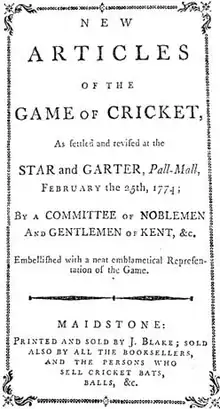
Image 7New articles of the game of cricket, 25 February 1774 (from Laws of Cricket)
Image 8Broadhalfpenny Down, the location of the first First Class match in 1772 is still played on today (from History of cricket)
Image 9A Game of Cricket at The Royal Academy Club in Marylebone Fields, now Regent's Park, depiction by unknown artist, c. 1790–1799 (from History of cricket)
Image 10A wicket consists of three stumps, upright wooden poles that are hammered into the ground, topped with two wooden crosspieces, known as the bails. (from Laws of Cricket)
Did you know
... that Coleraine Cricket Club once became champions of the North West Cricket Union Premiership by default after their nearest competitors went on holiday?
The International Cricket Council (ICC) is the international governing body of cricket, and produces team rankings for the various forms of cricket played internationally.
Test cricket is the longest form of cricket, played up to a maximum of five days with two innings per side.
Matches is the number of matches played in the 12–24 months since the May before last, plus half the number in the 24 months before that. See points calculations for more details.


.jpg.webp)
.jpg.webp)


.jpg.webp)


_-_Google_Art_Project.jpg.webp)


.svg.png.webp)


.svg.png.webp)


.svg.png.webp)


.svg.png.webp)


.svg.png.webp)