Portal:Aviation

| Main page | Categories & Main topics | Tasks and Projects |
The Aviation Portal

Aviation includes the activities surrounding mechanical flight and the aircraft industry. Aircraft includes fixed-wing and rotary-wing types, morphable wings, wing-less lifting bodies, as well as lighter-than-air craft such as hot air balloons and airships.
Aviation began in the 18th century with the development of the hot air balloon, an apparatus capable of atmospheric displacement through buoyancy. Some of the most significant advancements in aviation technology came with the controlled gliding flying of Otto Lilienthal in 1896; then a large step in significance came with the construction of the first powered airplane by the Wright brothers in the early 1900s. Since that time, aviation has been technologically revolutionized by the introduction of the jet which permitted a major form of transport throughout the world. (Full article...)
Selected article

The plane crashed in a field just outside Shanksville, Pennsylvania, about 150 miles (240 km) northwest of Washington, D.C., killing all 44 people aboard, including the hijackers. Many witnessed the impact from the ground and news agencies began reporting on the event within an hour. The plane fragmented upon impact, leaving a crater, and some debris was blown miles from the crash site. The remains of everyone on board the aircraft were later identified. Subsequent analysis of the flight recorders revealed how the actions taken by the passengers prevented the aircraft from reaching either the White House or United States Capitol. A permanent memorial is planned for construction on the crash site. The chosen design has been the source of criticism and is scheduled to be dedicated in 2011. (Full article...)
Selected image

Did you know
...that in the late 1940s the USAF Northrop YB-49 set both an unofficial endurance record and a transcontinental speed record? ...that the fighter pilot Aleksandr Kazakov destroyed 32 German and Austro-Hungarian planes during WWI, while his formal tally of 17 is explained by the fact that only planes crashed in the Russian-held territory were officially counted? ... that while flying accidents were commonplace at RAAF training establishments during World War II, No. 8 Service Flying Training School's first fatality was from drowning?
General images -
 Santos-Dumont's "Number 6" rounding the Eiffel Tower in the process of winning the Deutsch de la Meurthe Prize, October 1901. (from History of aviation)


 Jean-Marie Le Bris and his flying machine, Albatros II, 1868. (from History of aviation)
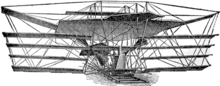 Maxim's flying machine (from History of aviation)
 Map of record breaking flights of the 1920s (from History of aviation)
 Concorde, G-BOAB, in storage at London Heathrow Airport following the end of all Concorde flying. This aircraft flew for 22,296 hours between its first flight in 1976 and final flight in 2000. (from History of aviation)
 Nieuport IV, operated by most of the world's air forces before WW1 for reconnaissance and bombing, including during the Italian-Turkish war. (from History of aviation)
 Me 262, world first operational jet fighter (from History of aviation)
.jpg.webp) "Map of Air Routes and Landing Places in Great Britain, as temporarily arranged by the Air Ministry for civilian flying", published in 1919, showing Hounslow, near London, as the hub (from History of aviation)
"Map of Air Routes and Landing Places in Great Britain, as temporarily arranged by the Air Ministry for civilian flying", published in 1919, showing Hounslow, near London, as the hub (from History of aviation) Otto Lilienthal, 29 May 1895. (from History of aviation)
.png.webp) Woodcut print of a kite from John Bate's 1635 book The Mysteryes of Nature and Art. (from History of aviation)
Woodcut print of a kite from John Bate's 1635 book The Mysteryes of Nature and Art. (from History of aviation)
 Apollo 11 lifts off on its mission to land a man on the Moon (from History of aviation)

 The Biot-Massia glider, restored and on display in the Musee de l'Air. (from History of aviation)
 1928 issue of Popular Aviation (now Flying magazine), which became the largest aviation magazine with a circulation of 100,000. (from History of aviation)
 One of Leonardo's sketches (from History of aviation)
.jpg.webp) A narrow-body Boeing 737 of Lufthansa in front of a wide-body Boeing 777 of Emirates (from Wide-body aircraft)
A narrow-body Boeing 737 of Lufthansa in front of a wide-body Boeing 777 of Emirates (from Wide-body aircraft)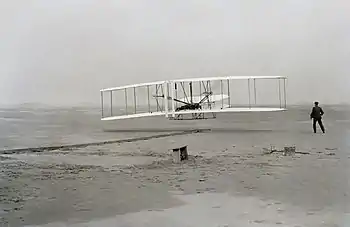 The Wright Flyer: the first sustained flight with a powered, controlled aircraft. (from History of aviation)
.jpg.webp) 1843 artist's impression of John Stringfellow's plane Ariel flying over the Nile (from History of aviation)
1843 artist's impression of John Stringfellow's plane Ariel flying over the Nile (from History of aviation)
 D.H. Comet, the world's first jet airliner. As in this picture, it also saw RAF service (from History of aviation)
.jpg.webp) Alberto Santos-Dumont flying the Demoiselle over Paris (from History of aviation)
Alberto Santos-Dumont flying the Demoiselle over Paris (from History of aviation).jpg.webp)
 The Wright Military Flyer aboard a wagon in 1908. (from History of aviation)
 French reconnaissance balloon L'Intrépide of 1796, the oldest existing flying device, in the Heeresgeschichtliches Museum, Vienna. (from History of aviation)
 Early Voisin biplane (from History of aviation)
 The business class cabin on an A350 (from Wide-body aircraft)
 Qantas De Havilland biplane, c. 1930 (from History of aviation)
 "Governable parachute" design of 1852 (from History of aviation)
 Paul Cornu's helicopter, built in 1907, was the first manned flying machine to have risen from the ground using rotating wings instead of fixed wings. (from History of aviation)
.jpg.webp) Clément Ader Avion III (1897 photograph). (from History of aviation)
Clément Ader Avion III (1897 photograph). (from History of aviation) The 14-bis, or Oiseau de proie. (from History of aviation)
 An Airbus A300's cross-section, showing cargo, passenger, and overhead areas (from Wide-body aircraft)
 The Aeroplane of Victor Tatin, 1879. (from History of aviation)
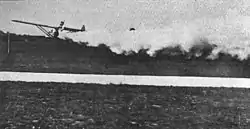 Opel RAK.1 - World's first public flight of a manned rocket-powered plane on 30 September 1929 (from History of aviation)
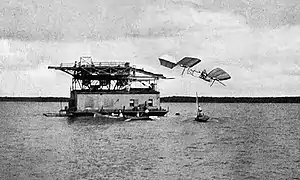 First failure of Langley's manned Aerodrome on the Potomac River, 7 October 1903 (from History of aviation)
 A cross-section comparison of Airbus A380 (double-deck the full length) and Boeing 747-400 (double-deck only in the front section) (from Wide-body aircraft)
%252C_Netherlands_PP1151411024_(cropped).jpg.webp) Three widebodies: KLM's Airbus A330 twinjet, McDonnell Douglas MD-11 trijet and Boeing 747-400 quadjet (from Wide-body aircraft)
Three widebodies: KLM's Airbus A330 twinjet, McDonnell Douglas MD-11 trijet and Boeing 747-400 quadjet (from Wide-body aircraft).jpg.webp) The 1884 Krebs & Renard first fully controllable free-flights with the LA FRANCE electric dirigible near Paris (Krebs arch.) (from History of aviation)
The 1884 Krebs & Renard first fully controllable free-flights with the LA FRANCE electric dirigible near Paris (Krebs arch.) (from History of aviation) Flagg biplane from 1933 (from History of aviation)
 Planophore model aeroplane by Alphonse Pénaud, 1871 (from History of aviation)
In the news

- May 29: Austrian Airlines cancels Moscow-bound flight after Russia refuses a reroute outside Belarusian airspace
- August 8: Passenger flight crashes upon landing at Calicut airport in India
- June 4: Power firm helicopter strikes cables, crashes near Fairfield, California
- January 29: Former basketball player Kobe Bryant dies in helicopter crash, aged 41
- January 13: Iran admits downing Ukrainian jet, cites 'human error'
- January 10: Fire erupts in parking structure at Sola Airport, Norway
- October 27: US announces restrictions on flying to Cuba
- October 3: World War II era plane crashes in Connecticut, US, killing at least seven
- September 10: Nevada prop plane crash near Las Vegas leaves two dead, three injured
- August 6: French inventor Franky Zapata successfully crosses English Channel on jet-powered hoverboard
Related portals
Associated Wikimedia
The following Wikimedia Foundation sister projects provide more on this subject:
-
 Commons
Free media repository -
 Wikibooks
Free textbooks and manuals -
 Wikidata
Free knowledge base -
Wikinews
Free-content news -
 Wikiquote
Collection of quotations -
 Wikisource
Free-content library -
 Wikiversity
Free learning tools -
 Wikivoyage
Free travel guide -
 Wiktionary
Dictionary and thesaurus
Selected biography

Foulois conducted the acceptance test for the Army's first aircraft, a Wright Model A, in 1909. He participated in the Mexican Expedition from 1916–17 and was part of the American Expeditionary Force in France during World War I where he was responsible for the logistics and maintenance of the U.S. air fleet. During World War I he and Billy Mitchell began a long and hostile relationship over the direction of military aviation and the best method to get there. After the war he served as a military attaché to Germany where he gathered a great deal of intelligence on German aviation. He later went on to command the 1st Aero Squadron and ultimately commanded the Air Corps.
He retired in 1935 as part of the fallout from the Air Mail scandal. Foulois continued to advocate for a strong air service in retirement. In 1959, at the invitation of the Chief of Staff of the Air Force, Foulois began touring Air Force bases advocating national security. He died of a heart attack on 25 April 1967 and is buried in his home town of Washington, Connecticut.
Selected Aircraft

The Boeing 747 is a widebody commercial airliner, often referred to by the nickname Jumbo Jet. It is among the world's most recognizable aircraft, and was the first widebody ever produced. Manufactured by Boeing's Commercial Airplane unit in the United States, the original version of the 747 was two and a half times the size of the Boeing 707, one of the common large commercial aircraft of the 1960s. First flown commercially in 1970, the 747 held the passenger capacity record for 37 years.
The four-engine 747 uses a double deck configuration for part of its length. It is available in passenger, freighter and other versions. Boeing designed the 747's hump-like upper deck to serve as a first class lounge or (as is the general rule today) extra seating, and to allow the aircraft to be easily converted to a cargo carrier by removing seats and installing a front cargo door. Boeing did so because the company expected supersonic airliners (whose development was announced in the early 1960s) to render the 747 and other subsonic airliners obsolete; while believing that the demand for subsonic cargo aircraft would be robust into the future. The 747 in particular was expected to become obsolete after 400 were sold but it exceeded its critics' expectations with production passing the 1,000 mark in 1993. As of June 2009, 1,416 aircraft have been built, with 107 more in various configurations remaining on order.
The 747-400, the latest version in service, is among the fastest airliners in service with a high-subsonic cruise speed of Mach 0.85 (567 mph or 913 km/h). It has an intercontinental range of 7,260 nautical miles (13,450 km; 8,350 mi). The 747-400 passenger version can accommodate 416 passengers in a typical three-class layout or 524 passengers in a typical two-class layout. The next version of the aircraft, the 747-8, is in production and scheduled to enter service in 2010. The 747 is to be replaced by the Boeing Y3 (part of the Boeing Yellowstone Project) in the future.
Today in Aviation
- 2013 – Widespread Syrian airstrikes against rebel forces in seven cities and regions kill at least 20 people.[1]
- 2011 – Unaware that Libyan rebels had taken possession of any tanks, North Atlantic Treaty Organization (NATO) aircraft mistakenly strike a Libyan rebel tank convoy near Ajdabiya, killing thirteen and wounding many,[2][3] Other NATO airstrikes mistakenly kill two rebels and wound 10 in Brega.[4][5]
- 2010 – United Airlines Flight 663 incident was a "minor international incident" in 2010 involving a Qatari diplomat on the leg of a United Airlines flight from Ronald Reagan Washington National Airport (Washington, DC) to Denver International Airport (Denver, Colorado). The diplomat prompted a mid-air terrorism alert after smoking in the airplane lavatory, which led the Qatari government to recall him two days later.
- 2009 – A Philippine Air Force Bell 412 helicopter crashes in bad weather in a heavily forested area at Mount Mangingihe, Sitio Tawangan, Kabayan, Benguet, Philippines. The helicopter was travelling from Loakan Airport to Ifugao in the Cordillera Administrative Region in Luzon when it crashed killing the 3 crew and 5 government officials.
- 2006 – First Fight: First free-flight of Boeing X-37
- 2004 – OH-58D Kiowa crashes near Baquba after being hit by ground fire; pilots rescued.
- 2003 – F-15E 88-1694/SJ of 4th FW/335th FS crashed on a combat bombing mission near Tikrit, Iraq. Both the pilot and Weapon Systems Officer (WSO) were killed.[6][7][8]
- 2001 – The robotic spacecraft Odyssey launches on its mission to orbit Mars, arriving at the planet the following October. The craft later collects data that would guess water to be on the plant. This is later confirmed by the Phoenix lander in July of 2008.
- 1999 – A Boeing KC-135R-BN Stratotanker, 57-1478, c/n 17549, of the 151st Air Refueling Squadron, Tennessee Air National Guard, is written off while undergoing maintenance at the Oklahoma ALC, Tinker AFB, Oklahoma, when the cabin is over-pressurized during a test and ruptures, tearing a 35 foot (10.6 m) hole in the aft fuselage, allowing tail section to drop to the ground.
- 1994 – TAAG Angola L-100 (C-130) D2-THC catches fire while taxiing to a parking spot due to overheated brakes in Malengue, Angola. All 4 occupants escaped unharmed.
- 1994 – Federal Express Flight 705, a McDonnell Douglas DC-10-30, experiences an attempted hijacking by a FedEx employee; the three crew members are severely injured, but manage to subdue the attacker and land the aircraft safely with no loss of life.
- 1992 – Azerbaijan Airlines were established.
- 1983 – STS-6, using space Shuttle Challenger, launches. The mission is the first perform to a spacewalk.
- 1972 – Both CF Bomarc SAM Squadrons closed.
- 1972 – American aircraft resume regular bombing of North Vietnam in response to the North Vietnamese "Easter Offensive" invasion of South Vietnam.
- 1969 – Mitsubishi-assembled, from Sikorsky components, Sikorsky HSS-1N Seabat, 8567, c/n 58-1528, of the Japanese Maritime Self-Defense Force, crashes this date, the sole loss of the type during Japanese service.
- 1967 – (7-22) The U. S. Army's first Cavalry Division (Airmobile) conducts Operation Lejeune, a helicopter and ground assault against Viet Cong forces in Quang Ngai Province, South Vietnam.
- 1967 – First flight of the Aérospatiale Gazelle.
- 1961 – Boeing B-52B-30-BO Stratofortress, 53-0380, c/n 16859, "Ciudad Juarez", of the 95th Bomb Wing, Biggs AFB, Texas, shot down by inadvertent launch of AIM-9 Sidewinder from a 188th Fighter Interceptor Squadron, New Mexico ANG North American F-100A-20-NA Super Sabre, 53-1662. Two F-100s, piloted by 1st Lt. James W. van Sycoc and Capt. Dale Dodd, had made five passes at the bomber when, on the sixth pass, pilot 1st Lt. van Sycoc radioed "Look out! One of my missiles is loose!" The heat-seeker missile struck one of the BUFF's engine pods on the port wing causing failure of the wing structure, and subsequent break-up of the bomber. Pilot, co-pilot, crew chief and tail gunner successfully eject, but three other crew are KWF when the B-52 crashed on Mount Taylor, New Mexico.
- 1961 – Moisture condensing in a connector plug causes a GAR-8 Sidewinder air-to-air missile carried by a New Mexico Air National Guard F-100A Super Sabre of the 188th Fighter Interceptor Squadron to fire accidentally while the F-100A is practicing bomber interception tactics against the U.S. Air Force B-52B Stratofortress Ciudad Juarez of the Strategic Air Command's 95th Bombardment Wing. The missile blows off the B-52B's port wing, and the bomber crashes on Mount Taylor in New Mexico, killing three members of its crew.[9]
- 1958 – AREA Ecuador Flight 222, a Douglas C-47 (DC-3) registered HC-ACL, crashes into a Chugchilan range of mountains after not maintaining the proper heading, resulting the fatalities of all 32 aboard.
- 1957 – A Varig Curtiss C-46 Commando (PP-VCF) crashes shortly after takeoff due to a fire in the left main gear wheel well. The pilot thought it was one of the engines, and shut it down unnecessarily. A go-around during a landing attempt when the gear doesn’t drop (due to the fire), allows more time for the fire to spread, leading to the left wing separating from the aircraft after the metal fatigue. All 40 aboard the aircraft perish.
- 1956 – USAF Douglas C-124C-DL Globemaster II, 52-1078, c/n 43987, of the 1501st Air Transport Wing, crashes just after takeoff from Travis AFB, California, killing three of the seven crew on board. Aircraft stalled at 100 feet, dropped one wing and plunged to the ground just SW of the base. Airframe splits into three sections, burns. The cause is attributed to incorrect assembly of the elevator and aileron control cables.
- 1950 – ASole prototype, Nord NC 1080 single-engine naval fighter, F-WFKZ, first flown 29 July 1949, is completely destroyed in a flight accident. Pilot Pierre Gallay dies in the accident. Cause is never determined and the project is abandoned.
- 1948 – The Royal Canadian Navy’s aircraft carrier, HMCS Magnificent, was commissioned to replace HMCS Warrior.
- 1945 – Accompanying B-29 Superfortresses, P-51 Mustangs of the U. S. Army Air Forces’ 15th, 21st, and 506th Fighter Groups based on Iwo Jima become the first Allied fighters to escort bombers all the way to Tokyo, Japan, and back. The escort flights last seven to eight hours. Fifty-four B-29 s land on Iwo Jima during the day.
- 1945 – 386 carrier aircraft of Task Force 58 attack an Imperial Japanese Navy task force bound for Okinawa while it is steaming in the East China Sea, sinking the battleship Yamato, the light cruiser Yahagi, and four of their eight escorting destroyers. It ends the last offensive sortie by Japanese surface ships of World War II.
- 1945 – The P-51 s flew for their first mission to Japan. The were escorted by the B-29.
- 1941 – Entered Service: Douglas Havoc night fighter with No. 85 Squadron, Royal Air Force
- 1940 – Entered Service: Amiot 354
- 1936 – TWA Flight 1, a Douglas DC-2, crashes near Uniontown, Pennsylvania due to pilot error, killing 12 of the 14 passengers and crew aboard.
- 1924 – Portuguese Commander Brito Pais and Captain Sarmento de Beires depart Lisbon eastbound in the Breguet 16.Bn2 Patria, beginning an attempt to fly around the world. They will crash Patria in India, but will continue in the de Havilland DH.9 A Patria II before being forced to end their attempt in June in Macau.
- 1922 – A Daimler Airways de Havilland DH.18 collides with a Cie des Cgrands Express Aériens Farman Goliath over France. A total of seven people – Everyone aboard the two aircraft – Is killed in the first mid-air collision of two airliners.
- 1922 – In the first mid-air collision of airliners, a Daimler Hire Ltd.-operated de Havilland DH.18 A, G-EAWO, collides with a Compagnie des Grands Express Aériens (CGEA)-operated Farman F.60 Goliath, F-GEAD, over the Thieulloy-St. Antoine road near Picardie, France, killing all seven people on both aircraft; the pilots of both machines were using the road as a route marker in bad weather and poor visibility
- 1922 – The United States’ Corps Observation Group makes its first patrol, becoming the first American aviation unit to enter action in Europe.
- 1908 – The members of the Aerial Experiment Association enter a competition sponsored by the Scientific American, which has offered $25,000 for a flight of over 0.62 miles. The Wrights refuse to enter because the rules state the airplane must take off without help.
- 1906 – Charles Rolls, in his new balloon, races Frank Hedges Butler and friends aboard the Aero Club III. Rolls outdistances his opponents, who come down at Wimbledon, while he lands at Beaconsfield, Buckinghamshire, England.
References
- Surk, Barbara, "Syria Airstrikes Launched By Regime, Rebels Warned Via Text Message," April 7, 2013, 2:52 p.m. EDT
- Staff (7 April 2011). "Libyan Rebels Near Ajdabiya 'Killed in Nato Air Strike'". BBC News. Retrieved 9 April 2011.
- "Neue Gaddafi-Taktik erschwert Angriffe der Nato" [Gaddafi makes new tactics of NATO attacks]. Der Spiegel (in German). 4 April 2011. Retrieved 16 October 2011.
- "Libya: Nato Airstrike 'Kills Rebels in Brega'". The Daily Telegraph. 7 April 2011. Retrieved 11 June 2011.
- Staff (8 April 2011). "NATO Confirms Its Planes Struck Libyan Rebels". Associated Press (via Fox News). Retrieved 9 April 2011.
- Marcel van Leeuwen (2008-12-21). "Boeing F-15 'Eagle'". zap16.com. Retrieved 2010-05-12.
USAF F-15C/D's from Al Jaber AB, Kuwait and F-15C/D from Prince Sultan AB, Saudi Arabia flew together with F-15E Strike Eagles combat-missions in Iraq. One F-15E (88-1694/SJ) of 333rd FS, 4th FW from Seymour Johnson AFB, NC was shot-down near Tikrit in Iraq on 6 April 2003, the pilots were Killed in Action.
- "Eric Das". Retrieved 2010-05-12.
Air Force Maj. William Watkins and Capt. Eric Das, were aboard an F-15E Strike Eagle jet fighter that went down in Iraq around 7:30 p.m. EDT Sunday, April 6
- "DOD IDENTIFIES AIR FORCE CASUALTY" (Press release). United States Department of Defense. 2003-04-23. Retrieved 2010-05-12.
The Department of Defense announced today that Major William R. Watkins III, 37, of Danville, Virginia, was killed in action April 7, 2003, while supporting Operation Iraqi Freedom. Watkins was assigned to the 333rd Fighter Squadron, Seymour Johnson Air Force Base, North Carolina. Watkins was the weapons system officer of an F-15E that went down April 7, 2003, during a combat mission in Iraq. The incident remains under investigation. The pilot of the F-15E, Captain Eric B. Das, was also killed when the aircraft went down.
- Hollway, Don, "'One of My Missiles is Loose!'", Aviation History, March 2013, p. 60.
- Shortcuts to this page: Portal:Airplanes • P:AVIA