Portal:Arthropods

The Arthropods PortalExamples of the five arthropod subphyla Arthropods (/ˈɑːrθrəpɒd/, from Ancient Greek ἄρθρον (arthron) 'joint', and πούς (pous) 'foot' (gen. ποδός)) are invertebrate animals with an exoskeleton, a segmented body, and paired jointed appendages. Arthropods form the phylum Arthropoda. They are distinguished by their jointed limbs and cuticle made of chitin, often mineralised with calcium carbonate. The arthropod body plan consists of segments, each with a pair of appendages. Arthropods are bilaterally symmetrical and their body possesses an external skeleton. In order to keep growing, they must go through stages of moulting, a process by which they shed their exoskeleton to reveal a new one. Some species have wings. They are an extremely diverse group, with up to 10 million species. The evolutionary ancestry of arthropods dates back to the Cambrian period. The group is generally regarded as monophyletic, and many analyses support the placement of arthropods with cycloneuralians (or their constituent clades) in a superphylum Ecdysozoa. Overall, however, the basal relationships of animals are not yet well resolved. Likewise, the relationships between various arthropod groups are still actively debated. Today, Arthropods contribute to the human food supply both directly as food, and more importantly, indirectly as pollinators of crops. Some species are known to spread severe disease to humans, livestock, and crops. (Full article...)
| ||||||||||||||||||||||||||


.jpg.webp)

 Restoration of the pretelson and telson of H. suecicus, showing the cercal blades, following Kjellesvig-Waering (1979) |
Holmipterus is a problematic genus of eurypterid, an extinct group of aquatic arthropods. The type and only species of Holmipterus, H. suecicus, is known from deposits of Middle Silurian age in the Sweden. The generic name honours Gerhard Holm, a renowned Swedish palaeontologist specialising in arthropods and crustaceans, and the species name suecicus is Latin for 'Swedish'.
Although Holmipterus was a large eurypterid and is known from multiple, albeit partial and fragmentary, specimens, it has proven difficult to determine where it fits in the eurypterid family tree. This is due to the fossil material referred to Holmipterus combining traits seen in different eurypterid groups, such as the Carcinosomatidae and Megalograptidae, and has some distinctive features, such as a telson (the posteriormost division of the body) with two articulating 'cercal blades', forming an organ capable of grasping. Though often classified either as a carcinosomatid or megalograptid, Holmipterus has also been classified as a genus of uncertain affinity within the Eurypterina suborder, or within the entire Eurypterida order. It is possible that the original 1979 description of Holmipterus suecicus reconstructed the telson inaccurately, and/or mistakenly combined fossil material actually belonging to two different genera. (Full article...)

.jpg.webp) Close up head detail of M. nigrocincta |
Myrmecia nigrocincta, commonly known as the jumper ant or jumping jack, is an ant of the genus Myrmecia. The species was first described by Frederick Smith in 1858. Colonies of this ant are abundant in eastern Australia. Ants of this species are known for their ability to jump up to 10 centimetres, and they also have a powerful, venomous sting. Rather than foraging on the ground, M. nigrocincta prefer to forage in trees where they are known to pollinate certain flowers.
This ant is a large species, some workers can grow to over 15 mm (0.6 in) in length. They have a distinctive pattern of orange-red and black which distinguishes them from other Myrmecia species. M. nigrocincta possess the gamergates gene which allows workers to reproduce, either in the presence of a queen or in a colony where the queen is missing. Life expectancy of a worker ant is over one year. They are known to enslave ants of other species as workers for their colony, and they are aggressive when attacking intruders. (Full article...)

Nephrops norvegicus, known variously as the Norway lobster, Dublin Bay prawn, shlobster (shrimp-lobster), langoustine (compare langostino) or scampi, is a slim, coral colored lobster which grows up to 25 cm (10 in) long, and is "the most important commercial crustacean in Europe". It is now the only extant species in the genus Nephrops, after several other species were moved to the closely related genus Metanephrops. It lives in the north-eastern Atlantic Ocean, and parts of the Mediterranean Sea, but is absent from the Baltic Sea and Black Sea. Adults emerge from their burrows at night to feed on worms and fish. (Full article...)

The coconut crab (Birgus latro) is a species of terrestrial hermit crab, also known as the robber crab or palm thief. It is the largest terrestrial arthropod in the world, with a weight of up to 4.1 kg (9 lb). It can grow to up to 1 m (3 ft 3 in) in width from the tip of one leg to the tip of another. It is found on islands across the Indian Ocean, and parts of the Pacific Ocean as far east as the Gambier Islands, Pitcairn Islands and Caroline Island, similar to the distribution of the coconut palm; it has been extirpated from most areas with a significant human population, including mainland Australia and Madagascar. Coconut crabs also live off the coast of Africa near Zanzibar.
The coconut crab is the only species of the genus Birgus, and is related to the other terrestrial hermit crabs of the genus Coenobita. It shows a number of adaptations to life on land. Juvenile coconut crabs use empty gastropod shells for protection like other hermit crabs, but the adults develop a tough exoskeleton on their abdomens and stop carrying a shell. Coconut crabs have organs known as branchiostegal lungs, which they use for breathing instead of their vestigial gills. After the juvenile stage, they will drown if immersed in water for too long. They have an acute sense of smell which they use to find potential food sources, and which has developed convergently with that of insects.
Adult coconut crabs feed primarily on fleshy fruits, nuts, seeds, and the pith of fallen trees, but they will eat carrion and other organic matter opportunistically. Anything left unattended on the ground is a potential source of food, which they will investigate and may carry away – thereby getting the alternative name of "robber crab". The species is popularly associated with the coconut palm, yet coconuts are not a significant part of its diet. Although it lives in a burrow, the crab has been filmed climbing coconut and pandanus trees. No film shows a crab selectively picking coconut fruit, though they might dislodge ripe fruit that otherwise would fall naturally. Climbing is an immediate escape route (if too far from the burrow) to avoid predation by large sea birds (when young) or by humans, or cannibalism (at any age) by bigger, older crabs. (Full article...)
 Fossil carapace and portions of the abdomen of R. vaningeni |
Rhinocarcinosoma is a genus of eurypterid, an extinct group of aquatic arthropods. Fossils of Rhinocarcinosoma have been discovered in deposits ranging of Late Silurian age in the United States, Canada and Vietnam. The genus contains three species, the American R. cicerops and R. vaningeni and the Vietnamese R. dosonensis. The generic name is derived from the related genus Carcinosoma, and the Greek ῥινός (rhinós, "nose"), referring to the unusual shovel-shaped protrusion on the front of the carapace (head plate) of Rhinocarcinosoma, its most distinctive feature.
Other than the protrusion, Rhinocarcinosoma was anatomically very similar to its close relative, Eusarcana, though it lacked the scorpion-like telson (the posteriormost division of the body) of that genus. Further distinguishing features include more slender appendages and slightly different ornamentation of scales. In terms of size, Rhinocarcinosoma was a medium-sized carcinosomatid eurypterid, with the largest species, R. vaningeni, reaching lengths of 39 centimetres (15.4 in). In contrast to other carcinosomatids, Rhinocarcinosoma is not known only from marine settings, but also from deposits that were once lakes or rivers. It was adapted to a bottom-dwelling lifestyle, as either a burrowing or digging scavenger or top predator, feeding on other invertebrates and small fish. (Full article...)
_(7686081848).jpg.webp)
Parasitoid wasps are a large group of hymenopteran superfamilies, with all but the wood wasps (Orussoidea) being in the wasp-waisted Apocrita. As parasitoids, they lay their eggs on or in the bodies of other arthropods, sooner or later causing the death of these hosts. Different species specialise in hosts from different insect orders, most often Lepidoptera, though some select beetles, flies, or bugs; the spider wasps (Pompilidae) exclusively attack spiders. More rarely, parasitoid wasps may use plant seeds as hosts, such as Torymus druparum.
Parasitoid wasp species differ in which host life-stage they attack: eggs, larvae, pupae, or adults. They mainly follow one of two major strategies within parasitism: either they are endoparasitic, developing inside the host, and koinobiont, allowing the host to continue to feed, develop, and moult; or they are ectoparasitic, developing outside the host, and idiobiont, paralysing the host immediately. Some endoparasitic wasps of the superfamily Ichneumonoidea have a mutualistic relationship with polydnaviruses, the viruses suppressing the host's immune defenses.
Parasitoidism evolved only once in the Hymenoptera, during the Permian, leading to a single clade, but the parasitic lifestyle has secondarily been lost several times including among the ants, bees, and yellowjacket wasps. As a result, the order Hymenoptera contains many families of parasitoids, intermixed with non-parasitoid groups. The parasitoid wasps include some very large groups, some estimates giving the Chalcidoidea as many as 500,000 species, the Ichneumonidae 100,000 species, and the Braconidae up to 50,000 species.
Host insects have evolved a range of defences against parasitoid wasps, including hiding, wriggling, and camouflage markings. (Full article...)
 Scorpiones |
Scorpions are predatory arachnids of the order Scorpiones. They have eight legs, and are easily recognized by a pair of grasping pincers and a narrow, segmented tail, often carried in a characteristic forward curve over the back and always ending with a stinger. The evolutionary history of scorpions goes back 435 million years. They mainly live in deserts but have adapted to a wide range of environmental conditions, and can be found on all continents except Antarctica. There are over 2,500 described species, with 22 extant (living) families recognized to date. Their taxonomy is being revised to account for 21st-century genomic studies.
Scorpions primarily prey on insects and other invertebrates, but some species hunt vertebrates. They use their pincers to restrain and kill prey, or to prevent their own predation. The venomous sting is used for offense and defense. During courtship, the male and female grasp each other's pincers and dance while he tries to move her onto his sperm packet. All known species give live birth and the female cares for the young as their exoskeletons harden, transporting them on her back. The exoskeleton contains fluorescent chemicals and glows under ultraviolet light.
The vast majority of species do not seriously threaten humans, and healthy adults usually do not need medical treatment after a sting. About 25 species (fewer than one percent) have venom capable of killing a human, which happens frequently in the parts of the world where they live, primarily where access to medical treatment is unlikely. (Full article...)
 Worker with cocoon |
The banded sugar ant (Camponotus consobrinus), also known as the sugar ant, is a species of ant native to Australia. A member of the genus Camponotus in the subfamily Formicinae, it was described by German entomologist Wilhelm Ferdinand Erichson in 1842. Its common name refers to the ant's liking for sugar and sweet food, as well as the distinctive orange-brown band that wraps around its gaster.
The ant is polymorphic and relatively large, with two different castes of workers: major workers (also known as soldiers), and minor workers. These two group of workers measure around 5 to 15 millimetres (0.2 to 0.6 in) in length, while the queen ants are even larger. Mainly nocturnal, banded sugar ants prefer a mesic habitat, and are commonly found in forests and woodlands. They also occur in urban areas, where they are considered a household pest. The ant's diet includes sweet secretions that are retrieved from aphids and other insects that it tends. This species is a competitor of the meat ant (Iridomyrmex purpureus), and food robbery and nest-plugging is known to occur between these two ants. Workers prey on insects, killing them with a spray of formic acid. Banded sugar ants are preyed upon by other ants, echidnas, and birds. The eggs of this species were consumed by Indigenous Australians. (Full article...)
 B. clavata holotype |
Brownimecia is an extinct genus of ants, the only genus in the tribe Brownimeciini and subfamily Brownimeciinae of the Formicidae. Fossils of the single identified species, Brownimecia clavata, are known from the Middle Cretaceous of North America. The genus is one of several ants described from Middle Cretaceous ambers of New Jersey. Brownimecia was initially placed in the subfamily Ponerinae, until it was transferred to its own subfamily in 2003; it can be distinguished from other ants due to its unusual sickle-like mandibles and other morphological features that makes this ant unique among the Formicidae. The ant is also small, measuring 3.43 millimetres (0.135 in), and a stinger is present in almost all of the specimens collected. The morphology of the mandibles suggest a high level of feeding specialization. (Full article...)
 Zigrasimecia hoelldobleri worker |
Zigrasimecia is an extinct genus of ants which existed in the Cretaceous period approximately 98 million years ago. The first specimens were collected from Burmese amber in Kachin State, 100 kilometres (62 mi) west of Myitkyina town in Myanmar. In 2013, palaeoentomologists Phillip Barden and David Grimaldi published a paper describing and naming Zigrasimecia tonsora. They described a dealate female with unusual features, notably the highly specialized mandibles. Other features include large ocelli, short scapes, 12 antennomeres, small eyes, and a clypeal margin that has a row of peg-like denticles. The genus Zigrasimecia was originally incertae sedis (uncertain placement) within Formicidae until a second species, Zigrasimecia ferox, was described in 2014, leading to its placement in the subfamily Sphecomyrminae. Later, it was considered to belong to the distinct subfamily Zigrasimeciinae.
Due to the highly specialized mandibles, scientists believe that the ants exhibited habits no longer seen in extant ants. The highly movable head suggests that mobility was an important factor for them (probably for feeding behavior), and the rugose projections may have played a major role in nest excavation because the mandibles would have prevented such activity. Zigrasimecia most likely interacted with the extinct ant genus Gerontoformica through conflict and probably shared some of their ecological niches. The mandibles of these ants were probably used for mechanical interactions with food, and they may also have served as traps for potential arthropod prey such as mites and small flies. Zigrasimecia was possibly a generalist predator. (Full article...)
 Eucteniza relata, female (top) and male |
Eucteniza ( /juːktəˈnaɪzə/ yook-tə-NY-zə) is a genus of trapdoor spiders in the family Euctenizidae containing at least 14 species occurring in Mexico and the southern United States. Species are distinguished by a softened rear portion of the carapace, and males possess large spines on the first two pairs of walking legs that are used to hold females during mating. Like other trapdoor spiders they create burrows with a hinged lid, from which they await passing insects and other arthropods to prey upon. Many species are known from only one or two localities, or from only male specimens. More species are expected to be discovered. Eucteniza is closely related to spiders of the genera Entychides and Neoapachella. (Full article...)
 Female common earwig, Forficula auricularia |
Earwigs make up the insect order Dermaptera. With about 2,000 species in 12 families, they are one of the smaller insect orders. Earwigs have characteristic cerci, a pair of forcep-like pincers on their abdomen, and membranous wings folded underneath short, rarely used forewings, hence the scientific order name, "skin wings". Some groups are tiny parasites on mammals and lack the typical pincers. Earwigs are found on all continents except Antarctica.
Earwigs are mostly nocturnal and often hide in small, moist crevices during the day, and are active at night, feeding on a wide variety of insects and plants. Damage to foliage, flowers, and various crops is commonly blamed on earwigs, especially the common earwig Forficula auricularia.
Earwigs have five molts in the year before they become adults. Many earwig species display maternal care, which is uncommon among insects. Female earwigs may care for their eggs, and even after they have hatched as nymphs will continue to watch over offspring until their second molt. As the nymphs molt, sexual dimorphism such as differences in pincer shapes begins to show. (Full article...)
 |
Coccinellidae (/ˌkɒksɪˈnɛlɪˌdiː/) is a widespread family of small beetles. They are commonly known as ladybugs in North America and ladybirds in Great Britain. Entomologists prefer the names ladybird beetles or lady beetles to avoid confusion with true bugs. Many of the species have conspicuous aposematic colours and patterns, such as red with black spots, that warn potential predators that they are distasteful.
The majority of the more than 6,000 described species are generally considered beneficial insects, because many prey on herbivorous hemipterans such as aphids or scale insects, which are agricultural pests. Many coccinellids lay their eggs directly in aphid and scale insect colonies, ensuring their larvae have an immediate food source. However, some species such as the herbivorous Mexican bean beetle are agricultural pests. (Full article...)
 Restoration of P. hamiltoni. |
Paleomerus is a genus of strabopid, a group of extinct arthropods. It has been found in deposits from the Cambrian period (Atdabanian epoch). It is classified in the family Strabopidae of the monotypic order Strabopida. It contains two species, P. hamiltoni from Sweden and P. makowskii from Poland. The generic name is composed by the Ancient Greek words παλαιός (palaiós), meaning "ancient", and μέρος (méros), meaning "part" (and therefore, "ancient part").
Paleomerus is one of the oldest arthropods, being sometimes interpreted as the model of the first arachnomorphs. It is part of the order Strabopida, a poorly known group closely related to the aglaspidids of uncertain affinities, often being ignored by researchers and authors due to the poor preservation and abundance of their fossils. It has been suggested that Paleomerus and the closely related Strabops could be synonymous with each other, since they differ only in the size of the telson (the posteriormost division of the body) and the position of the eyes. These two genera were originally deferred by a hypothetical twelfth segment in Paleomerus, but after the discovery and description of a fourth specimen of P. hamiltoni, it has been shown that this segment actually represents the tail of the animal. (Full article...)
 Silhouette Island and the neighboring islands |
Afrolychas braueri, commonly known as the Seychelles forest scorpion, is a species of scorpion in the family Buthidae. It is currently thought to survive only on Silhouette Island, Seychelles, although the species was historically found on two additional Seychellois islands. This scorpion lives in leaf litter in forests that are largely unaffected by invasive plant species. It is a small yellowish-brown scorpion with three prominent keels on the dorsal surface of its mesosoma, which distinguishes it from other scorpions. While not much is known about the Seychelles forest scorpion's ecology due to the paucity of sightings, it is known to rely solely on its venom to capture its prey and defend its young. Its venom is not dangerous to humans.
The Seychelles forest scorpion has only been observed a handful of times and as such is believed to live in very low population densities. It is listed as a critically endangered species by the International Union for Conservation of Nature and is one of the most endangered scorpion species in the world. It is thought to be primarily threatened by invasive plant species, particularly Cinnamomum verum, degrading its habitat. Its entire known range is protected by Silhouette National Park, and recent conservation efforts on the island include vegetation restoration and the removal of cinnamon. (Full article...)
Did you know ... ?

- ... that a typical Labia minor (pictured) is chocolate brown, up to 7 mm long, and is equipped with pincers?
- ... that the extinct parasitic wasp Metapelma archetypon is thought to have preyed upon wood-boring beetles?
- ... that the possibly extinct wall crab spider species Garcorops jadis was named for C. S. Lewis' Jadis, the White Witch?
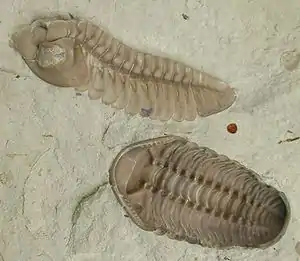
- ... that the extinct trilobite Bumastus was named after its resemblance to large grapes?
- ... that the larva of the Texas beetle, Brachypsectra fulva, can live for over two years without feeding?
- ... that the extinct mason bee species Anthidium exhumatum and Anthidium scudderi are known from the Eocene Florissant Formation in Colorado?
General images -
_-_Oberer_Brauner_Jura_-_Bissingen_unter_Teck.jpg.webp)
 A species of Scutigerella, a genus of Symphylan. (from Myriapoda)
 Eggs of Potamon fluviatile, a freshwater crab
 Decapods, from Ernst Haeckel's 1904 work Kunstformen der Natur (from Crustacean)
 Mature queen of a termite colony, showing how the unsclerotised cuticle stretches between the dark sclerites that failed to stretch as the abdomen grew to accommodate her ovaries (from Arthropod exoskeleton)
 Arthropleura armata, an arthropleuridean (from Myriapoda)
 This female Pandinus scorpion Has heavily sclerotised chelae, tail and dorsum, but has flexible lateral areas to allow for expansion when gravid (from Arthropod exoskeleton)
 Holotype of the xiphosuran Lunataspis aurora (from Chelicerata)
 Scolopendra cingulata, a centipede (from Myriapoda)
 Norway lobsters on sale at a Spanish market
.jpg.webp) Crab larva barely recognisable as a crab, radically changes its form when it undergoes ecdysis as it matures (from Arthropod exoskeleton)
Crab larva barely recognisable as a crab, radically changes its form when it undergoes ecdysis as it matures (from Arthropod exoskeleton)_crop.jpg.webp) A Eurypauropodid Pauropod. (from Myriapoda)
A Eurypauropodid Pauropod. (from Myriapoda) Tachypodoiulus niger, a millipede (from Myriapoda)
.jpg.webp) The whip spider Phrynichus phipsoni, with short chelicerae and large specialized pedipalps (from Chelicerata)
The whip spider Phrynichus phipsoni, with short chelicerae and large specialized pedipalps (from Chelicerata) Time series photos of a Tibicen Dog Day Cicada moulting in Ohio USA. (from Arthropod exoskeleton)
 Body structure of a typical crustacean – krill (from Crustacean)
 Ghost crab, showing a variety of integument types in its exoskeleton, with transparent biomineralization over the eyes, strong biomineralization over the pincers, and tough chitin fabric in the joints and the bristles on the legs (from Arthropod exoskeleton)
 Some of the various hypotheses of myriapod phylogeny. Morphological studies (trees a and b) support a sister grouping of Diplopoda and Pauropoda, while studies of DNA or amino acid similarities suggest a variety of different relationships, including the relationship of Pauropoda and Symphyla in tree c. (from Myriapoda)
 Formation of anterior segments across arthropod taxa based on gene expression and neuroanatomical observations, Note the chelicera(Ch) and chelifore(Chf) arose from somite 1 and thus correspond to the first antenna(An/An1) of other arthropods. (from Chelicerata)
 In honeypot ant repletes, the abdomens of the workers that hold the sugar solution grow vastly, but only the unsclerotised cuticle can stretch, leaving the unstretched sclerites as dark islands on the clear abdomen (from Arthropod exoskeleton)
 The house centipede Scutigera coleoptrata has rigid sclerites on each body segment. Supple chitin holds the sclerites together and connects the segments flexibly. Similar chitin connects the joints in the legs. Sclerotised tubular leg segments house the leg muscles, their nerves and attachments, leaving room for the passage of blood to and from the hemocoel (from Arthropod exoskeleton)
 Reconstruction of Mollisonia plenovenatrix, the oldest known arthropod with confirmed chelicerae (from Chelicerata)
 The head of an ant: Chitin reinforced with sclerotisation (from Arthropod exoskeleton)
 Zoea larva of the European lobster, Homarus gammarus
 Featured picture -
%252C_Las_Bachas%252C_isla_Santa_Cruz%252C_islas_Gal%C3%A1pagos%252C_Ecuador%252C_2015-07-23%252C_DD_30.jpg.webp) Photograph credit: Diego DelsoThe red rock crab (Grapsus grapsus), also known as "Sally Lightfoot", is one of the commonest crabs along the western seaboard of the Americas. John Steinbeck wrote of them, "Everyone who has seen them has been delighted with them ... These little crabs, with brilliant cloisonné carapaces, walk on their tiptoes, they have remarkable eyes and an extremely fast reaction time." He tried to catch them but to little avail. "If you walk slowly, they move slowly ahead of you in droves. If you hurry, they hurry. When you plunge at them, they seem to disappear in a puff of blue smoke."
Photograph credit: Diego DelsoThe red rock crab (Grapsus grapsus), also known as "Sally Lightfoot", is one of the commonest crabs along the western seaboard of the Americas. John Steinbeck wrote of them, "Everyone who has seen them has been delighted with them ... These little crabs, with brilliant cloisonné carapaces, walk on their tiptoes, they have remarkable eyes and an extremely fast reaction time." He tried to catch them but to little avail. "If you walk slowly, they move slowly ahead of you in droves. If you hurry, they hurry. When you plunge at them, they seem to disappear in a puff of blue smoke." Photo: JJ HarrisonThe head of a female Clynotis severus species of jumping spider. The eyes of a spider are called simple eyes (as opposed to compound eyes) because in each eye, a single lens collects and focuses light onto the retina. In this spider, the two largest eyes in the middle are the most acute. The remainder on the sides and on the top of its head are "secondary eyes".
 Mictyris longicarpusPhoto credit: liquidGhoulThe light blue soldier crab (Mictyris longicarpus) inhabits beaches in the Indo-Pacific region. Soldier crabs filter sand or mud for microorganisms. They congregate during the low tide, and bury themselves in a corkscrew pattern during high tide, or whenever they are threatened.
 Credit: Jens PetersenMantis shrimp (peacock mantis shrimp – Odontodactylus scyllarus – pictured) are marine crustaceans of the order Stomatopoda. They take their name from the physical resemblance to praying mantises and shrimp.
 Lithograph: Sidney Hall; restoration: Adam CuerdenA lithograph by Sidney Hall, published in Urania's Mirror, depicting the constellation Scorpius. One of the 48 constellations identified by the Greek astronomer Ptolemy in the second century, Scorpius lies between Libra to the west and Sagittarius to the east. It contains 18 main stars, the brightest of which is Antares. Although frequently identified as a scorpion, this constellation has also been likened to a "leaning coconut tree" (Java) or "Maui's fishhook" (Hawaii).
 Photograph: AlvesgasparAnthidium florentinum, a species of bee in the family Megachilidae. Bees are flying insects closely related to wasps and ants that are involved in pollination. There are nearly 20,000 known species of bees in seven recognized biological families. Bees are found on every continent except Antarctica, in every habitat on the planet that contains insect-pollinated flowering plants. Bees range in size from tiny stingless bee species whose workers are less than 2 millimetres (0.08 in) long, to Megachile pluto, whose females can attain a length of 39 millimetres (1.54 in).
 Photo: Lt. Elizabeth Crapo, NOAA CorpsThe red rock crab (Grapsus grapsus) is one of the most common crabs along the western coast of the Americas. Adults are quite variable in color, including brownish-red, mottled or spotted brown, pink, yellow, bright orange and red. It feeds on algae primarily, sometimes sampling other plant matter and dead animals.
 Credit: KarlRLonghorn beetles (Saperda carcharias pictured) are a cosmopolitan family of beetles, Cerambycidae, characterised by extremely long antennae. It is a large family, with over 20,000 described species; several are serious pests, with the larvae boring into wood.
 Photo credit: Fir0002An assassin bug belonging to the Reduviidae family of insects. A predatory insect so named because of its tendency to wait in ambush for its prey, the assassin bug uses its long rostrum to inject a lethal saliva that liquefies the internal structures of the prey, which are then sucked out.
.jpg.webp) Photo credit: Basile MorinXylotrupes socrates (Siamese rhinoceros beetle, or "fighting beetle"), male, on a banana leaf. This scarab beetle is particularly known for its role in insect fighting in Northern Laos and Thailand.
Photo credit: Basile MorinXylotrupes socrates (Siamese rhinoceros beetle, or "fighting beetle"), male, on a banana leaf. This scarab beetle is particularly known for its role in insect fighting in Northern Laos and Thailand. Photo credit: Fir0002A macro shot of the head of a dragonfly, focusing on its compound eyes. Dragonfly eyes have up to 30,000 facets; each one is a separate light-sensing organ or ommatidium, arranged to give nearly a 360° field of vision.
 Photograph: WaugsbergA honeycomb is a mass of hexagonal prismatic wax cells built by honey bees in their hives to contain their larvae and stores of honey and pollen. Honey bees consume about 8.4 lb (3.8 kg) of honey to secrete 1 lb (0.5 kg) of wax. As such, many beekeepers attempt to conserve honeycombs where possible.
.jpg.webp) Photo credit: Didier DescouensCaterpillar of Large white butterfly. Pieris brassicae is a butterfly in the family Pieridae. It is a close relative of the small white, Pieris rapae. The large white is common throughout Europe, North Africa and Asia.
Photo credit: Didier DescouensCaterpillar of Large white butterfly. Pieris brassicae is a butterfly in the family Pieridae. It is a close relative of the small white, Pieris rapae. The large white is common throughout Europe, North Africa and Asia..jpg.webp) Photo credit: André KarwathThe Ozyptila praticola species of crab spider is found throughout Europe and the Middle East. They do not build webs to trap prey, but are active hunters. Crab spiders are so named because of their first two pairs of legs, which are held out to the side giving them a crab-like appearance. Also, like crabs, these spiders move sideways and backwards more easily than forwards.
Photo credit: André KarwathThe Ozyptila praticola species of crab spider is found throughout Europe and the Middle East. They do not build webs to trap prey, but are active hunters. Crab spiders are so named because of their first two pairs of legs, which are held out to the side giving them a crab-like appearance. Also, like crabs, these spiders move sideways and backwards more easily than forwards. Photo credit: ChrumpsThe rose chafer (Cetonia aurata) is a reasonably large beetle (20 mm/¾ in long) that has metallic green coloration with a distinct V shaped scutellum, the small triangular area between the wing cases just below the thorax. Rose chafers are found over southern and central Europe and the southern part of the UK.
%252C_mating.jpg.webp) Photo credit: Tom FriedelTwo Eastern Lubber grasshoppers (Romalea guttata) mating. Native to the southeastern and south central portion of the United States, it is well known both for its size and its unique coloration. During reproduction, the male grasshopper introduces sperm into the ovipositor through its aedeagus (reproductive organ), and inserts its spermatophore, a package containing the sperm, into the female's ovipositor.
Photo credit: Tom FriedelTwo Eastern Lubber grasshoppers (Romalea guttata) mating. Native to the southeastern and south central portion of the United States, it is well known both for its size and its unique coloration. During reproduction, the male grasshopper introduces sperm into the ovipositor through its aedeagus (reproductive organ), and inserts its spermatophore, a package containing the sperm, into the female's ovipositor..jpg.webp) Photograph: Spongepuppy
Photograph: Spongepuppy_male_underside.jpg.webp) Photograph credit: Charles James SharpDanaus genutia, the common tiger or striped tiger, is a species of brush-footed butterfly found in Sri Lanka, India, Myanmar, south-eastern Asia and Australia. It prefers areas of moderate to heavy rainfall, and typical habitats include scrubby jungle, deciduous forests and fallow land near habitations. The insect sequesters toxins from plants, and advertises its unpalatability by having prominent markings and striking colour patterns. This adult male common tiger, of the subspecies D. g. genutia, was photographed in Kerala, India.
Photograph credit: Charles James SharpDanaus genutia, the common tiger or striped tiger, is a species of brush-footed butterfly found in Sri Lanka, India, Myanmar, south-eastern Asia and Australia. It prefers areas of moderate to heavy rainfall, and typical habitats include scrubby jungle, deciduous forests and fallow land near habitations. The insect sequesters toxins from plants, and advertises its unpalatability by having prominent markings and striking colour patterns. This adult male common tiger, of the subspecies D. g. genutia, was photographed in Kerala, India. Photograph credit: Jeevan JoseAttacus taprobanis is a species of moth in the family Saturniidae native to southern India and Sri Lanka. This adult male, photographed in Kadavoor, Kerala, developed from a larva feeding on a mahogany tree. When ready to pupate, the larva formed a papery cocoon 7.5 cm (3 in) long interwoven with a leaf; before doing this, the larva had attached the leaf to the stem with a silken thread and cut the leaf stalk. The colours of the dying leaf provided camouflage for the pupa, and the adult insect emerged some 24 days later.
 Credit: QuartlThe buffalo treehopper, Stictocephala bisonia (formerly Ceresa bisonia), is a species of treehopper native to North America. They use their piercing mouthparts to feed on the sap of plants including black locust, clover, elm, goldenrod and willow.
 Photo credit: Piccolo NamekThe orb-weaver spiders (family Araneidae) are the familiar builders of spiral wheel-shaped webs often found in gardens, fields and forests. The family is a large one, including over 2800 species in over 160 genera worldwide, making it the third largest known (behind Salticidae and Linyphiidae). The web has always been thought of as an engineering marvel.
 Photo: Richard BartzA macro view of a Gonia capitata fly feeding on honey, showing its proboscis and pedipalps (the two appendages protruding from the proboscis), two types of insect mouthparts. The proboscis actually comprises the labium, a quadrupedal structure, and a sponge-like labellum at the end. Flies eat solid food by secreting saliva and dabbing it over the food item. As the saliva dissolves the food, the solution is then drawn up into the mouth as a liquid. The labellum's surface is covered by minute food channels which form a tube leading to the esophagus, and food is drawn up the channels by capillary action.
.jpg.webp) Credit: Didier DescouensThe Atlantic horseshoe crab, Limulus polyphemus, is a marine chelicerate arthropod. It is most commonly found in the Gulf of Mexico and along the northern Atlantic coast of North America, with Delaware Bay a main area of annual migration.
Credit: Didier DescouensThe Atlantic horseshoe crab, Limulus polyphemus, is a marine chelicerate arthropod. It is most commonly found in the Gulf of Mexico and along the northern Atlantic coast of North America, with Delaware Bay a main area of annual migration.
Taxa
- Chelicerata: spider · Acari · Opiliones · pseudoscorpion · scorpion · Solifugae · sea spider · Schizomida · Amblypygi · Thelyphonida · Palpigradi · Ricinulei · Xiphosura · †Chasmataspidida · †Eurypterida
- Crustacea: Malacostraca (Decapoda – crab, lobster, hermit crab; Amphipoda; Isopoda; mantis shrimp) · Maxillopoda (barnacle; copepod) · Branchiopoda (fairy shrimp; Triops; Daphnia) · ostracod · Remipedia · Cephalocarida
- Hexapoda: Entognatha (springtail; Diplura; Protura) · insect (beetle; fly; bee; wasp; ant; butterfly; moth; cockroach; flea; louse; mayfly; dragonfly; damselfly; earwig; mantis)
- Myriapoda: centipede · millipede (pill millipede) · Pauropoda · Symphyla · †Arthropleuridea
- †Trilobite: †Agnostida · †Asaphida · †Corynexochida · †Harpetida · †Nectaspida · †Redlichiida · †Lichida · †Phacopida · †Proetida · †Ptychopariida
- † indicates an extinct taxon.
Topics
- Anatomy: antenna · arthropod exoskeleton · arthropod leg · arthropod eye · book lung · chelicerae · differences between butterflies and moths · gill · insect morphology · invertebrate trachea · Malpighian tubule system · mandible · rostrum · simple eye in invertebrates
- Study: arachnology · entomology · forensic entomology · glossary of entomology terms · lepidopterist · list of carcinologists · list of entomologists · myrmecology · timeline of entomology
- Development: crustacean larvae · ecdysis · exuvia
- As food: entomophagy · fried spider · crab fisheries · lobster fishing · shrimp paste
- Miscellaneous: arthropod bites and stings · beneficial insects · economic entomology · endangered arthropod · evolution of insects · insectivore
Related portals

Recognized content
Featured articles

Featured lists
Good articles
 Abantiades latipennis
- Andreacarus voalavo
- Archimyrmex
- Arthropod
- Avitomyrmex
- Bee
- Bees and toxic chemicals
- Black bean aphid
- Black-headed sugar ant
- Brownimecia
- Bumblebee
- Butterfly
- California spiny lobster
- Cancer pagurus
- Cape lobster
- Caprella mutica
- Carcinus maenas
- Chelicerata
- Chirocephalus diaphanus
- Cicada
- Coconut crab
- Colony collapse disorder
- Cricket (insect)
- Crustacean
- Cultural depictions of spiders
- Damselfly
- Dragonfly
- Dyspanopeus sayi
- Earwig
- Eucteniza
- External morphology of Lepidoptera
- Helicoverpa zea
- Hemigrapsus estellinensis
- Hemilepistus reaumuri
- Hemiptera
- Homarus gammarus
- Insect
- Insect wing
- Jack jumper ant
- Johngarthia lagostoma
- Katipo
- Lepidoptera
- Locust
- Lulworth skipper
- Macabeemyrma
- Maevia inclemens
- Malacostraca
- Megachile campanulae
- Metanephrops challengeri
- Mole cricket
- Myrmecia (ant)
- Myrmecia nigriceps
- Myrmecia nigrocincta
- Myrmeciites
- Mysida
- Neotrypaea californiensis
- Nephrops norvegicus
- Ochetellus
- Opabinia
- Phaeacius
- Phasmatodea
- Phengaris rebeli
- Polish cochineal
- Polistes exclamans
- Portia fimbriata
- Portia labiata
- Portia schultzi
- Potamon fluviatile
- Prionomyrmex
- Psylliodes luridipennis
- Ralph Vary Chamberlin
- Scyllarides latus
- Seychellum
- Sirex woodwasp
- Sphecius grandis
- Spider
- Tatuidris
- Termite
- Timema
- Trogloraptor
- Unicorn (spider)
- Waptia
- Wasp
- Worker policing
- Yantaromyrmex
- Ypresiomyrma
- Zygoballus sexpunctatus
Featured images
 Featured image set: butterfly wing magnifications
Full list of featured images |
|---|
|
Categories

WikiProjects

- WikiProject Tree of Life
- WikiProject Animals
- WikiProject Arthropods
- WikiProject Spiders
- WikiProject Insects
- WikiProject Lepidoptera
- WikiProject Arthropods
- WikiProject Animals
What are WikiProjects?
To do
 Here are some tasks you can do:
- Start a new article. Arthropods cover an huge range of taxa and other topics, so there will always be plenty of missing articles. Some which have been explicitly requested are listed here.
- Clean up existing articles. Lists of articles needing cleanup are available either grouped by the work needed or ungrouped.
- Expand an existing article. Existing articles are often incomplete and missing information on key aspects of the topic. It is particularly important that the most widely read articles be broad in their scope. Wikipedia:WikiProject Arthropods/Popular pages (updated monthly) shows the number of views each article gets, along with assessments of its quality and importance. Articles with higher importance ratings and greater numbers of views are the priority for article improvements, but almost all our articles would benefit from expansion. Stubs can be found in Category:Arthropod stubs and its subcategories.
Associated Wikimedia
The following Wikimedia Foundation sister projects provide more on this subject:
-
 Commons
Free media repository -
 Wikibooks
Free textbooks and manuals -
 Wikidata
Free knowledge base -
 Wikinews
Free-content news -
 Wikiquote
Collection of quotations -
 Wikisource
Free-content library -
 Wikispecies
Directory of species -
 Wikiversity
Free learning tools -
 Wikivoyage
Free travel guide -
 Wiktionary
Dictionary and thesaurus
-
 List of all portalsList of all portals
 -
 The arts portal
 -
 Biography portal
 -
 Current events portal
 -
 Geography portal
 -
 History portal
 -
 Mathematics portal
 -
 Science portal
 -
 Society portal
 -
 Technology portal
 -
 Random portalRandom portal
 -
 WikiProject PortalsWikiProject Portals