List of birds of Ireland
The avifauna of Ireland included a total of 522 species as of the end of 2019 according to the Irish Rare Birds Committee (IRBC).[1] Of them, 183 are rare, and 14 of the rarities have not been seen in Ireland since 1950. Three species were either introduced to Ireland or came to Ireland from another introduced population.


Ireland has a relatively low diversity of breeding birds due to its isolation. Several species such as the tawny owl, Eurasian nuthatch and willow tit which breed in Great Britain have not been recorded. However, there are large colonies of seabirds including important populations of European storm-petrels, northern gannets, and roseate terns. Other notable breeding birds include corn crakes and red-billed choughs. There are no endemic species but there are endemic subspecies of white-throated dipper, coal tit, and Eurasian jay.
Large numbers of wildfowl and waders winter in Ireland, attracted by its mild climate. About half the world population of the Greenland race of greater white-fronted geese spend the winter there. During autumn, many migrating seabirds can be seen off the coasts including several species of skuas, shearwaters, and petrels. Ireland's westerly position means that North American birds are regularly recorded in autumn.
This list's taxonomic treatment (designation and sequence of orders, families and species) and nomenclature (English and scientific names) are those of the International Ornithological Congress (IOC) as of July 2021.[2] Many of the Irish names are taken from the National Terminology Database for Irish.[3]
Population status symbols are those of the Red List published by the International Union for Conservation of Nature (IUCN).[4] Except for endemic species, the symbols apply to the species' worldwide status, not their status solely in Hawaii or the status of listed Hawaiian subspecies. The symbols and their meanings, in increasing order of peril, are:
LC = least concern NT = near threatened VU = vulnerable EN = endangered CR = critically endangered EW = extinct in the wild EX = extinct
Ducks, geese, swans


Order: Anseriformes Family: Anatidae
Anatidae includes the ducks and most duck-like waterfowl, such as geese and swans. These birds are adapted to an aquatic existence with webbed feet, flattened bills, and feathers that are excellent at shedding water due to an oily coating.
| Common name | Binomial | Irish name | Status |
|---|---|---|---|
| Brant goose | Branta bernicla | Cadhan | LC |
| Canada goose | Branta canadensis | Gé cheanadach | Introduced |
| Barnacle goose | Branta leucopsis | Gé ghiúrainn / cadhan | LC |
| Greylag goose | Anser anser | Crann-ghé / gé mhór fhionn / gé ghlas | LC |
| Pink-footed goose | Anser brachyrhynchus | Gé ghobghearr | LC |
| Greater white-fronted goose | Anser albifrons | Gé bhánéadanach mhór | LC |
| Mute swan | Cygnus olor | Eala bhalbh | LC |
| Tundra swan | Cygnus columbianus | Eala thundra | LC |
| Whooper swan | Cygnus cygnus | Eala ghlórach | LC |
| Common shelduck | Tadorna tadorna | Seil-lacha | LC |
| Mandarin duck | Aix galericulata | Lacha mhandarin | Introduced |
| Northern shoveler | Spatula clypeata | Slapaire tuaisceartach | LC |
| Gadwall | Mareca strepera | Gadual | LC |
| Eurasian wigeon | Mareca penelope | Rualacha | LC |
| Mallard | Anas platyrhynchos | Mallard[5] | LC |
| Northern pintail | Anas acuta | Biorearrach tuaisceartach | LC |
| Eurasian teal | Anas crecca | Praslacha ghlaseiteach | LC |
| Common pochard | Aythya ferina | Póiseard cíordhearg / lacha mhásach | VU |
| Tufted duck | Aythya fuligula | Lacha bhadánach | LC |
| Greater scaup | Aythya marila | Lacha iascán mór | LC |
| Common eider | Somateria mollissima | Éadar | NT |
| Common scoter | Melanitta nigra | Scótar / lacha scótarach | LC |
| Long-tailed duck | Clangula hyemalis | Lacha earrfhada | VU |
| Common goldeneye | Bucephala clangula | Órshúileach | LC |
| Common merganser | Mergus merganser | Síolta / tumaire | LC |
| Red-breasted merganser | Mergus serrator | Síolta rua | LC |
| Ruddy duck | Oxyura jamaicensis | Lachra rua | Introduced |
Pheasants and allies
.jpg.webp)
Order: Galliformes Family: Phasianidae
The Phasianidae are a family of terrestrial birds which consists of quails, partridges, snowcocks, francolins, spurfowls, tragopans, monals, pheasants, peafowls, and jungle fowls. In general, they are plump (although they vary in size) and have broad, relatively short wings.
| Common name | Binomial | Irish name | Status |
|---|---|---|---|
| Western capercaillie | Tetrao urogallus | Capall coille | EX |
| Willow ptarmigan | Lagopus lagopus | Tarmachan | LC |
| Grey partridge | Perdix perdix | Cearc coille | LC |
| Common quail | Coturnix coturnix | Gearg / gearraghuirt | LC |
| Common pheasant | Phasianus colchicus | Feasán mhuinceach | Introduced |
Nightjars
Order: Caprimulgiformes Family: Caprimulgidae
Nightjars are medium-sized nocturnal birds that usually nest on the ground. They have long wings, short legs, and very short bills. Most have small feet, of little use for walking, and long pointed wings. Their soft plumage is camouflaged to resemble bark or leaves.
| Common name | Binomial | Irish name | Status |
|---|---|---|---|
| European nightjar | Caprimulgus europaeus | Tuirne lín | LC |
Swifts

Order: Apodiformes Family: Apodidae
Swifts are small birds which spend the majority of their lives flying. These birds have very short legs and never settle voluntarily on the ground, perching instead only on vertical surfaces. Many swifts have long swept-back wings which resemble a crescent or boomerang.
| Common name | Binomial | Irish name | Status |
|---|---|---|---|
| Common swift | Apus apus | Gabhlán gaoithe | LC |
Cuckoos
_by_Tim_Peukert.jpg.webp)
Order: Cuculiformes Family: Cuculidae
The family Cuculidae includes cuckoos, roadrunners, and anis. These birds are of variable size with slender bodies, long tails, and strong legs. The Old World cuckoos are brood parasites.
| Common name | Binomial | Irish name | Status |
|---|---|---|---|
| Common cuckoo | Cuculus canorus | Cuach | LC |
Pigeons and doves

%252C_Palacio_de_Nymphenburg%252C_M%C3%BAnich%252C_Alemania01.JPG.webp)
Order: Columbiformes Family: Columbidae
Pigeons and doves are stout-bodied birds with short necks and short slender bills with a fleshy cere.
| Common name | Binomial | Irish name | Status |
|---|---|---|---|
| Rock dove | Columba livia | Colm aille | LC |
| Stock dove | Columba oenas | Colm gorm | LC |
| Common wood pigeon | Columba palumbus | Colm coille | LC |
| Eurasian collared dove | Streptopelia decaocto | Fearán baicdhubh | LC |
Rails, crakes and coots
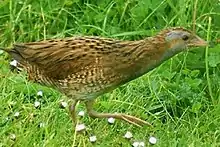
Order: Gruiformes Family: Rallidae
Rallidae is a large family of small to medium-sized birds which includes the rails, crakes, coots, and gallinules. Typically they inhabit dense vegetation in damp environments near lakes, swamps, or rivers. In general they are shy and secretive birds, making them difficult to observe. Most species have strong legs and long toes which are well adapted to soft uneven surfaces. They tend to have short, rounded wings and to be weak fliers.
| Common name | Binomial | Irish name | Status |
|---|---|---|---|
| Water rail | Rallus aquaticus | Rálóg uisce / tradhna uisce | LC |
| Corn crake | Crex crex | Traonach | VU |
| Common moorhen | Gallinula chloropus | Cearc uisce / truisc / coileach fraoich | LC |
| Eurasian coot | Fulica atra | Cearc cheannann | LC |
Grebes
.jpg.webp)
Order: Podicipediformes Family: Podicipedidae
Grebes are small to medium-large freshwater diving birds. They have lobed toes and are excellent swimmers and divers. However, they have their feet placed far back on the body, making them quite ungainly on land.
| Common name | Binomial | Irish name | Status |
|---|---|---|---|
| Little grebe | Tachybaptus ruficollis | Spágaire tonn / tomaire beag | LC |
| Great crested grebe | Podiceps cristatus | Foitheach mór / Lúnadán mór an chorraicín | LC |
| Horned grebe | Podiceps auritus | Beann-foitheach | VU |
| Black-necked grebe | Podiceps nigricollis | Foithíoch cluasach | LC |
Oystercatchers

Order: Charadriiformes Family: Haematopodidae
The oystercatchers are large and noisy plover-like birds, with strong bills used for smashing or prising open molluscs.
| Common name | Binomial | Irish name | Status |
|---|---|---|---|
| Eurasian oystercatcher | Haematopus ostralegus | Roilleach / riabhán / scaladóir | NT |
Plovers

_(11).jpg.webp)
Order: Charadriiformes Family: Charadriidae
The family Charadriidae includes the plovers, dotterels, and lapwings. They are small to medium-sized birds with compact bodies, short thick necks, and long, usually pointed, wings. They are found in open country worldwide, mostly in habitats near water.
| Common name | Binomial | Irish name | Status |
|---|---|---|---|
| Northern lapwing | Vanellus vanellus | Saotharcán Tuaisceartach | NT |
| European golden plover | Pluvialis apricaria | Feadóg bhuí / fideog | LC |
| Grey plover | Pluvialis squatarola | Feadóg bolgdubh | LC |
| Common ringed plover | Charadrius hiaticula | Feadóg chladaigh / feadóg an fháinne / ladhrán | LC |
Sandpipers, snipes


Order: Charadriiformes Family: Scolopacidae
Scolopacidae is a large diverse family of small to medium-sized shorebirds including the sandpipers, curlews, godwits, shanks, tattlers, woodcocks, snipes, dowitchers, and phalaropes. The majority of these species eat small invertebrates picked out of the mud or soil. Variation in length of legs and bills enables multiple species to feed in the same habitat, particularly on the coast, without direct competition for food.
| Common name | Binomial | Irish name | Status |
|---|---|---|---|
| Eurasian curlew | Numenius arquata | Crotach / cruiteach | NT |
| Bar-tailed godwit | Limosa lapponica | Guibneach stríocearrach | NT |
| Black-tailed godwit | Limosa limosa | Guilbneach earrdubh | NT |
| Ruddy turnstone | Arenaria interpres | Piadálai trá ruadh | LC |
| Red knot | Calidris canutus | Cnota rua | NT |
| Ruff | Calidris pugnax | Rufachán | LC |
| Sanderling | Calidris alba | Luathrán | LC |
| Dunlin | Calidris alpina | Breacó | LC |
| Purple sandpiper | Calidris maritima | Gobadan cosbhuí | LC |
| Eurasian woodcock | Scolopax rusticola | Creabhar | LC |
| Jack snipe | Lymnocryptes minimus | Naoscach bhídeach | LC |
| Common snipe | Gallinago gallinago | Naoscach | LC |
| Red-necked phalarope | Phalaropus lobatus | Falaróp gobchaol | LC |
| Common sandpiper | Actitis hypoleucos | Gobadán coiteann | LC |
| Green sandpiper | Tringa ochropus | Gobadán glas | LC |
| Common redshank | Tringa totanus | Cosdeargán | LC |
| Spotted redshank | Tringa erythropus | Cosdeargán breac | LC |
| Common greenshank | Tringa nebularia | Ladhrán glas | LC |
Gulls, terns, skimmers


Order: Charadriiformes Family: Laridae
Laridae is a family of medium to large seabirds, the gulls, terns, and skimmers. Gulls are typically grey or white, often with black markings on the head or wings. They have stout, longish bills and webbed feet. Terns are a group of generally medium to large seabirds typically with grey or white plumage, often with black markings on the head. Most terns hunt fish by diving but some pick insects off the surface of fresh water. Terns are generally long-lived birds, with several species known to live in excess of 30 years.
| Common name | Binomial | Irish name | Status |
|---|---|---|---|
| Black-legged kittiwake | Rissa tridactyla | Saidhbhéar | VU |
| Sabine's gull | Xema sabini | Sléibhín Sabine | LC |
| Black-headed gull | Chroicocephalus ridibundus | Sléibhín | LC |
| Little gull | Hydrocoloeus minutus | Sléibhín beag | LC |
| Mediterranean gull | Ichthyaetus melanocephalus | Sléibhín meánmhuirí | LC |
| Common gull | Larus canus | Faoileán bán | LC |
| Great black-backed gull | Larus marinus | Droimneach mór | LC |
| Glaucous gull | Larus hyperboreus | Faoileán glas | LC |
| Iceland gull | Larus glaucoides | Faoileán Íoslannach | LC |
| European herring gull | Larus argentatus | Faoileán scadán | LC |
| Lesser black-backed gull | Larus fuscus | Droimneach beag | LC |
| Sandwich tern | Thalasseus sandvicensis | Geabhróg scothdhubh | LC |
| Little tern | Sternula albifrons | Geabhróg bheag | LC |
| Roseate tern | Sterna dougallii | Geabhróg rosach | LC |
| Common tern | Sterna hirundo | Geabhróg | LC |
| Arctic tern | Sterna paradisaea | Geabhróg Artach | LC |
Skuas

Order: Charadriiformes Family: Stercorariidae
The family Stercorariidae are, in general, medium to large birds, typically with grey or brown plumage, often with white markings on the wings. They nest on the ground in temperate and arctic regions and are long-distance migrants.
| Common name | Binomial | Irish name | Status |
|---|---|---|---|
| Great skua | Stercorarius skua | Meirleach mór | LC |
| Pomarine jaeger | Stercorarius pomarinus | Meirleach pomairíneach | LC |
Auks

Order: Charadriiformes Family: Alcidae
Alcids are superficially similar to penguins due to their black-and-white colours, their upright posture, and some of their habits. However, they are not related to the penguins and differ in being able to fly. Auks live on the open sea, only deliberately coming ashore to nest.
| Common name | Binomial | Irish name | Status |
|---|---|---|---|
| Common murre | Uria aalge | Foracha | LC |
| Razorbill | Alca torda | Crosán | LC |
| Great auk | Pinguinus impennis | Foracha mhór | EX |
| Black guillemot | Cepphus grylle | Foracha dhubh | LC |
| Atlantic puffin | Fratercula arctica | Puifín | VU |
Loons
_in_the_Morro_Bay.jpg.webp)
Order: Gaviiformes Family: Gaviidae
Loons, also known as divers, are a group of aquatic birds found in many parts of North America and northern Europe. They are the size of a large duck or small goose, which they somewhat resemble in shape when swimming, but to which they are completely unrelated.
| Common name | Binomial | Irish name | Status |
|---|---|---|---|
| Red-throated loon | Gavia stellata | Lóma rua | LC |
| Common loon | Gavia immer | Lóma mór | LC |
Northern storm petrels

Order: Procellariiformes Family: Hydrobatidae
Though the members of this family are similar in many respects to the southern storm petrels, including their general appearance and habits, there are enough genetic differences to warrant their placement in a separate family.
| Common name | Binomial | Irish name | Status |
|---|---|---|---|
| European storm petrel | Hydrobates pelagicus | Guairdeall | LC |
| Leach's storm petrel | Hydrobates leucorhous | Guairdeall gabhlach | VU |
Petrels, shearwaters, diving petrels

Order: Procellariiformes Family: Procellariidae
The procellariids are the main group of medium-sized "true petrels", characterised by united nostrils with medium septum and a long outer functional primary.
| Common name | Binomial | Irish name | Status |
|---|---|---|---|
| Northern fulmar | Fulmarus glacialis | Fulmaire | LC |
| Sooty shearwater | Ardenna griseus | Cánóg dhorcha | NT |
| Manx shearwater | Puffinus puffinus | Cánóg dhubh | LC |
| Balearic shearwater | Puffinus mauretanicus | CR |
Gannets, boobies
Order: Suliformes Family: Sulidae
The sulids comprise the gannets and boobies. Both groups are medium to large coastal seabirds that plunge-dive for fish.
| Common name | Binomial | Irish name | Status |
|---|---|---|---|
| Northern gannet | Morus bassanus | Gainead | LC |
Cormorants, shags

Order: Suliformes Family: Phalacrocoracidae
Phalacrocoracidae is a family of medium to large coastal, fish-eating seabirds that includes cormorants and shags. Plumage colouration varies, with the majority having mainly dark plumage, some species being black-and-white and a few being colourful.
| Common name | Binomial | Irish name | Status |
|---|---|---|---|
| Great cormorant | Phalacrocorax carbo | Broigheall | LC |
| European shag | Gulosus aristotelis | Seaga | LC |
Herons, bitterns
-_In_Breeding_plumage-actively_catching_prey_in_Kolkata_I_IMG_7990.jpg.webp)

Order: Pelecaniformes Family: Ardeidae
The family Ardeidae contains the bitterns, herons, and egrets. Herons and egrets are medium to large wading birds with long necks and legs. Bitterns tend to be shorter-necked and more wary. Members of Ardeidae fly with their necks retracted, unlike other long-necked birds such as storks, ibises, and spoonbills.
| Common name | Binomial | Irish name | Status |
|---|---|---|---|
| Grey heron | Ardea cinerea | Corr réisc | LC |
| Little egret | Egretta garzetta | Éigrit bheag | LC |
Kites, hawks, eagles


Order: Accipitriformes Family: Accipitridae
Accipitridae is a family of birds of prey which includes hawks, eagles, kites, harriers, and Old World vultures. These birds have powerful hooked beaks for tearing flesh from their prey, strong legs, powerful talons, and keen eyesight.
| Common name | Binomial | Irish name | Status |
|---|---|---|---|
| Golden eagle | Aquila chrysaetos | Iolar firéan | CR Reintroduced |
| Eurasian sparrowhawk | Accipiter nisus | Spioróg | LC |
| Hen harrier | Circus cyaneus | Cromán na gcearc | LC |
| Red kite | Milvus milvus | Cúr rua | EN Reintroduced |
| White-tailed eagle | Haliaeetus albicilla | Iolar mara | EN Reintroduced |
| Common buzzard | Buteo buteo | Clamhán | LC |
Barn owls
Order: Strigiformes Family: Tytonidae
Barn owls are medium to large owls with large heads and characteristic heart-shaped faces. They have long strong legs with powerful talons.
| Common name | Binomial | Irish name | Status |
|---|---|---|---|
| Western barn owl | Tyto alba | Scréachóg reilige | LC |
Owls

Order: Strigiformes Family: Strigidae
The typical owls are small to large solitary nocturnal birds of prey. They have large forward-facing eyes and ears, a hawk-like beak, and a conspicuous circle of feathers around each eye called a facial disk.
| Common name | Binomial | Irish name | Status |
|---|---|---|---|
| Long-eared owl | Asio otus | Ceann cait | LC |
| Short-eared owl | Asio flammeus | Ulchabhán réisc | LC |
Kingfishers
.jpg.webp)
Order: Coraciiformes Family: Alcedinidae
Kingfishers are medium-sized birds with large heads, long pointed bills, short legs, and stubby tails.
| Common name | Binomial | Irish name | Status |
|---|---|---|---|
| Common kingfisher | Alcedo atthis | Cruidín | LC |
Woodpeckers

Order: Piciformes Family: Picidae
Woodpeckers are small to medium-sized birds with chisel-like beaks, short legs, stiff tails, and long tongues used for capturing insects. Some species have feet with two toes pointing forward and two backward, while several species have only three toes. Many woodpeckers have the habit of tapping noisily on tree trunks with their beaks. Great spotted woodpecker has started breeding in recent years.[6]
| Common name | Binomial | Irish name | Status |
|---|---|---|---|
| Great spotted woodpecker | Dendrocopos major | Mórchnagaire breac | LC |
Caracaras, falcons

Order: Falconiformes Family: Falconidae
Falconidae is a family of diurnal birds of prey. They differ from hawks, eagles, and kites in that they kill with their beaks instead of their talons.
| Common name | Binomial | Irish name | Status |
|---|---|---|---|
| Common kestrel | Falco tinnunculus | Pocaire gaoithe | LC |
| Merlin | Falco columbarius | Meirliún | LC |
| Peregrine falcon | Falco peregrinus | Fabhcún gorm | LC |
Crows, jays

Order: Passeriformes Family: Corvidae
The family Corvidae includes crows, ravens, jackdaws, jays, choughs, magpies, treepies, nutcrackers, and ground jays. Corvids are above average in size among the Passeriformes, and some of the larger species show high levels of intelligence.
| Common name | Binomial | Irish name | Status |
|---|---|---|---|
| Eurasian jay | Garrulus glandarius | Scréachóg / scéachóg choille | LC |
| Eurasian magpie | Pica pica | Snag breac | LC |
| Red-billed chough | Pyrrhocorax pyrrhocorax | Cág cosdearg | LC |
| Eurasian jackdaw | Corvus monedula | Cág | LC |
| Rook | Corvus frugilegus | Rúcach | LC |
| Carrion crow | Corvus corone | Caróg dhubh | LC |
| Hooded crow | Corvus cornix | Caróg liath | NE |
| Northern raven | Corvus corax | Fiach dubh | LC |
Tits, chickadees
_on_line.jpeg.webp)
Order: Passeriformes Family: Paridae
The Paridae are mainly small stocky woodland species with short stout bills. Some have crests. They are adaptable birds, with a mixed diet including seeds and insects.
| Common name | Binomial | Irish name | Status |
|---|---|---|---|
| Coal tit | Periparus ater | Meantán dubh | LC |
| Eurasian blue tit | Cyanistes caeruleus | Meantán gorm | LC |
| Great tit | Parus major | Meantán mór | LC |
Bearded reedling
Order: Passeriformes Family: Panuridae
This species, the only one in its family, is found in reed beds throughout temperate Europe and Asia.
| Common name | Binomial | Irish name | Status |
|---|---|---|---|
| Bearded reedling | Panurus biarmicus | Meantán croiméalach | DD |
Larks

Order: Passeriformes Family: Alaudidae
Larks are small terrestrial birds with often extravagant songs and display flights. Most larks are fairly dull in appearance. Their food is insects and seeds.
| Common name | Binomial | Irish name | Status |
|---|---|---|---|
| Eurasian skylark | Alauda arvensis | Fuiseog | LC |
Swallows, martins

Order: Passeriformes Family: Hirundinidae
The family Hirundinidae is adapted to aerial feeding. They have a slender streamlined body, long pointed wings, and a short bill with a wide gape. The feet are adapted to perching rather than walking, and the front toes are partially joined at the base.
| Common name | Binomial | Irish name | Status |
|---|---|---|---|
| Sand martin | Riparia riparia | Gabhlán gainimh | LC |
| Barn swallow | Hirundo rustica | Fáinleog | LC |
| Common house martin | Delichon urbicum | Gabhlán binne | LC |
Bushtits
.jpg.webp)
Order: Passeriformes Family: Aegithalidae
Long-tailed tits are a group of small passerine birds with medium to long tails. They make woven bag nests in trees. Most eat a mixed diet which includes insects.
| Common name | Binomial | Irish name | Status |
|---|---|---|---|
| Long-tailed tit | Aegithalos caudatus | Meantán earrfhada | LC |
Leaf warblers and allies
Order: Passeriformes Family: Phylloscopidae
Leaf warblers are a family of small insectivorous birds found mostly in Eurasia and ranging into Wallacea and Africa. The species are of various sizes, often green-plumaged above and yellow below, or more subdued with greyish-green to greyish-brown colors.
| Common name | Binomial | Irish name | Status |
|---|---|---|---|
| Wood warbler | Phylloscopus sibilatrix | Ceolaire coille | LC |
| Willow warbler | Phylloscopus trochilus | Ceolaire sailí | LC |
| Common chiffchaff | Phylloscopus collybita | Tiuf-teaf | LC |
Reed warblers and allies
Order: Passeriformes Family: Acrocephalidae
The members of this family are usually rather large for "warblers". Most are rather plain olivaceous brown above with much yellow to beige below. They are usually found in open woodland, reedbeds, or tall grass. The family occurs mostly in southern to western Eurasia and surroundings, but it also ranges far into the Pacific, with some species in Africa.
| Common name | Binomial | Irish name | Status |
|---|---|---|---|
| Sedge warbler | Acrocephalus schoenobaenus | Ceolaire cíbe | LC |
| Eurasian reed warbler | Acrocephalus scirpaceus | Ceolaire giolcaí | LC |
Grassbirds and allies
Order: Passeriformes Family: Locustellidae
Locustellidae are a family of small insectivorous songbirds found mainly in Eurasia, Africa, and the Australian region. They are smallish birds with tails that are usually long and pointed, and tend to be drab brownish or buffy all over.
| Common name | Binomial | Irish name | Status |
|---|---|---|---|
| Common grasshopper warbler | Locustella naevia | Ceolaire casarnaí | LC |
Sylviid babblers

Order: Passeriformes Family: Sylviidae
The family Sylviidae is a group of small insectivorous passerine birds. They mainly occur as breeding species, as another common name (Old World warblers) implies, in Europe, Asia, and, to a lesser extent, Africa. Most are of generally undistinguished appearance, but many have distinctive songs.
| Common name | Binomial | Irish name | Status |
|---|---|---|---|
| Eurasian blackcap | Sylvia atricapilla | Caipín dubh | LC |
| Garden warbler | Sylvia borin | Ceolaire garraí | LC |
| Lesser whitethroat | Curruca curruca | Gilphíb bheag | LC |
| Common whitethroat | Curruca communis | Gilbhíb mór | LC |
Goldcrests, kinglets

Order: Passeriformes Family: Regulidae
The kinglets, also called crests, are a small group of birds which were sometimes included in the Old World warblers, family Sylviidae.
| Common name | Binomial | Irish name | Status |
|---|---|---|---|
| Goldcrest | Regulus regulus | Cíorbhuí | LC |
Wrens

Order: Passeriformes Family: Troglodytidae
The wrens are mainly small and inconspicuous except for their loud songs. These birds have short wings and thin down-turned bills. Several species often hold their tails upright. All are insectivorous.
| Common name | Binomial | Irish name | Status |
|---|---|---|---|
| Eurasian wren | Troglodytes troglodytes | Dreolín | LC |
Treecreepers

Order: Passeriformes Family: Certhiidae
Treecreepers are small woodland birds, brown above and white below. They have thin pointed down-curved bills, which they use to extricate insects from bark. They have stiff tail feathers, like woodpeckers, which they use to support themselves on vertical trees.
| Common name | Binomial | Irish name | Status |
|---|---|---|---|
| Eurasian treecreeper | Certhia familiaris | Snag coiteann | LC |
Starlings, rhabdornis
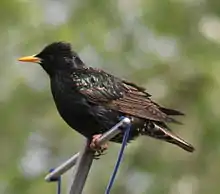
Order: Passeriformes Family: Sturnidae
Starlings are small to medium-sized passerine birds. Their flight is strong and direct and they are very gregarious. Their preferred habitat is fairly open country. They eat insects and fruit. Plumage is typically dark with a metallic sheen.
| Common name | Binomial | Irish name | Status |
|---|---|---|---|
| European starling | Sturnus vulgaris | Druid | LC |
Thrushes

Order: Passeriformes Family: Turdidae
The thrushes are a group of passerine birds that occur mainly in the Old World. They are plump, soft plumaged, small to medium-sized insectivores or sometimes omnivores, often feeding on the ground. Many have attractive songs.
| Common name | Binomial | Irish name | Status |
|---|---|---|---|
| Ring ouzel | Turdus torquatus | Lon creige | LC |
| Eurasian blackbird | Turdus merula | Lon dubh | LC |
| Fieldfare | Turdus pilaris | Sacán | LC |
| Redwing | Turdus iliacus | Deargán sneachta | NT |
| Song thrush | Turdus philomelos | Smólach ceoil | LC |
| Mistle thrush | Turdus viscivorus | Smólach mór | LC |
Chats, Old World flycatchers


Order: Passeriformes Family: Muscicapidae
Old World flycatchers are a large family of mainly small arboreal insectivores. The appearance of these birds is highly varied, but they mostly have weak songs and harsh calls.
| Common name | Binomial | Irish name | Status |
|---|---|---|---|
| Spotted flycatcher | Muscicapa striata | Cuilire liath | LC |
| European robin | Erithacus rubecula | Spideog | LC |
| European pied flycatcher | Ficedula hypoleuca | Cuilire alabhreac | LC |
| Black redstart | Phoenicurus ochruros | Earrdheargán dubh | LC |
| Common redstart | Phoenicurus phoenicurus | Earrdheargán | LC |
| Whinchat | Saxicola rubetra | Caislín aitinn | LC |
| European stonechat | Saxicola rubicola | Caislín cloch | LC |
| Northern wheatear | Oenanthe oenanthe | Clochrán | LC |
Dippers

Order: Passeriformes Family: Cinclidae
Dippers are a group of perching birds whose habitat includes aquatic environments in the Americas, Europe, and Asia. They are named for their bobbing or dipping movements.
| Common name | Binomial | Irish name | Status |
|---|---|---|---|
| White-throated dipper | Cinclus cinclus | Gabha dubh | LC |
Old World sparrows, snowfinches

Order: Passeriformes Family: Passeridae
Sparrows are small passerine birds. In general, sparrows tend to be small, plump, brown or grey birds with short tails and short powerful beaks. Sparrows are seed eaters, but they also consume small insects.
| Common name | Binomial | Irish name | Status |
|---|---|---|---|
| House sparrow | Passer domesticus | Gealbhan binne | LC |
| Eurasian tree sparrow | Passer montanus | Gealbhan crainn | LC |
Accentors

Order: Passeriformes Family: Prunellidae
The accentors are the only bird family which is completely endemic to the Palearctic. They are small, fairly drab species superficially similar to Old World sparrows.
| Common name | Binomial | Irish name | Status |
|---|---|---|---|
| Dunnock | Prunella modularis | Donnóg | LC |
Wagtails, pipits


Order: Passeriformes Family: Motacillidae
Motacillidae is a family of small passerine birds with medium to long tails. They include the wagtails, longclaws and pipits. They are slender, ground feeding insectivores of open country.
Two subspecies of white wagtail occur in Ireland:[7]
- Motacilla alba yarrelli, "pied wagtail", a common breeding resident.
- M. a. alba, nominate subspecies occurring as a migrant.
| Common name | Binomial | Irish name | Status |
|---|---|---|---|
| Grey wagtail | Motacilla cinerea | Glasóg liath | LC |
| White wagtail | Motacilla alba | Glasóg shráide / glasóg bhán | LC |
| Meadow pipit | Anthus pratensis | Riabhóg mhóna | LC |
| Tree pipit | Anthus trivialis | Riabhóg choille | LC |
| European rock pipit | Anthus petrosus | Riabhóg chladaigh | LC |
Finches, euphonias

Order: Passeriformes Family: Fringillidae
Finches are seed-eating passerine birds that are small to moderately large and have a strong beak, usually conical and in some species very large. All have twelve tail feathers and nine primaries. These birds have a bouncing flight with alternating bouts of flapping and gliding on closed wings, and most sing well.
| Common name | Binomial | Irish name | Status |
|---|---|---|---|
| Common chaffinch | Fringilla coelebs | Rí rua | LC |
| Brambling | Fringilla montifringilla | Breacán | LC |
| Hawfinch | Coccothraustes coccothraustes | Glasán gobmhór | DD |
| Eurasian bullfinch | Pyrrhula pyrrhula | Corcrán coille | LC |
| European greenfinch | Chloris chloris | Glasán darach | LC |
| Twite | Linaria flavirostris | Gleoiseach sléibhe | LC |
| Common linnet | Linaria cannabina | Gleoiseach | LC |
| Common redpoll | Acanthis flammea | Deargéadan | LC |
| Red crossbill | Loxia curvirostra | Crosghob rua | LC |
| European goldfinch | Carduelis carduelis | Lasair choille | LC |
| Eurasian siskin | Spinus spinus | Siscín | LC |
Longspurs, snow buntings
Order: Passeriformes Family: Calcariidae
The Calcariidae are a group of passerine birds that had been traditionally grouped with the New World sparrows, but differ in a number of respects and are usually found in open grassy areas.
| Common name | Binomial | Irish name | Status |
|---|---|---|---|
| Lapland longspur | Calcarius lapponicus | Gealóg Laplannach | LC |
| Snow bunting | Plectrophenax nivalis | Gealóg shneachta | LC |
Buntings

Order: Passeriformes Family: Emberizidae
Emberizidae is a family of passerine birds containing a single genus. Until 2017, the New World sparrows (Passerellidae) were also considered part of this family.
| Common name | Binomial | Irish name | Status |
|---|---|---|---|
| Yellowhammer | Emberiza citrinella | Buíóg | LC |
| Common reed bunting | Emberiza schoeniclus | Gealóg ghiolcaí | LC |
Notes
References
- "Irish List covering the whole of Ireland on 31st Dec 2019" (PDF). Irish Rare Birds Committee. 31 December 2019. Retrieved 16 July 2020.
- Gill, F.; Donsker, D.; Rasmussen, P. (July 2021). "IOC World Bird List (v 11.2)". Retrieved 14 July 2021.
- "The National Terminology Database for Irish". téarma.ie.
- "The IUCN Red List of Threatened Species". www.iucnredlist.org. Retrieved 19 August 2017.
- "Mallard". téarma.ie. The National Terminology Database for Irish.
- "Have you heard Ireland's drumming woodpeckers?". RTÉ. 3 April 2018. Retrieved 21 February 2020.
- "White Wagtail". Birds of the World. The Cornell Lab or Ornithology. doi:10.2173/bow.whiwag.01. Retrieved 19 September 2020.
- Dempsey, Eric & O'Clery, Michael (1995). Pocket Guide to the Common Birds of Ireland. Gill & Macmillan Ltd, Dublin.
- Dempsey, Eric & O'Clery, Michael (2007). Finding Birds in Ireland: The Complete Guide. Gill & Macmillan Ltd, Dublin.
See also
External links

- National Biodiversity Network Distribution Maps (Ongoing)
- Oiseaux Ireland page. Many photos. Not all species.
- Irish Birding Latest sightings.
- Irish Rare Birds Committee
- NIBWA Northern Ireland Bird watchers Association.
- NIOC Northern Ireland Ornithologists Club. Excellent photographs
- Bird Guides Irish list, county lists, latest sightings and photos.
- RSPB Royal Society for the Protection of Birds A-Z