Hadronyche
Hadronyche is a genus of venomous Australian funnel-web spiders that was first described by L. Koch in 1873.[3] Originally placed with the curtain web spiders, it was moved to the Hexathelidae in 1980,[4] then to the Atracidae in 2018.[5]
| Hadronyche | |
|---|---|
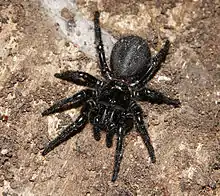 | |
| Hadronyche modesta | |
Scientific classification  | |
| Kingdom: | Animalia |
| Phylum: | Arthropoda |
| Subphylum: | Chelicerata |
| Class: | Arachnida |
| Order: | Araneae |
| Infraorder: | Mygalomorphae |
| Family: | Atracidae |
| Genus: | Hadronyche L. Koch, 1873[1] |
| Type species | |
| H. cerberea L. Koch, 1873 | |
| Species | |
|
32, see text | |
| Synonyms[1] | |
Description
Their size varies significantly, measuring from 1 to 5 cm. Most species in this genus, as most Myglomorphae, have a glossy black or brown carapace. They have a very long life span for spiders, having been known to live for up to 20 years.
They can be easily identified by the raised morphology of their caput (the front part of the cephalothorax). If identification is not certain, they can be distinguished from Atrax by the unmodified or blunt apophysis in their second tibia, or from Illawarra by the male tarsi, which have two instead of tree ventral spine rows.[6]
Venom
While Australian funnel-web spider venom is medically significant, no human fatalities as a result have been recorded since the introduction of antivenom in 1980.[7] The venom profile of this genus is also different from the other genera from the Atracidae family.[6]
Distribution
They are found in eastern Australia from northeast Queensland to Tasmania and the Gulf Ranges region of South Australia.[6] They live primarily in the moist regions, and highlands of the east coast. Although they are also found in drier open forests in the Western Slopes of the dividing range and South Australia's gulf ranges.[8]
Burrows
Hadronyche spiders usually make their burrows under rocks or logs, usually in cool humid areas. As with most funnel web spiders, these spiders make funnel shaped webs. The webs have silk trip lines radiating from the entrance which function as a warning system, alerting the spiders to the presence of insect prey or a possible mate. In the case of seasonal rains, the burrows can flood. While these spiders are able to survive submerged for several hours by trapping air bubbles with their hair covered legs beneath their abdomens, prolonged flooding can force them to leave their burrows. They may also leave their burrow to find a mate.[8]
Species
As of March 2022, it contains 32 species, all from Australia:[1]
- Hadronyche adelaidensis (Gray, 1984) – South Australia
- Hadronyche alpina Gray, 2010 – New South Wales, Australian Capital Territory
- Hadronyche annachristiae Gray, 2010 – New South Wales
- Hadronyche anzses Raven, 2000 – Queensland
- Hadronyche cerberea L. Koch, 1873 (type species) – New South Wales
- Hadronyche emmalizae Gray, 2010 – New South Wales
- Hadronyche eyrei (Gray, 1984) – South Australia
- Hadronyche flindersi (Gray, 1984) – South Australia
- Hadronyche formidabilis (Rainbow, 1914) – Queensland, New South Wales
- Hadronyche infensa (Hickman, 1964) – Queensland, New South Wales
- Hadronyche jensenae Gray, 2010 – Victoria
- Hadronyche kaputarensis Gray, 2010 – New South Wales
- Hadronyche lamingtonensis Gray, 2010 – Queensland
- Hadronyche levittgreggae Gray, 2010 – New South Wales
- Hadronyche lynabrae Gray, 2010 – New South Wales
- Hadronyche macquariensis Gray, 2010 – New South Wales
- Hadronyche marracoonda Gray, 2010 – New South Wales, Australian Capital Territory
- Hadronyche mascordi Gray, 2010 – New South Wales
- Hadronyche meridiana Hogg, 1902 – New South Wales, Victoria
- Hadronyche modesta (Simon, 1891) – Victoria
- Hadronyche monaro Gray, 2010 – New South Wales
- Hadronyche monteithi Gray, 2010 – Queensland
- Hadronyche nadgee (Whitington & Harris, 2021) – Australia (New South Wales)
- Hadronyche nimoola Gray, 2010 – New South Wales, Australian Capital Territory
- Hadronyche orana Gray, 2010 – New South Wales
- Hadronyche pulvinator (Hickman, 1927) – Tasmania
- Hadronyche raveni Gray, 2010 – Queensland
- Hadronyche tambo Gray, 2010 – Victoria
- Hadronyche valida (Rainbow & Pulleine, 1918) – Queensland, New South Wales
- Hadronyche venenata (Hickman, 1927) – Tasmania
- Hadronyche versuta (Rainbow, 1914) – New South Wales
- Hadronyche walkeri Gray, 2010 – New South Wales
References
- "Gen. Hadronyche L. Koch, 1873". World Spider Catalog Version 20.0. Natural History Museum Bern. 2019. doi:10.24436/2. Retrieved 2019-06-10.
- Gray, M. R. (1988). "Aspects of the systematics of the Australian funnel web spiders (Araneae: Hexathelidae: Atracinae) based upon morphological and electrophoretic data". Australian Entomological Society Miscellaneous Publication. 5: 117.
- Koch, L. (1873). Die Arachniden Australiens.
- Raven, R. J. (1980). "The evolution and biogeography of the mygalomorph spider family Hexathelidae (Araneae, Chelicerata)". Journal of Arachnology. 8: 255.
- Hedin, M.; et al. (2018). "Phylogenomic reclassification of the world's most venomous spiders (Mygalomorphae, Atracinae), with implications for venom evolution". Scientific Reports. 8 (1636): 4. Bibcode:2018NatSR...8.1636H. doi:10.1038/s41598-018-19946-2. PMC 5785998. PMID 29374214.
- Gray, Michael R. (2010). "A Revision of the Australian Funnel-web Spiders (Hexathelidae: Atracinae)" (PDF). Australian Museum. Retrieved November 13, 2022.
{{cite web}}: CS1 maint: url-status (link) - "Australian Venom Research Unit - Funnel web spiders". University of Melbourne. Retrieved 2019-06-09.
- "Funnel-web Spiders". The Australian Museum. Retrieved 2022-11-14.
{{cite web}}:|first=missing|last=(help)
External links
 Data related to Hadronyche at Wikispecies
 Media related to Hadronyche at Wikimedia Commons