Gliese 486
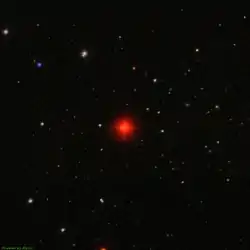
Gliese 486, also known as Wolf 437, is a M-type main-sequence star in the constellation Virgo. Its surface temperature is 3340±54 K. Gliese 486 is similar to the Sun in its concentration of heavy elements, with a metallicity Fe/H index of 0.07±0.16. It was suspected to be a flare star,[7] although measurements available in 2019 did not reveal any flares.[8] The chemical makeup of the star is unremarkable and consistent with solar abundances or being slightly metal-poor.[5]
 | |
| Observation data Epoch J2000 Equinox J2000 | |
|---|---|
| Constellation | Virgo |
| Right ascension | 12h 47m 56.6249s[1] |
| Declination | +09° 45′ 05.0319″[1] |
| Apparent magnitude (V) | 11.395 |
| Characteristics | |
| Evolutionary stage | main sequence |
| Spectral type | M3.5V[2] |
| Astrometry | |
| Radial velocity (Rv) | 19.106 km/s |
| Proper motion (μ) | RA: −1008.267[3] mas/yr Dec.: −460.034[3] mas/yr |
| Parallax (π) | 123.776 ± 0.0329 mas[3] |
| Distance | 26.351 ± 0.007 ly (8.079 ± 0.002 pc) |
| Details[4] | |
| Mass | 0.323±0.015 M☉ |
| Radius | 0.328±0.011 R☉ |
| Luminosity | 0.01210±0.00023 L☉ |
| Temperature | 3340±54 K |
| Metallicity [Fe/H] | −0.15±0.13[5] dex |
| Rotation | 49.9±5.5 d[5] |
| Rotational velocity (v sin i) | <2[6] km/s |
| Age | 1-8[5] Gyr |
| Other designations | |
| Database references | |
| SIMBAD | data |
The star has an unremarkable magnetic field in the chromosphere of about 1.6 kilogauss.[6] It is rotating very slowly and is likely to be very old, belonging kinematically to the old thin disk of the Milky Way.[9]
Multiplicity surveys did not detect any stellar companions to Gliese 486 as at 2020.[10]
Planetary system

In 2021, one planet, named Gliese 486 b, was discovered on a tight, circular orbit.[4] It represents a rare class of rocky exoplanet suitable for spectroscopic characterization in the near future[11] by the James Webb Space Telescope.[12] As in 2022, no hydrogen or steam dominated atmosphere was detected, although secondary planetary atmosphere with the higher molecular weight remains a possibility.[13]
In August 2022, this planetary system was included among 20 systems to be named by the third NameExoWorlds project.[14]
| Companion (in order from star) |
Mass | Semimajor axis (AU) |
Orbital period (days) |
Eccentricity | Inclination | Radius |
|---|---|---|---|---|---|---|
| b | 2.82+0.11 −0.12 M🜨 |
0.01734+0.00026 −0.00027 |
1.467119+0.000031 −0.000030 |
<0.05 | 88.4+1.1 −1.4° |
1.305+0.063 −0.067 R🜨 |
References
- "Wolf 437". SIMBAD. Centre de données astronomiques de Strasbourg. Retrieved 2021-03-10.
- Bozhinova, I.; Helling, Ch.; Scholz, A. (2014), "Planetary host stars: Evaluating uncertainties in cool model atmospheres", Monthly Notices of the Royal Astronomical Society, 450: 160–182, arXiv:1405.5416, Bibcode:2015MNRAS.450..160B, doi:10.1093/mnras/stv613
- Brown, A. G. A.; et al. (Gaia collaboration) (2021). "Gaia Early Data Release 3: Summary of the contents and survey properties". Astronomy & Astrophysics. 649: A1. arXiv:2012.01533. Bibcode:2021A&A...649A...1G. doi:10.1051/0004-6361/202039657. S2CID 227254300. (Erratum: doi:10.1051/0004-6361/202039657e). Gaia EDR3 record for this source at VizieR.
- Trifonov, T.; et al. (2021), "A nearby transiting rocky exoplanet that is suitable for atmospheric investigation", Science, 371 (6533): 1038–1041, arXiv:2103.04950, Bibcode:2021Sci...371.1038T, doi:10.1126/science.abd7645, PMID 33674491, S2CID 232124642
- Caballero, J. A.; et al. (2022), "A detailed analysis of the Gl 486 planetary system", Astronomy & Astrophysics, 665: A120, arXiv:2206.09990, Bibcode:2022A&A...665A.120C, doi:10.1051/0004-6361/202243548, S2CID 249889232
- Moutou, Claire; Hébrard, Élodie M.; Morin, Julien; Malo, Lison; Fouqué, Pascal; Torres-Rivas, Andoni; Martioli, Eder; Delfosse, Xavier; Artigau, Étienne; Doyon, René (2017), "SPIRou input catalogue: Activity, rotation and magnetic field of cool dwarfs", Monthly Notices of the Royal Astronomical Society, 472 (4): 4563–4586, arXiv:1709.01650, Bibcode:2017MNRAS.472.4563M, doi:10.1093/mnras/stx2306
- O'Donoghue, D.; Koen, C.; Kilkenny, D.; Stobie, R. S.; Koester, D.; Bessell, M. S.; Hambly, N.; MacGillivray, H. (2003), "The DA+d Me eclipsing binary EC13471-1258: its cup runneth over ... Just", Monthly Notices of the Royal Astronomical Society, 345 (2): 506–528, arXiv:astro-ph/0307144, Bibcode:2003MNRAS.345..506O, doi:10.1046/j.1365-8711.2003.06973.x, S2CID 17408072
- Vida, Krisztián; Leitzinger, Martin; Kriskovics, Levente; Seli, Bálint; Odert, Petra; Kovács, Orsolya Eszter; Korhonen, Heidi; Van Driel-Gesztelyi, Lidia (2019), "The quest for stellar coronal mass ejections in late-type stars", Astronomy & Astrophysics, 623: A49, arXiv:1901.04229, doi:10.1051/0004-6361/201834264, S2CID 119095055
- Browning, Matthew K.; Basri, Gibor; Marcy, Geoffrey W.; West, Andrew A.; Zhang, Jiahao (2010), "Rotation and Magnetic Activity in a Sample of M-Dwarfs", The Astronomical Journal, 139 (2): 504, Bibcode:2010AJ....139..504B, doi:10.1088/0004-6256/139/2/504, S2CID 121835145
- Lamman, Claire; Baranec, Christoph; Berta-Thompson, Zachory K.; Law, Nicholas M.; Schonhut-Stasik, Jessica; Ziegler, Carl; Salama, Maïssa; Jensen-Clem, Rebecca; Duev, Dmitry A.; Riddle, Reed; Kulkarni, Shrinivas R.; Winters, Jennifer G.; Irwin, Jonathan M. (2020), "Robo-AO M-dwarf Multiplicity Survey: Catalog", The Astronomical Journal, 159 (4): 139, arXiv:2001.05988, Bibcode:2020AJ....159..139L, doi:10.3847/1538-3881/ab6ef1, S2CID 210718832
- Hot Super-Earth Discovered 26 Light-Years Away
- Newfound exoplanet could be 'Rosetta Stone' for studies of alien atmospheres
- Ridden-Harper, Andrew; Nugroho, Stevanus; Flagg, Laura; Jayawardhana, Ray; Turner, Jake D.; Ernst de Mooij; MacDonald, Ryan; Deibert, Emily; Tamura, Motohide; Kotani, Takayuki; Hirano, Teruyuki; Kuzuhara, Masayuki; Omiya, Masashi; Kusakabe, Nobuhiko (2022), High-Resolution Transmission Spectroscopy of the Terrestrial Exoplanet GJ 486b, arXiv:2212.11816
- "List of ExoWorlds 2022". nameexoworlds.iau.org. IAU. 8 August 2022. Retrieved 27 August 2022.
2021 in space | ||
|---|---|---|
| ||
| Space probe and telescope launches  |
|    |
| Impact events | ||
| Selected NEOs | ||
| Exoplanets |
| |
| Discoveries |
| |
| Comets | ||
| Space exploration |
| |
| ||
