Bashu nationalism
Bashu nationalism (traditional Chinese: 巴蜀民族主義; simplified Chinese: 巴蜀民族主义; pinyin: Bāshǔ mínzú zhǔyì; Sichuanese Pinyin: Ba1su2 min2quo2 zu3nyi4) is an independence movement in Sichuan Province, China. Liu Zhongjing, who invented the term "Basuria" (巴蜀利亞; 巴蜀利亚; Bāshǔlìyǎ), calls for the rejection of Han Chinese culture and the de-Sinicization of Sichuan.[2] He has advocated for the secession of Basuria and other states from China.[2]
Bashu Nationalism/Basuria Independence Movement | |
|---|---|
 Flag of the Basurian independence movement[1] | |
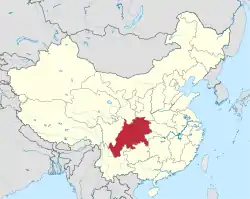 | |
| Today part of | People's Republic of China |
Terminology
The term "Basuria" is a neologism coined by Liu Zhongjing, who wants an independent political entity for the Bashu people to separate from China and become a country of its own.[2] Basuria is an attempt to resurrect the Tribal Confederation of Ba and the Kingdom of Shu, both of which were conquered by the State of Qin in 316 BCE.[2]
Independence movement

In 2011 author and political critic Liao Yiwu expressed his wish for an independent Sichuan, stating that he will return to his homeland if Sichuan is separated.[3] In 2016 writer and activist Yu Jie also expressed his wish for an independent Sichuan.[4]
From 2007 onwards Liu Zhongjing started publishing and posting under the name "数卷残编" and started to gain followers.[2] Liu believes that the best course for Bashu people is to seek independence from China.[2] As of 2018, he seemingly relocated to the United States.[2] On July 21, 2021, Liu Zhongjing was interviewed by Radio Free Asia about Basurian independence, as the Acting President (臨時大總統) of the Republic of Basuria.[5]
At the end of June 2020, China passed the Hong Kong national security law, which has attracted global attention. According to the Hong Kong police's action guidelines for the "national security law", examples of behaviors that endanger national security were mentioned, including demonstrators waving designated flags. Examples of flags listed by the police include the "Basurian flag" that appeared in the 2019 New Year's Day parade.[6][7]
In August 2019, the Shanghai National Party and the Uyghur American Association jointly held an anti-communist independence movement party conference on Capitol Hill. Participants included supporters of independence movements in Hong Kong (Hong Kong independence), East Turkestan (East Turkestan independence movement), and Ba–Shu, as well as Chinese democracy activists.[8][9]
See also
References
- "Archived copy". Archived from the original on 2021-11-28. Retrieved 2022-04-29.
{{cite web}}: CS1 maint: archived copy as title (link) - King, Dylan Levi (March 13, 2019). "China's intellectual dark web and its most active fanatic". SupChina.
- "'My dream is that China splits up into 10 or so countries': Beijing a 'threat to world' says dissident writer Liao Yiwu". Hong Kong Free Press HKFP. April 6, 2019.
- "從順民到公民:與民主台灣同行". Yahoo News.
- "专访"大蜀民国临时总统"刘仲敬谈天下事- 介绍 #巴蜀独立 背后的理念,#民族发明 的条件和历史脉络,为何 #大一统 #中华民族 #中国主义 都是虚幻造假的名词". Radio Free Asia. July 23, 2021.
- "【港版國安法】警首因港獨旗作拘捕 大律師:只藏有無展示不構成罪行". 蘋果日報 (in Chinese (China)). 2020-07-01. Archived from the original on 2020-07-02. Retrieved 2020-07-01.
- According to the action guidelines for the "National Security Law" obtained by Apple Daily, examples of behaviors that endanger national security are mentioned, including demonstrators waving designated flags or chanting some slogans. Examples of flags listed by the police include the "Nine Separatists" flag. According to online information, the "Nine Separatists" refers to Shanghai, Southern Mongolia, Tibet, Xinjiang, Taiwan, Sichuan, Guangdong, Manchuria, and Fujian.
- "独派人士下月聚首华府 向中国霸权说不" (in Chinese). 自由亚洲电台. 2019-07-31. Archived from the original on 2019-09-22. Retrieved 2019-12-19.
- "首屆反共獨立運動政黨會議在華盛頓召開" (in Chinese). 中央廣播電臺. 2019-09-18. Archived from the original on 2019-12-19. Retrieved 2019-12-19.
External links
- Republic of Basuria- Website of Liu Zhongjing
Sichuan topics | |||||
|---|---|---|---|---|---|
| General | |||||
| History |
| ||||
| Geography | |||||
| Culture |
| ||||
| People | |||||
| Religion | |||||
| Languages |
| ||||
| Tourist attractions | |||||
| Related | |||||

