fanon
See also: Fanon
English
Pronunciation
- IPA(key): /ˈfænən/
Etymology 1
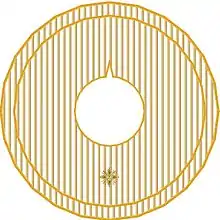
A papal fanon (seen from above, laying flat).
From Middle English fanon, fanoun, from Old French fanon, from Medieval Latin fanō, from Frankish *fano, from Proto-Germanic *fanô.
Noun
fanon (plural fanons)
Noun
fanon (uncountable)
- (fandom slang) Elements introduced by fans which are not in the official canon of a fictional world but are widely believed to be or treated as if canonical.
- 2014, Maria Lindgren Leavenworth & Malin Isaksson, Fanged Fan Fiction: Variations on Twilight, True Blood and The Vampire Diaries, page 53:
- In this way, smaller groups within a fandom agree on readings which may be completely at odds with the canon, but which in time acquire legitimacy as fanon.
- 2018, Kali DeDominicis, "Fitting Him for Leather Trousers: Fanon and the Reclamation of Draco Malfoy and Slytherin House", in Harry Potter and Convergence Culture: Essays on Fandom and the Expanding Potterverse (eds. Amanda Firestone & Leisa A. Clark), page 97:
- Loyalty is one aspect of Slytherin that canon and fanon readings technically agree on, but fans are significantly more sincere about this characterization.
- 2019, Holly Luetkenhaus & Zoe Weinstein, Austentatious: The Evolving World of Jane Austen Fans, page 24:
- So in a fandom as old as Austen's, how does fanon get created?
- 2014, Maria Lindgren Leavenworth & Malin Isaksson, Fanged Fan Fiction: Variations on Twilight, True Blood and The Vampire Diaries, page 53:
Derived terms
See also
Further reading
 Papal Fanon on Wikipedia.Wikipedia
 - Fanon in fiction on Wikipedia.Wikipedia
- Fanon article at TV Tropes
References
- OED 2nd edition 1989
French
Etymology
From Middle French fanon, fannon, from Old French fanon, fanum, borrowed from Frankish *fano (“cloth”), from Proto-Germanic *fanô. Cognate with English fane and vane.
Pronunciation
- IPA(key): /fa.nɔ̃/
Noun
fanon m (plural fanons)
- dewlap (pendulous skin under the neck of an ox, lizard, or other animal)
- wattle (wrinkled fold of skin hanging from the neck of a turkey or other bird)
- baleen plate; (in the plural) baleen (bony material that makes up the plates in the mouth of a baleen whale)
- feather, feathering (long hair on the lower legs of a horse)
- (heraldry) bracelet on the right arm
- fanon (vestment reserved for the Pope)
- (usually in the plural) fanon (part of a bishops mitre)
- (by extension, usually in the plural) tabs on a banner or pennant
Derived terms
Further reading
- “fanon”, in Trésor de la langue française informatisé [Digitized Treasury of the French Language], 2012.
Middle English
Etymology
Borrowed from Old French fanon, from Medieval Latin fanō, from Frankish *fano, from Proto-Germanic *fanô. Doublet of fane (“flag, vane”).
Pronunciation
- IPA(key): /faˈnuːn/, /ˈfanun/, /ˈfanən/
Descendants
- English: fanon
References
- “fanǒun, n.”, in MED Online, Ann Arbor, Mich.: University of Michigan, 2007, retrieved 2019-1-3.
Norman
Etymology
(This etymology is missing or incomplete. Please add to it, or discuss it at the Etymology scriptorium.)
Romanian
Declension
Declension of fanon
| singular | plural | |||
|---|---|---|---|---|
| indefinite articulation | definite articulation | indefinite articulation | definite articulation | |
| nominative/accusative | (un) fanon | fanonul | (niște) fanoane | fanoanele |
| genitive/dative | (unui) fanon | fanonului | (unor) fanoane | fanoanelor |
| vocative | fanonule | fanoanelor | ||
References
- fanon in Academia Română, Micul dicționar academic, ediția a II-a, Bucharest: Univers Enciclopedic, 2010. →ISBN
This article is issued from Wiktionary. The text is licensed under Creative Commons - Attribution - Sharealike. Additional terms may apply for the media files.