See also:
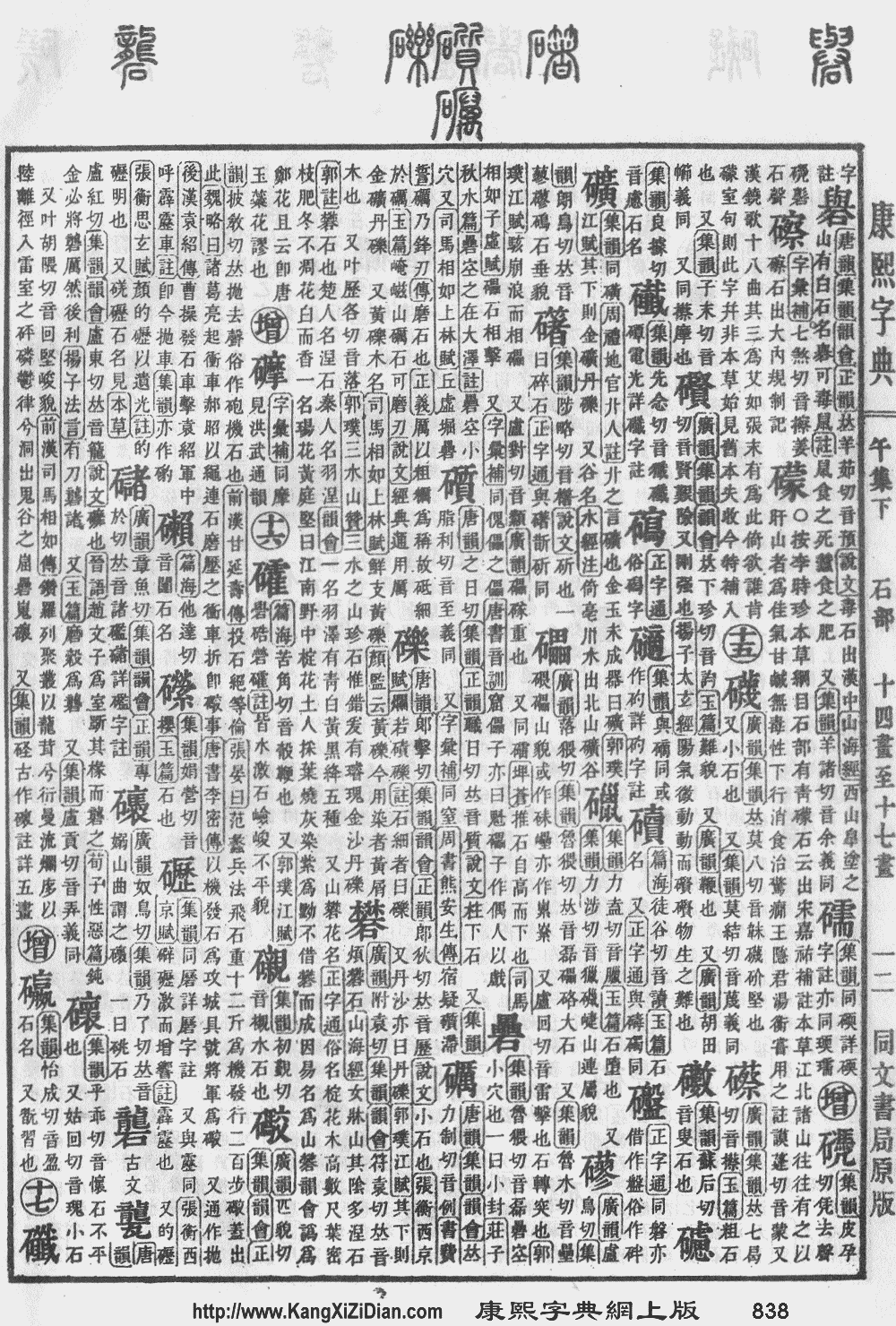
U+792A, 礪
CJK UNIFIED IDEOGRAPH-792A

[U+7929]
CJK Unified Ideographs
[U+792B]
U+F985, 礪
CJK COMPATIBILITY IDEOGRAPH-F985

[U+F984]
CJK Compatibility Ideographs
[U+F986]

Translingual

Han character

(Kangxi radical 112, +15, 20 strokes, cangjie input 一口一廿月 (MRMTB), four-corner 11627, composition)

  1. whetstone
  2. sharpen

References


Chinese

trad.
simp.
alternative forms

Glyph origin

Historical forms of the character
Shuowen Jiezi (compiled in Han)
Small seal script

Pronunciation


Rime
Character
Reading # 1/1
Initial () (37)
Final () (35)
Tone (調) Departing (H)
Openness (開合) Open
Division () III
Fanqie
Reconstructions
Zhengzhang
Shangfang
/liᴇiH/
Pan
Wuyun
/liɛiH/
Shao
Rongfen
/ljæiH/
Edwin
Pulleyblank
/liajH/
Li
Rong
/liɛiH/
Wang
Li
/lĭɛiH/
Bernard
Karlgren
/li̯ɛiH/
Expected
Mandarin
Reflex
Expected
Cantonese
Reflex
lai6
BaxterSagart system 1.1 (2014)
Character
Reading # 1/1
Modern
Beijing
(Pinyin)
Middle
Chinese
‹ ljejH ›
Old
Chinese
/*[r]at-s/
English grindstone

Notes for Old Chinese notations in the Baxter–Sagart system:

* Parentheses "()" indicate uncertain presence;
* Square brackets "[]" indicate uncertain identity, e.g. *[t] as coda may in fact be *-t or *-p;
* Angle brackets "<>" indicate infix;
* Hyphen "-" indicates morpheme boundary;

* Period "." indicates syllable boundary.
Zhengzhang system (2003)
Character
Reading # 1/1
No. 12623
Phonetic
component
Rime
group
Rime
subdivision
1
Corresponding
MC rime
Old
Chinese
/*m·rads/

Definitions

  1. whetstone
  2. to whet; to sharpen
          to steel oneself; to harden oneself; to discipline oneself

Compounds

  • 帶礪带砺
  • 帶礪山河带砺山河
  • 帶礪河山带砺河山
  • 河山帶礪河山带砺
  • 法礪法砺
  • 淬礪淬砺
  • 砥兵礪伍砥兵砺伍
  • 砥志礪行砥志砺行
  • 砥礪砥砺 (dǐlì)
  • 砥節礪行砥节砺行
  • 磨礪磨砺 (mólì)
  • 磨礪以須磨砺以须
  • 礪兵秣馬砺兵秣马
  • 礪吻磨距砺吻磨距
  • 礪山帶河砺山带河
  • 礪帶山河砺带山河
  • 礪戈秣馬砺戈秣马
  • 礪石砺石

Japanese

Shinjitai

Kyūjitai

Kanji

(uncommon “Hyōgai” kanji, kyūjitai kanji, shinjitai form )

  1. This term needs a translation to English. Please help out and add a translation, then remove the text {{rfdef}}.

Readings

  • Go-on: (re)
  • Kan-on: れい (rei)
  • Kun: あらと (arato, ); みがく (migaku, 礪く)
  • Nanori: (to)

Korean

Hanja

(ryeo>yeo) (hangeul >, revised ryeo>yeo, McCuneReischauer ryŏ>yŏ, Yale lye>ye)

  1. This term needs a translation to English. Please help out and add a translation, then remove the text {{rfdef}}.
This article is issued from Wiktionary. The text is licensed under Creative Commons - Attribution - Sharealike. Additional terms may apply for the media files.