Portal:Solar System/Selected article/5
Earth is the third planet from the Sun and the only place known in the universe where life has originated and found habitability. While Earth may not contain the largest volumes of water in the Solar System, only Earth sustains liquid surface water, extending over 70.8% of the Earth with its ocean, making Earth an ocean world. Earth's polar regions currently retain most of all other water with large sheets of ice covering ocean and land, dwarfing Earth's groundwater, lakes, rivers and atmospheric water. Land, consisting of continents and islands, extends over 29.2% of the Earth and is widely covered by vegetation. Below Earth's surface material lies Earth's crust consisting of several slowly moving tectonic plates, which interact to produce mountain ranges, volcanoes, and earthquakes. Earth's liquid outer core generates a magnetic field that shapes the magnetosphere of Earth, largely deflecting destructive solar winds and cosmic radiation.
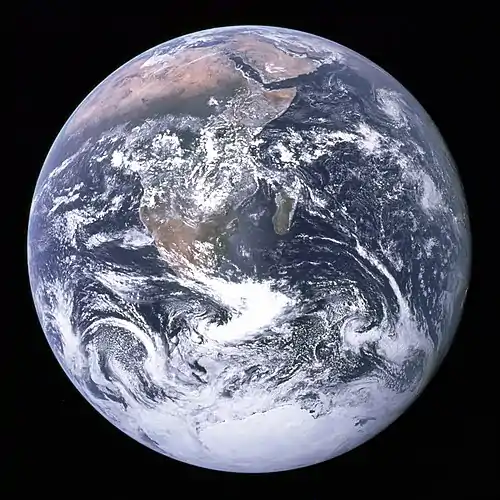
Earth has an atmosphere, which sustains Earth's surface conditions and protects it from most meteoroids and UV-light at entry. It has a composition of primarily nitrogen and oxygen. Water vapor is widely present in the atmosphere, forming clouds that cover most of the planet. The water vapor acts as a greenhouse gas and, together with other greenhouse gases in the atmosphere, particularly carbon dioxide (CO2), creates the conditions for both liquid surface water and water vapour to persist via the capturing of energy from the Sun's light. This process maintains the current average surface temperature of 14.76°C, at which water is liquid under atmospheric pressure. Differences in the amount of captured energy between geographic regions (as with the equatorial region receiving more sunlight than the polar regions) drive atmospheric and ocean currents, producing a global climate system with different climate regions, and a range of weather phenomena such as precipitation, allowing components such as nitrogen to cycle. (Full article...)