Energy in the United States
Most of the energy used in the United States in 2021 came from fossil fuels, as 36% of the nation's energy originated from petroleum, 32% from natural gas, and 11% from coal. Nuclear power supplied 8% and renewable energy supplied 12%, which includes biomass, wind, hydro, solar and geothermal.[1]


The United States was the second-largest energy producer and consumer in 2021 after China.[3] Imports peaked in 2005, when they represented 30% of total consumption. A consistent decline occurred for the next 15 years. In 2019, net imports were negative for the first time since 1952. As of 2021, the US net exports 3.9% of energy production.[4]
The country had a per-capita energy consumption of 295 million BTU (311 GJ), ranking it tenth in the world behind Canada, Norway, and several Arabic nations.[5] This figure had varied between 300 to 360 million BTU (320 to 380 GJ) for half a century starting in the late 60s. In 2020, per capita consumption dipped below 300 million BTUs for the first time since 1967.[6] In comparison, the world average increased from 68.3 to 77.5 million BTU (72.1 to 81.8 GJ) per person between 1980 and 2019.[7]
The United States' portion of the Electrical grid in North America had a nameplate generation capacity of 1,213 GW and produced 3,988 TWh in 2021, using 37% of primary energy to do so.[8] [9] The country is the second-largest producer and consumer of electricity, behind China.[10] Natural gas overtook coal as the dominant source for electric generation in 2016. While coal use has been dropping, it remained larger than either nuclear or renewables.[11]
History


From its founding until the late 19th century, population and energy use in the United States both increased by about 3% per year,[12][13] resulting in a relatively constant per-capita energy use of 100 million BTU. Wood made up the majority of this until near the end of the 1800s, meaning the average American burned 8 tons of wood each year.
By the late 1800s, coal had surpassed wood as the major source of energy, as it would often be cheaper for those living in cities. Lighting, heating and transportation could all be fueled by coal. [14] During the first half of the 20th century, per-capita energy use doubled. After 1950, coal production and use began to stagnate. Petroleum and natural gas took its place, as car ownership doubled in the two decades after the war,[15] and as the number of pipelines rose dramatically.[16]
Domestic oil production peaked in 1970 and would not recover for 40 years. However, oil imports allowed oil consumption to double. Oil represented the vast majority of net imports during this time.[17] Increased reliance on imported oil coincided with the 1973 oil crisis.
Around 2010, many trends began to reverse. Oil production doubled, while domestic use receded. This allowed the United States to be a net exporter of energy for the first time 70 years. By 2020, improvements in fracking had allowed natural gas production to increase by more than half,[18] while coal decreased by half.
Renewables in the decades before 2010 were mainly comprised of hydro and wood. Hydro power had been relatively constant since 1970, while wood saw a bump in 1980. Trends by 2010 saw wind, solar and biofuels increasing by a factor of ten over the next decade. By 2020, wind had surpassed hydro, and biofuels had surpassed wood.[19]
Summary
|
 U.S. energy flow, 2021. A quad is 1015 BTU, or 1.055 × 10¹⁸ joules (1.055 EJ). Note the breakdown of useful and waste energy in each sector (dark vs. light gray) due to the nature of heat engines, which cannot convert all thermal energy into useful work and consequently lose a portion of their heat to the environment. |
|
Primary energy production

The United States is the world's second-largest producer of energy. It produces 16% of the world's energy, about three-fourths as much as China. Since 2019, the country has been a net exporter of energy. In total, 97.78 quads were produced and net exports were 3.9% of production.[10][4]
Coal
Generation of electricity is the largest user of coal, although its use is in decline. About 50% of electric power was produced by coal in 2005, declining to 30% in 2016 and 23% in 2019.[22][23] Electric utilities buy more than 90% of the coal consumed in the United States.[24]
The United States is a net exporter of coal. Coal exports, for which Europe is the largest customer, peaked in 2012 and have declined since. In 2015, the U.S. exported 7.0% of mined coal.[25]
Coal has been used to generate electricity in the United States since an Edison plant was built in New York City in 1882.[26] The first AC power station was opened by General Electric in Ehrenfeld, Pennsylvania in 1902, servicing the Webster Coal and Coke Company.[26] By the mid-20th century, coal had become the leading fuel for generating electricity in the U.S. The long, steady rise of coal-fired generation of electricity shifted to a decline after 2007. The decline has been linked to the increased availability of natural gas, decreased consumption,[27] renewable electricity, and more stringent environmental regulations. The Environmental Protection Agency has advanced restrictions on coal plants to counteract mercury pollution, smog, and global warming.
Natural Gas


Natural gas was the largest source of energy production in the United States in 2016, representing 33% of all energy produced in the country.[28] Natural gas has been the largest source of electrical generation in the United States since July 2015.
The United States has been the world's largest producer of natural gas since 2009, when it surpassed Russia. U.S. natural gas production achieved new record highs for each year from 2011 through 2015. Marketed natural gas production in 2015 was 28.8 trillion cubic feet (820 billion cubic metres), a 5.4% increase over 2014, and a 52% increase over the production of 18.9 trillion cu ft (540 billion m3) per day in 2005.[29]
Because of the greater supply, consumer prices for natural gas are significantly lower in the United States than in Europe and Japan.[30] The low price of natural gas, together with its smaller carbon footprint compared to coal, has encouraged a rapid growth in electricity generated from natural gas.
Between 2005 and 2014, U.S. production of natural gas liquids (NGLs) increased 70%, from 1.74 million barrels of oil equivalent (10.6 PJ) per day in 2005 to 2.96 million barrels of oil equivalent (18.1 PJ) per day in 2014. The U.S. has been the world's leading producer of natural gas liquids since 2010, when U.S. NGL production passed that of Saudi Arabia.
Although the United States leads the world in natural gas production, it is only fifth in proved reserves of natural gas, behind Russia, Iran, Qatar, and Turkmenistan.
Petroleum
Oil is one of the largest sources of energy in the United States. The United States influences world oil reserves for both growth and development.[31] As the 20th century progressed, petroleum gained increasing importance by providing heating and electricity to the commercial and industrial sectors. Oil was also used in transportation; first for railroads and later for motor vehicles.[32]

As automobiles became more affordable, demand for oil quickly rose. Since the rise of the automobile industry, oil price, demand, and production have all increased as well. Between 1900 and 1980, fuel was directly correlated with Gross National Product (GNP). Furthermore, oil shocks have often coincided with recessions, and the government has responded to oil shocks in several ways.[33] In the 1920s, oil prices were peaking and many commentators believed that oil supplies were running out. Congress was confronted by requests to augment supplies, so a generous depletion allowance was enacted for producers in 1926, which increased investment returns substantially. This change induced additional exploration activity, and subsequently the discovery of large new oil reservoirs.[34]
In the next decade the situation was reversed with prices low and dropping. This resulted in demands for more "orderly" competition and set minimum oil prices. Rather than repealing the previous policies enacted in the 1920s, Congress enacted a price-support system. Similar cycles have occurred in the 1950s and 1970s.[34]
Nuclear
Renewables

Renewable energy in the United States accounted for 13.2% of the domestically produced electricity in 2014,[35] and 11.2% of total energy generation.[36] As of 2014, more than 143,000 people work in the solar industry and 43 states deploy net metering, where energy utilities buy back excess energy generated by solar arrays.[37]
Renewable energy reached a major milestone in the first quarter of 2011, when it contributed 11.7% of total U.S. energy production (2.245 quadrillion BTU or 2.369 EJ of energy), surpassing nuclear energy production (2.125 quadrillion BTU or 2.242 EJ).[38] 2011 was the first year since 1997 that renewables exceeded nuclear in total U.S. energy production.[39]
The development of renewable energy and efficient energy use marks "a new era of energy exploration" in the United States, according to President Barack Obama.[40] Studies suggest that if there is enough political will, it is feasible to supply the whole United States with 100% renewable energy by 2050.[41][42]
Biomass
Wood energy is created by the incineration of rigid cellulose material found in trees and woody bushes captures Among the most significant renewable energy sources is wood energy.[43] When examining the Renewable Energy as a Share of Total Primary Energy Consumption in 2011, wood consumption is 22%[44] There are five main types/forms of wood resources that can be converted into fuel energy, the five are biomass, woody biomass, wood pellets, wood chips, and cordwood.[45]
Biomass has been used since cavemen and hunter and gatherer societies. Biomass is organic, indicating it is constructed up of elements obtained from living organisms such as animals and plants. The most prevalent biomass sources used for energy are plants, wood, and waste. Biomass fuel sources are how they're referred to. Biomass energy is a nonrenewable energy source.[46]
Woody biomass, which encompasses trees and other woody plants, is defined as a result of maintenance, regenerating, and hazardous fuel reduction initiatives, as well as natural disasters.[47]
The average American family until the 1800s was most likely to use wood as the main source of energy consumption. Wood would be considered the predominant renewable energy source used until the mid to late 1800s.[48] The consumption of wood continues to be a significant aspect of fuel in various different countries, for numerous reasons including cooking and heating, as well as lighting their houses.[49] As mentioned, the second largest source of wood consumption was in the United States. Wood was used within homes as wood-burning appliances, wood in fireplaces, as well as pellets in pellet stoves.[50] Ranging from 1776 up until 2012, the use of wood as an energy source has been steady, there has been a minuscule increase from 1836 to 1926, with a peak in the late 1880s.[51]
Geothermal
The Geysers in Northern California is the largest complex of geothermal energy production in the world.
Hydro
Hydroelectricity was considered one of the largest sources of electricity until 2019.[52] Hydroelectricity was responsible for about 6.3% of the U.S. utility-scale electricity generation, as well as about 31.5% of total utility-scale renewable electricity generation in 2021.[52] Hydroelectric energy, also known as Hydroelectric Power or hydroelectricity, is a type of energy that generates electricity by utilizing the potential energy of water, such as water running over a waterfall. For centuries, individuals have exploited this energy.[53]
In many cases, hydroelectric energy or hydroelectric power plants' process to produce electricity can be compared to coal-fired power plants.[54] Hydropower presently accounts for 37% of total renewable electricity output and 7% of overall electricity generation in the United States.[55] The angle of inclination formed by a dam or diversion construction allows water to flow in and out on one side, therefore, generating electricity.[55]
The cost of hydropower can be considered very affordable, due to the fact that the source of electricity and energy come from moving water, states within the United States that have more moving water such as Washington and Oregon have more affordable electricity bills.[55] There are many advantages of hydropower, since it is fueled by water it is considered a clean source of energy. As well as it is a domestic source of energy, making it easier to reply to each state's sources rather than being reliant on international sources.[56] Hydropower accounted for 17% of global energy generation in 2020, making it the third largest generator following coal and natural gas. Hydropower's overall production has grown by 70% internationally in the previous 20 years, but its percentage of overall generation has remained steady due to the rise of wind, solar PV, coal, and natural gas.[57]
Hydroelectricity is mostly used for electricity production in the United States and in 2019 there were 1,460 utility scale hydropower facilities. These produced 274 billion kilowatt-hours. In 2019, it accounted for 6.6% of total electricity production and 38% of renewable electricity. The amount of electricity in the United States from hydropower has remained relatively the same since the 70's, however it's percentage has decreased due to more production from other sources. In 1950, 30% of total electricity production came from hydropower despite only 101 billion kilowatt-hours being produced.[58][59]
Hydropower has been used to produce electricity in the United States since 1880 when it was used to power the Wolverine Chair factory in Grand Rapids, Michigan.[59]
In 2019, the top five Hydroelectricity producing states produced 65% of the United States total hydroelectricity. This includes Washington state with 24%, California with 15%, New York with 11%, Oregon, with 11% and, Alabama with 4%. The largest hydroelectric power plant in the United States, which is also the largest overall power, is the Grand Coulee Dam built in Washington state in 1942 with a generating capacity of 6,809 Megawatts.[58]
Hydroelectric power is currently the largest producer of renewable energy in the U.S. It produced around 6.2% of the nation's total electricity in 2010 which was 60.2% of the total renewable energy in the U.S.[60] The United States is the fourth largest producer of hydroelectricity in the world after China, Canada, and Brazil. The Grand Coulee Dam is the 5th largest hydroelectric power station in the world.

Solar
The United States has some of the largest solar farms in the world. Solar Star is a 579-megawatt (MWAC) farm near Rosamond, California.[62] The Desert Sunlight Solar Farm is a 550-megawatt solar power plant in Riverside County, California[63] and the Topaz Solar Farm, a 550 MW photovoltaic power plant, is in San Luis Obispo County, California.[64] The solar thermal SEGS group of plants in the Mojave Desert has a total generating capacity of 354 MW.[65] Rooftop solar has also become a growing contributor to overall solar power generation, with overall generated capacity at 26 GW in 2022 (around 1% of total generation capacity), with the states of California, Texas, Florida experiencing the fastest growth.[66]
A concentrating solar array (CSP) with thermal storage has a practical capacity factor of 33%[67] and could provide power 24 hours a day. Prior to 2012, in six southwestern states (Arizona, California, Colorado, Nevada, New Mexico, and Utah) the U.S. Bureau of Land Management (BLM) owned nearly 98 million acres or 400,000 square kilometres (an area larger than the state of Montana) that was open to proposals for solar power installations. To streamline consideration of applications, the BLM produced a Programmatic Environmental Impact Statement (PEIS). By the subsequent Record of Decision in October 2012, the BLM withdrew 78% of its land from possible solar development, leaving 19 million acres (77,000 km2) still open to applications for solar installations, an area nearly as large as South Carolina. Of the area left open to solar proposals, the BLM has identified 285,000 acres (115,000 ha) in highly favorable areas it calls Solar Energy Zones.[68] In Spain, with natural gas backups, CSP has reached a capacity factor of 66%, with 75% being a theoretical maximum.[69]

Wind
U.S. wind power's installed capacity now exceeds 65,000 MW and supplies 4% of the nation's electric power.[70][71] Texas is firmly established as the leader in wind power development followed by Iowa and California.[72]
Final energy consumption
Consumption by sector
The U.S. Department of Energy tracks national energy consumption in four broad sectors: industrial, transportation, residential, and commercial. The industrial sector has long been the country's largest energy user, currently representing about 33% of the total. Next in importance is the transportation sector followed by the residential and commercial sectors.
| Sector name | Description | Major uses[73][74][75] |
|---|---|---|
| Industrial | Facilities and equipment used for producing and processing goods. |
22% chemical production 16% petroleum refining 14% metal smelting/refining |
| Transportation | Vehicles which transport people and goods on ground, air, or water. |
61% gasoline fuel 21% diesel fuel 12% aviation |
| Residential | Living quarters for private households. | 32% space heating 13% water heating 12% lighting 11% air conditioning 8% refrigeration 5% electronics 5% washers/dryers |
| Commercial | Service-providing facilities and equipment (businesses, government, other institutions). |
25% lighting 13% heating 11% cooling 6% refrigeration 6% water heating 6% ventilation 6% electronics |
Regional variation
Household energy use varies significantly across the United States. An average home in the Pacific region (consisting of California, Oregon, and Washington) consumes 35% less energy than a home in the South Central region. Some of the regional differences can be explained by climate. The heavily populated coastal areas of the Pacific states experience generally mild winters and summers, reducing the need for both home heating and air conditioning. The warm, humid climates of the South Central and South Atlantic regions lead to higher electricity usage, while the cold winters experienced in the Northeast and North Central regions result in much higher consumption of natural gas and heating oil. Other regional differences stem from energy efficiency measures taken at the local and state levels. California has some of the strictest environmental laws and building codes in the country, leading its per-household energy consumption to be lower than all other states except Hawaii.
The state with the lowest per-capita energy use is Rhode Island, at 161 million BTU per year, and the highest is Louisiana, at 908 million BTU per year.[76] Energy use and prices often have an inverse relationship; Hawaii uses some of the least energy per capita but pays the highest price on average, while Louisiana pays the least on average.
Residential prices follow a similar trend, but the differences between states are usually less drastic. The exception is Hawaii, which pays 84 cents per million BTU, more than double the next largest state of Florida, which pays 33 cents.
 Overall energy
consumption per capita Residential energy
consumption per capita Overall price
per million BTU Residential price
per million BTU
The land-use decisions of cities and towns also explain some of the regional differences in energy use. Townhouses are more energy efficient than single-family homes because less heat, for example, is used per person. Similarly, areas with more homes in a compact neighborhood encourage walking, biking and transit, thereby reducing transportation energy use. A 2011 U.S. EPA study found that multi-family homes in urban neighborhoods, with well-insulated buildings and fuel-efficient cars, use less than two-thirds of the energy used by conventionally built single-family houses in suburban areas (with standard cars).[77]
Electricity
The United States is the world's second-largest producer and consumer of electricity. It generates 15% of the world's electricity supply, about half as much as China.[78]
Generation

The United States had a nameplate generation capacity of 1,213 GW and produced 3,988 TWh in 2021. Total generation has been flat since 2010. Net electricity imports were 39 TWh, or about 1% of sales. Historically, net imports have been between just under 0% to just over 1.5%.[79] [80]
Fossil fuels made up the majority of generation, with natural gas providing 38% and coal 23%. Petroleum provided less than 1%. Natural gas as a proportion of fossil fuels has been increasing since the 90's, with coal peaking around 2008 and natural gas becoming the top fossil fuel in 2016.
Nuclear provided 20%, a level consistent since about 1990. Nuclear surpassed coal in 2020 for the first time, as coal dipped to its lowest proportion in over 70 years.
Among renewables, wind and solar continued to expand, with wind exceeding hydro since 2019. Renewable use has doubled from 2010 to 2020, reaching 20% of total generation.[79]
 Monthly TWh by source [2]
 Monthly TWh by renewable source
 Yearly TWh by source
 Yearly TWh by renewable source
Capacity
|
The following table summarizes the electrical energy generated by fuel source for the United States grid in 2021. Figures account for generation losses, but not transmission losses.[81] Fission had the highest capacity factor, while Petroleum had the lowest.
|
|


Generation by state
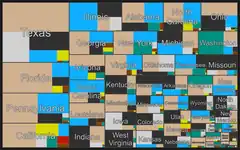
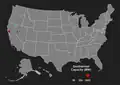
The following figures offer detail into the sources of generation used in each state.[82] Most often, natural gas is the largest source in a given state, with 22 states using it more than any other. Among renewable sources, 18 states use wind power more than any other.
Though not always the most prominent source, each state will use at least one source at a rate above the national average. Twelve states use nuclear power more than average, and California and Hawaii each use more solar and petroleum, respectively.
Texas contributes more to the grid than any other state, followed by Florida, Pennsylvania and California. On net, Pennsylvania exports the most power, while California imports the most.
 Largest generation source
 Largest renewable generation source
 Most over-represented source
 Net electricity imports/exports
Consumption

Electric grid consumption in the U.S. was 3,806 TWh in 2021. Since 2010, total consumption has remained within 2% of this figure. Per capita consumption was 11.5 MWh in 2021, down 8% from its peak in 2007.[83]
Residential customers used 39%. Each month, the average customer used 886 kWh and paid $121 at an average rate of 13.7 cents/kWh. The commercial sector used 35% and industrial used 26% of the total. Transportation used less than half of one percent.[84]
System loss within the grid includes use in the generation process and transmission losses, as well as unaccounted loads. For 2021, this amounted to 203 TWh, or 5.3% of grid generation. Electricity used directly at the commercial or industrial level added 139 TWh, so total consumption was 3,945 TWh.[85]
 Total electric use per capita [82]
 Residential use per capita
 Overall price per kWh in cents
 Residential price per kWh
See also
References
- "U.S. energy facts explained - consumption and production - U.S. Energy Information Administration (EIA)". eia.gov. Retrieved August 18, 2022.
- "Total Energy Annual Data - U.S. Energy Information Administration (EIA)".
- "Total Energy Consumption" Eia.gov. Retrieved March 19, 2023.
- "U.S. Energy facts - imports and exports - U.S. Energy Information Administration (EIA)".
- "Other Statistics - Energy intensity by GDP and population" Eia.gov. Retrieved March 19, 2023.
- "1.5: Energy consumption, expenditures, and emissions indicators estimates"Annual Energy Review Eia.gov. Retrieved March 19, 2023
- "Energy Intensity" Eia.gov. Retrieved March 19, 2023
- "Electricity Net Generation: Electric Power Sector"Net Generation Eia.gov. Retrieved March 18, 2023
- "Existing Capacity by Energy Source" Existing Capacity by Energy Source Eia.gov. Retrieved March 20, 2023
- "International - U.S. Energy Information Administration (EIA)".
- "Electricity Net Generation" Eia.gov. Retrieved March 20, 2023
- https://www.census.gov/library/publications/1975/compendia/hist_stats_colonial-1970.html
- "EIA offers two approaches to compare renewable electricity generation with other sources". U.S. Energy Information Administration. Retrieved May 3, 2021.
- https://eh.net/encyclopedia/the-us-coal-industry-in-the-nineteenth-century-2/
- https://tedb.ornl.gov/wp-content/uploads/2022/03/TEDB_Ed_40.pdf#page=85
- https://pstrust.org/about-pipelines/stats/age-of-natural-gas-pipelines/
- https://www.eia.gov/energyexplained/us-energy-facts/imports-and-exports.php
- https://www.reuters.com/markets/commodities/is-us-shale-oil-revolution-over-kemp-2022-11-22/
- https://www.eia.gov/totalenergy/data/monthly/pdf/sec10_3.pdf
- "U.S. energy facts explained – consumption and production – U.S. Energy Information Administration (EIA)". eia.gov. Retrieved September 1, 2022.
- "Electricity in the U.S. – U.S. Energy Information Administration (EIA)". eia.gov. Retrieved September 16, 2020.
- Inventory of Assessed Federal Coal Resources and Restrictions to Their Development (PDF) (Report). U.S. Departments of Energy, Interior and Agriculture. August 2007. p. 94. Retrieved March 28, 2017.
- "Electricity in the U.S. – U.S. Energy Information Administration (EIA)". eia.gov. Retrieved October 24, 2020.
- "Industrial plans spur coal price spike - Pittsburgh Tribune-Review". Archived from the original on September 11, 2008. Retrieved June 18, 2018.
- U.S. coal exports fall on lower European demand, increased global supply, U.S. Energy Information Administration, October 3, 2014.
- Speight, James G. (September 4, 2012). The Chemistry and Technology of Coal, Third Edition. CRC Press. p. 13. ISBN 9781439836460.
- Trevor Houser, Jason Bordoff and Peter Marsters (April 25, 2017). "Can Coal Make a Comeback?". energypolicy.columbia.edu. Center on Global Energy Policy, School of International and Public Affairs, Columbia University. Retrieved May 15, 2017.
Increased competition from cheap natural gas is responsible for 49% of the decline in domestic U.S. coal consumption. Lower-than-expected demand is responsible for 26 percent, and the growth in renewable energy is responsible for 18 percent.
- U.S. Energy Information Administration,Overview. Retrieved February 13, 2017.
- U.S. EIA, Natural gas wellhead value and marketed production. Retrieved April 25, 2015.
- "Global natural gas prices vary considerably – Today in Energy – U.S. Energy Information Administration (EIA)". eia.gov.
- "What role have natural resources played in the politics and economy of the Middle East?". Global Connections. Public Broadcasting System (PBS). Retrieved June 22, 2014.
- Hamilton, James. "Historical Oil Shocks" (PDF). Econweb. University of California, San Diego. Retrieved June 22, 2014.
- Cleveland, Cutler J.; Costanza, Robert; Hall, Charles A. S.; Kaufmann, Robert (1984). "Energy and the U.S. Economy: A Biophysical Perspective" (PDF). Science. 225 (4665): 890–897. Bibcode:1984Sci...225..890C. doi:10.1126/science.225.4665.890. PMID 17779848. S2CID 2875906. Retrieved June 22, 2014.
- Van Doren, Peter. "A Brief History of Energy Regulations" (PDF). downsizinggovernment. CATO Institute. Retrieved June 22, 2014.
- U.S. Energy Information Administration, Electric Power Monthly, January 2013. Eia.gov
- U.S. Energy Information Administration,Energy monthly, Eia.gov. Retrieved November 6, 2013.
- Editorial Board (April 26, 2014). "The Koch Attack on Solar Energy". The New York Times.
- Ron Pernick and Clint Wilder (2012). "Clean Tech Nation" (PDF). p. 5.
- U.S. Energy Information Administration, Total Energy. Eia.gov
- "EERE News: President Obama Touts Clean Energy on Earth Day". Archived from the original on April 29, 2009. Retrieved April 29, 2009.
- M.Z. Jacobson et al. 2015: 100% clean and renewable wind, water, and sunlight (WWS) all-sector energy roadmaps for the 50 United States. Energy and Environmental Science Issue 8, p. 2093-2117. doi:10.1039/C5EE01283J.
- M.Z. Jacobson et al. 2015: Low-cost solution to the grid reliability problem with 100% penetration of intermittent wind, water, and solar for all purposes. Proceedings of the National Academy of Sciences Issue 112, Number 49, p. 15060–15065. doi:10.1073/pnas.1510028112.
- See #Fossil-fuel equivalency – these figures are actually closer to 2.8% each.
- U.S. Dept. of Energy, "Annual Energy Report" (2010), Energy Flow diagram
- Barr, Robert. "China surpasses U.S. as top energy consumer". Associated Press. Retrieved June 16, 2012.
- World Per Capita Total Primary Energy Consumption, 1980–2005 Archived October 13, 2006, at the Wayback Machine (MS Excel format)
- "EIA offers two approaches to compare renewable electricity generation with other sources". U.S. Energy Information Administration. Retrieved May 3, 2021.
- "Annual Coal Report" (PDF). Eia.gov. Retrieved October 14, 2017.
- "More than 100 coal-fired plants have been replaced or converted to natural gas since 2011 – Today in Energy – U.S. Energy Information Administration (EIA)". eia.gov. Retrieved November 14, 2021.
- "World Development Indicators – Google Public Data Explorer". Retrieved October 14, 2017.
- U.S. Dept. of Energy, "Energy in the United States: 1635–2000"
- "Hydropower explained – U.S. Energy Information Administration (EIA)". eia.gov. Retrieved May 28, 2022.
- "Hydroelectric Energy | National Geographic Society". education.nationalgeographic.org. Retrieved May 28, 2022.
- "Hydroelectric Power: How it Works | U.S. Geological Survey". www.usgs.gov. Retrieved May 28, 2022.
- "Hydropower Basics". Energy.gov. Retrieved May 28, 2022.
- "Benefits of Hydropower". Energy.gov. Retrieved May 28, 2022.
- "Executive summary – Hydropower Special Market Report – Analysis". IEA. Retrieved May 28, 2022.
- "Where hydropower is generated – U.S. Energy Information Administration (EIA)". eia.gov. Retrieved October 24, 2020.
- "Hydropower explained – U.S. Energy Information Administration (EIA)". eia.gov. Retrieved October 24, 2020.
- "Direct Federal Financial Interventions and Subsidies in Energy in Fiscal Year 2013". Energy Information Administration. Retrieved November 10, 2015.
- Gearino, Dan (March 9, 2023). "One State Generates Much, Much More Renewable Energy Than Any Other, and It's Not California / Here's a state-by-state tally of the leaders and laggards for wind, solar and other renewable energy in 2022". Inside Climate News. Archived from the original on March 9, 2023. (archive of chart) Gearino cites IEA as data source, crediting Paul Horn for a related bar chart. ● Population data from "Table 2: Resident Population for the 50 States, the District of Columbia, and Puerto Rico: 2020 Census" (PDF). Census.gov. United States Census Bureau. 2021. Archived (PDF) from the original on March 6, 2023.
- "Solar Star, Largest PV Power Plant in the World, Now Operational". GreenTechMedia.com. June 24, 2015.
- "DOE Closes on Four Major Solar Projects". Renewable Energy World. September 30, 2011.
- Steve Leone (December 7, 2011). "Billionaire Buffett Bets on Solar Energy". Renewable Energy World.
- SEGS I, II, III, IV, V, VI, VII, VIII & IX Archived August 5, 2014, at the Wayback Machine
- "Storms and steep utility bills drive US rooftop solar boom". Financial Times. October 8, 2022. Retrieved October 10, 2022.
- "Concentrating Solar Power Projects: Ivanpah Solar Electric Generating System : Concentrating Solar Power". Nrel.gov. Retrieved October 14, 2017.
- "Solar Energy Program". blmsolar.anl.gov. Retrieved October 14, 2017.
- "Torresol Energy – Gemasolar thermosolar plant". Torresolenergy.com. Retrieved October 14, 2017.
- U.S. Energy Information Administration, , September 2013. Eia.gov
- "AWEA 4th quarter 2012 Public Market Report" (PDF). American Wind Energy Association (AWEA). January 2013. Archived from the original (PDF) on May 18, 2013. Retrieved January 30, 2013.
- American Wind Energy Association, Annual U.S. wind power rankings track industry's rapid growth Archived June 19, 2010, at the Wayback Machine
- U.S. Dept. of Energy, "Manufacturing Trend Data" (2002), Table 2b
- U.S. Dept. of Energy, "Annual Energy Outlook" (February 2006), Table A2
- U.S. Dept. of Energy, "Buildings Energy Data Book Archived 2006-09-23 at the Wayback Machine" (September 2006), sec. 1.2.3
- "U.S. Energy Information Administration - EIA - Independent Statistics and Analysis".
- EPA, OA, OP, OSC, U.S. (April 5, 2013). "Smart Growth – U.S. EPA" (PDF). U.S. EPA. Retrieved October 14, 2017.
{{cite web}}: CS1 maint: multiple names: authors list (link) - "International - U.S. Energy Information Administration (EIA)".
- "Electricity net generation: electric power sector" Eia.gov. Retrieved March 29, 2023
- "Existing Capacity by Energy Source" Existing Capacity by Energy Source Eia.gov. Retrieved March 29, 2023
- "Annual Energy Review"Annual Energy Review Eia.gov. Retrieved March 16, 2023
- "Historical State Data".
- 8.9 Electricity end use https://www.eia.gov/totalenergy/data/annual/
- 8.10 Average prices of electricity to ultimate customers https://www.eia.gov/totalenergy/data/annual/
- Electricity overview https://www.eia.gov/totalenergy/data/monthly/pdf/sec7_3.pdf

External links
- Energy Information Administration – Official Energy Statistics from the U.S. government's Energy Information Administration
- The Carbon Brief Profile: United States
- Transportation Energy Data Book