Anaphalis margaritacea
Anaphalis margaritacea, commonly known as the western pearly everlasting[5] or pearly everlasting, is an Asian and North American species of flowering perennial plant in the family Asteraceae.
| Anaphalis margaritacea | |
|---|---|
 | |
| Corymb of capitula | |
Scientific classification  | |
| Kingdom: | Plantae |
| Clade: | Tracheophytes |
| Clade: | Angiosperms |
| Clade: | Eudicots |
| Clade: | Asterids |
| Order: | Asterales |
| Family: | Asteraceae |
| Genus: | Anaphalis |
| Species: | A. margaritacea |
| Binomial name | |
| Anaphalis margaritacea | |
| Synonyms[4] | |
|
Synonymy
| |

Description
A. margaritacea grows erect up to about 90 centimetres (3 feet) tall,[6] with narrow, alternate leaves up to 12.5 cm (5 inches). The undersides of the leaves are densely covered in tiny hairs.[7] The stems are dry and brittle. The whitish to yellowish flower grows to about 6 millimetres (1⁄4 in) across[7] as part of a corymb inflorescence, the most conspicuous part of which is the numerous pearly white bracts that surround the disc florets.[8] It blooms between June and September.[7]
The plant is dioecious, meaning the pollen-producing (male) and seed-producing (female) flowers are borne on separate plants.[7]


Taxonomy
- Varieties and subspecies[4]
- Anaphalis margaritacea var. cinnamomea (DC.) Herder ex Maxim.
- Anaphalis margaritacea subsp. japonica (Maxim.) Kitam.
- Anaphalis margaritacea var. margaritacea
- Anaphalis margaritacea var. yedoensis (Franch. & Sav.) Ohwi
Etymology
The species' common name 'pearly everlasting'[9] comes from the pearly white bracts.[10]
Distribution and habitat
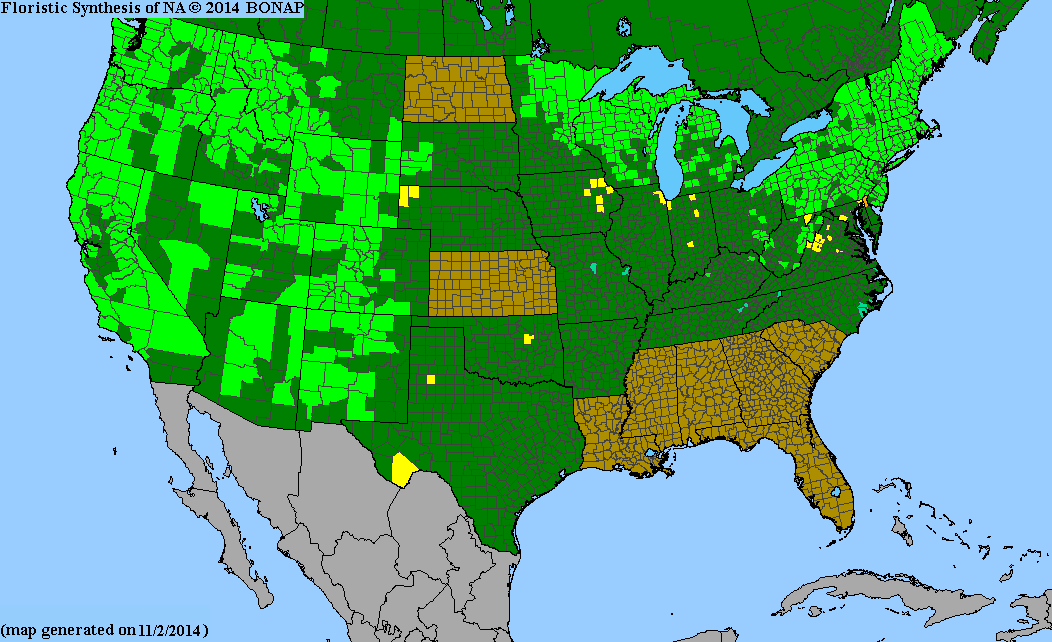
It is widespread across most of Canada and the United States, as well as northwestern Mexico.[8][11] Asian populations are found in China, the Russian Far East, Japan, Korea, northern Indochina, and the Himalayas.[12] The species is reportedly naturalized in Europe though not native there. It prefers dry, sunny climates, but is hardy to temperatures well below freezing.[7]
Ecology
The leaves are host to the caterpillars of the American painted lady butterfly (Vanessa virginiensis)[13] and the painted lady butterfly (Vanessa cardui).[14]
Uses
The leaves and young plants are edible when cooked.[15]
References
- NatureServe (2006). "Anaphalis margaritacea". NatureServe Explorer: An online encyclopedia of life, Version 6.1. Arlington, Virginia. Archived from the original on 2007-09-29. Retrieved 2007-06-27.
- "Anaphalis margaritacea". International Plant Names Index (IPNI). Royal Botanic Gardens, Kew; Harvard University Herbaria & Libraries; Australian National Botanic Gardens. 2008-06-08.
- "Anaphalis margaritacea". Germplasm Resources Information Network (GRIN). Agricultural Research Service (ARS), United States Department of Agriculture (USDA). Retrieved 2008-06-08.
- "Anaphalis margaritacea". The Global Compositae Checklist (GCC) – via The Plant List.
- USDA, NRCS (n.d.). "Anaphalis margaritacea". The PLANTS Database (plants.usda.gov). Greensboro, North Carolina: National Plant Data Team. Retrieved 8 January 2016.
- Hogan, C. Michael (2010). "Anaphalis margaritacea". Encyclopedia of Life. Retrieved 2022-07-03.
- Spellenberg, Richard (2001) [1979]. National Audubon Society Field Guide to North American Wildflowers: Western Region (rev ed.). Knopf. p. 354. ISBN 978-0-375-40233-3.
- Nesom, Guy L. (2006). "Anaphalis margaritacea". In Flora of North America Editorial Committee (ed.). Flora of North America North of Mexico (FNA). Vol. 19. New York and Oxford – via eFloras.org, Missouri Botanical Garden, St. Louis, MO & Harvard University Herbaria, Cambridge, MA.
- BSBI List 2007 (xls). Botanical Society of Britain and Ireland. Archived from the original (xls) on 2015-06-26. Retrieved 2014-10-17.
- Fagan, Damian (2019). Wildflowers of Oregon: A Field Guide to Over 400 Wildflowers, Trees, and Shrubs of the Coast, Cascades, and High Desert. Guilford, CT: FalconGuides. p. 27. ISBN 978-1-4930-3633-2. OCLC 1073035766.
- "Anaphalis margaritacea". County-level distribution map from the North American Plant Atlas (NAPA). Biota of North America Program (BONAP). 2014.
- Zhu, Shixin; Bayer, Randall J. "Anaphalis margaritacea". Flora of China. Vol. 20–21 – via eFloras.org, Missouri Botanical Garden, St. Louis, MO & Harvard University Herbaria, Cambridge, MA.
- "Vanessa virginiensis". Butterflies and Moths of North America.
- The Xerces Society (2016), Gardening for Butterflies: How You Can Attract and Protect Beautiful, Beneficial Insects, Timber Press.
- "Pearly everlasting (Anaphalis margaritacea)".
External links
 Media related to Anaphalis margaritacea at Wikimedia Commons
 Data related to Anaphalis margaritacea at Wikispecies